The joy of having clean water
Bo My is a highland hamlet in Bach Dang Commune, Cao Bang Province, where residents are widely dispersed. Previously, local people mainly used rainwater and stream water for their daily activities. These water sources were untreated and unfiltered, failing to meet hygiene standards and posing potential risks to people's health.
Therefore, the Bo My Hamlet domestic water supply project was constructed and put into operation in 2021, providing a stable and sustainable supply of clean water to more than 600 local residents. After the facility was handed over, Bo My Hamlet established a three-member management and operation team responsible for operating the facility, periodically recording water meter readings, collecting payments, and carrying out maintenance and repairs when damage or deterioration occurred.
Mong Truong Thuyet, head of the facility's management and operation team, said that the water fees collected, amounting to around 1.7 million VND per month, are used to provide allowances for team members and purchase materials to repair damage, helping the clean water facility operate in a stable and sustainable manner. Hoang Van Thuc, a resident of Bo My Hamlet, expressed his delight: “At present, with water priced at 2,000 VND per cubic metre, my family only has to spend several tens of thousands of VND each month to have enough water for our daily activities. The water quality is guaranteed, so our living conditions are improving day by day.”
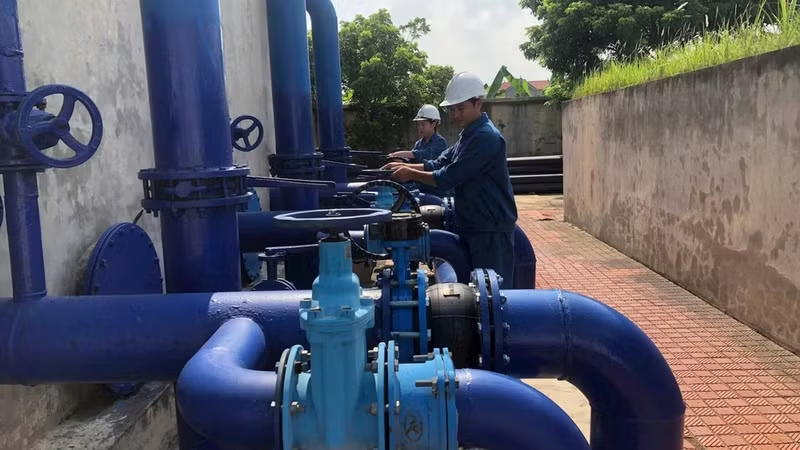
Pham Trung Nghia, head of the management station of the Tien Tien Clean Water Plant (Hai Duong Rural Clean Water Joint Stock Company), said: “The plant currently supplies about 3,500 cubic metres of water per day and night to 6,989 households in Nam Dong Ward and Quyet Thang Commune. To ensure effective water supply to residents, maintaining water production quality is always our top priority. All stages, from extracting surface water to chemical treatment, are carried out in accordance with established procedures; the treatment tanks are cleaned periodically, and equipment is maintained to ensure stable operation. During operation, workers regularly monitor surveillance cameras to ensure that there are no water shortages. In addition, plant workers are always on standby to carry out timely repairs and address pipeline incidents, reducing water losses and restoring domestic water supply to residents as quickly as possible.”
Raising community awareness of clean water use
To date, 17,588 centralised rural water supply facilities have been built nationwide, helping raise the proportion of people with access to clean water to more than 74%. Contributing to these achievements, some localities have supported investment in the construction and upgrading of facilities and attracted businesses to invest, rapidly increasing the proportion of households using water that meets quality standards and gradually establishing an effective and sustainable rural clean water market.
However, according to Nguyen Hong Khanh, Deputy Director of the Department of Irrigation Management and Construction (Ministry of Agriculture and Environment), of the water supply facilities that have been built, only 9,611 are operating sustainably or relatively sustainably, while the remaining 7,977 are operating unsustainably or are no longer operational. In addition, the provision of clean water to rural residents still faces a number of limitations.
Vu Cong Cuong, Director of Hai Duong Rural Clean Water Joint Stock Company (Hai Phong), said: “The company is currently providing a stable clean water supply in 31 communes and wards, serving 107,898 customers. However, water supply also faces difficulties because many sections of the pipeline system have deteriorated after a long period of operation; increasingly complex climate change is affecting the quality of raw water sources. The clean water price applied since 2017 has not yet been adjusted, placing significant pressure on production and business operations and limiting resources for investment in, replacement and upgrading of infrastructure.”
In Cao Bang Province, although 1,397 rural domestic water supply facilities have been built, only 789 are currently operational. This is attributed to the fact that some residents have not yet become accustomed to the concept of “using water and paying for it” and continue to use water from streams, rivers and springs, resulting in many facilities operating inefficiently, becoming damaged and deteriorating.
To increase the proportion of people with access to clean water, according to the Department of Irrigation Management and Construction, communications should be strengthened and community awareness of clean water use raised in the coming period. Relevant agencies should review and assess the current state of rural domestic water supply and control water quality at centralised facilities and household level.
At the same time, science and technology development and digital transformation should be promoted, particularly the completion of a national database on rural clean water, in order to improve the effectiveness of management, monitoring and policy formulation. Effective resources for international cooperation in finance, technology and management experience should continue to be mobilised to support the sustainable development of the rural clean water sector; new facilities should be constructed, while existing centralised rural water supply facilities should be upgraded and repaired in accordance with the specific characteristics of each region. In addition, interconnected regional water supply systems should be developed, and appropriate technologies for treating saline and brackish water should be applied to suit the actual conditions of each area.