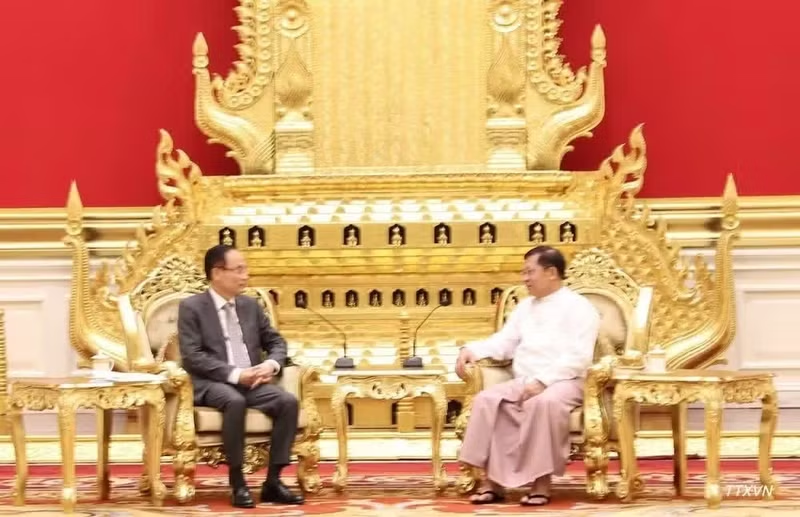
This marked the first official visit by Myanmar President Min Aung Hlaing since the country concluded its general election and formed a new government in April 2026.
Hosting Myanmar President Min Aung Hlaing for an official visit to Vietnam represented a concrete step in implementing the foreign policy guidelines of the 14th National Party Congress, as well as Political Bureau’s Resolution No. 06-NQ/TW on implementing the 14th Congress’ foreign policy and Political Bureau’s Resolution No. 59-NQ/TW (on international integration in the new context.
The visit has contributed to consolidating the traditional friendship and the Comprehensive Cooperative Partnership between Viet Nam and Myanmar, while strengthening political trust and ties between the two nations’ high-level leadership. It has also offered an opportunity for Viet Nam and Myanmar to expand cooperation within both bilateral and multilateral frameworks and to foster substantive collaboration across various sectors.
Although diplomatic relations were officially established on May 28, 1975, the bond between the two peoples—sharing the same “Southeast Asian home”—had long been cultivated by generations of leaders and citizens from both countries.
Viet Nam established a resident representative office in Yangon as early as 1947. Historic visits—such as that of Myanmar Prime Minister U Nu to Viet Nam in 1954 and President Ho Chi Minh to Myanmar in 1958—stood as significant milestones that helped solidify the foundation of the bilateral relationship.
Sharing many cultural and historical similarities—particularly a tradition of steadfast struggle for national independence—Viet Nam and Myanmar have maintained a close and enduring relationship over the years, fostering continued growth and achieving positive cooperative results.
In 2017, the two nations elevated their ties to a Comprehensive Cooperative Partnership. The year 2025 marked the 50th anniversary of the establishment of diplomatic relations. Bilateral ties have been sustained through various channels of exchange and contact.
Viet Nam has consistently attached great importance to its relationship with Myanmar, seeking to expand economic exchanges and promote cooperation across sectors such as security and defense, culture, education and training, tourism, people-to-people exchanges, and cooperation between the two countries’ Parties and legislatures.
Myanmar has highly valued Viet Nam’s role, standing, and development achievements, as well as the leadership of the Communist Party of Viet Nam and the State—particularly that of General Secretary and President To Lam.
Myanmar has regarded Viet Nam as a trusted partner that shares in its challenges and maintains a supportive stance; it also views Viet Nam as a partner with significant potential for collaboration in highly complementary fields such as trade, investment, science and technology, information and communications, infrastructure, the production of essential goods, and agriculture.
Myanmar hoped that Viet Nam will continue to offer support, act as a bridge for dialogue with interested partners, and share lessons on national reconstruction and development, thereby elevating the bilateral relationship to new heights through practical, comprehensive cooperation across all channels and levels.
Viet Nam affirmed its commitment to continued cooperation in implementing ASEAN’s Five-Point Consensus (5PC) alongside Myanmar’s own “Five-Point Roadmap”.
Economic and trade cooperation stood out as a highlight of the bilateral relationship. Bilateral trade turnover reached 590 million USD in 2025; and reached 335 million USD in the first six months of 2026. Viet Nam is Myanmar’s seventh-largest foreign investor, with investments concentrated primarily in telecommunications, banking, real estate, construction, industrial manufacturing, and agriculture.
Myanmar has viewed Viet Nam as a partner with significant potential—particularly in trade, investment, and science and technology—where the two economies are highly complementary, Vietnamese enterprises possess strengths, and the cooperation aligns with Myanmar’s socio-economic development needs.
By hosting the official visit of Myanmar’s President Min Aung Hlaing, Viet Nam sent a strong message regarding its consistent foreign policy of peace, cooperation, and development; the multilateralisation and diversification of external relations; the promotion of ties with traditional friends; and the high value placed on the relationship with Myanmar.
The visit has opened opportunities for Viet Nam and Myanmar to strengthen their Comprehensive Cooperative Partnership and further expand the scope for comprehensive, practical cooperation—especially in the areas of economy, trade, investment, science and technology, connectivity, tourism, and people-to-people exchanges.
At the same time, the visit has demonstrated the importance Viet Nam has attached to ASEAN centrality and the interests of ASEAN member states, working towards regional peace, stability, and development, as well as a united, cohesive, and resilient ASEAN Community.

![[Infographic] Comprehensive strategic partnership between Viet Nam and Denmark](https://en-cdn.nhandan.vn/images/SCsTDAWshkugd_CR7euN3dJE8R5tBjXTeI_Ei3N1rqlMQ51GV2YGcjvxpQFD7-NjQniu1tgyhNBVDsDJmLSxVpkf6BzifI5ne9fyVawgZKkw1QSqvshBTU8QQcE1uc2tD2kFaBWIxM59QGKFzthJwQ/comprehensive-strategic-partnership-between-viet-nam-and-denmark-8462.png.avif)