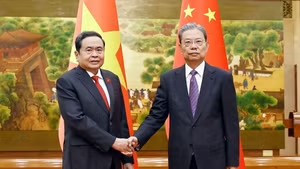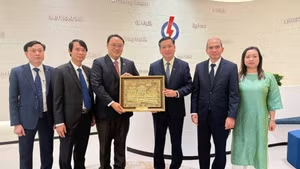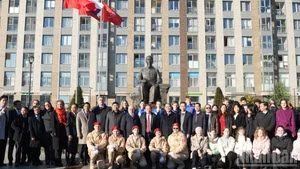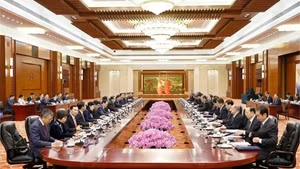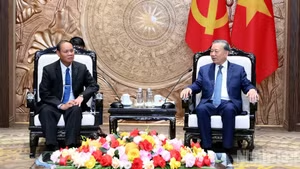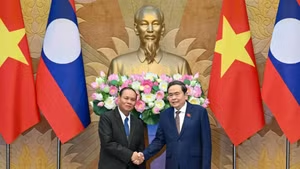
The visit, made at the invitation of General Secretary of the Communist Party of Viet Nam Central Committee and President To Lam, will also strengthen bilateral political trust and expand both bilateral and multilateral co‑operation.
This was the assessment of Vietnamese Ambassador to Myanmar Nguyen Anh Duc in an interview with Nhan Dan Newspaper ahead of the Myanmar President’s official visit to Viet Nam, as well as prospects for bilateral relations.
Consolidating traditional friendship and comprehensive co‑operation
According to Ambassador Nguyen Anh Duc, this is the first official visit to Viet Nam by Myanmar President Min Aung Hlaing since Myanmar completed its general election in January and formed a new government in April 2026. It is also the highest‑level exchange of delegations between the two sides since 2019.
The ambassador noted that, as ASEAN strives to improve the effectiveness of its co‑ordination and support Myanmar in seeking a long‑term solution to the Myanmar issue, Viet Nam’s hosting of the Myanmar President demonstrates its proactive, positive and responsible role. It contributes to ASEAN’s joint efforts towards peace, stability and sustainable development in Myanmar and the region, while promoting the process of building the ASEAN Community.
“As both Viet Nam and Myanmar are entering a new stage of development, I am confident that the Myanmar President’s official visit to Viet Nam will be a great success, creating fresh momentum to develop the Viet Nam–Myanmar comprehensive co‑operation partnership substantively and effectively, bringing benefits to the people of both countries,” Ambassador Nguyen Anh Duc said.
Viet Nam–Myanmar relations enter a new phase
Viet Nam and Myanmar are two mainland Southeast Asian countries with a traditional friendship. Both are ASEAN members and comprehensive co‑operation partners. The peoples of the two countries share close sentiments and have supported each other during the past struggle for national liberation and the current process of national development.
Myanmar was among the earliest countries to establish relations with Viet Nam. In 1947, Viet Nam opened a permanent mission in Yangon, followed by a government representative office in 1948 and a consulate‑general in 1957. The two countries officially established diplomatic relations in 1975.
Over more than 50 years of historical ups and downs, bilateral relations have made positive progress across all fields. Before political upheaval occurred in Myanmar in 2021, bilateral co‑operation had developed strongly in politics, economic and investment, defence and security, culture and education, and co‑ordination at regional and international forums.
I am confident that the Myanmar President’s official visit to Viet Nam will be a great success, creating fresh momentum to develop the Viet Nam–Myanmar comprehensive co‑operation partnership substantively and effectively, bringing benefits to the people of both countries.
Vietnamese Ambassador to Myanmar Nguyen Anh Duc
Economic and trade co‑operation has been considered a bright spot in bilateral relations. In 2020, Viet Nam rose to become Myanmar’s ninth‑largest trading partner and seventh‑largest foreign investor, with two‑way trade reaching nearly 1 billion USD and 25 projects with total registered investment of nearly 2.2 billion USD.
Several major Vietnamese companies have operated successfully in Myanmar and made significant contributions to its economic development, notably the Viettel–Mytel joint venture, THACO and BIDV. The two countries have established the Viet Nam–Myanmar Friendship Association and the Myanmar–Viet Nam Friendship Association, creating a bridge for people‑to‑people exchanges.
After 2021, bilateral co‑operation was temporarily disrupted, although several areas continued to be maintained. Despite numerous difficulties, some Vietnamese enterprises have remained in Myanmar and continued their business operations. Bilateral trade has been maintained at around 500 million USD per year.
Immediately after Myanmar was struck by an earthquake on March 28, 2025, Viet Nam promptly dispatched a rescue and relief team of more than 100 members, together with medical equipment and supplies, essential goods and 300,000 USD in aid to help Myanmar address the consequences.
Earlier, in August 2024, the Viet Nam Red Cross Society provided 200,000 USD in support to the Myanmar Red Cross Society to assist recovery efforts following Cyclone Mocha.
At regional and international multilateral forums, Viet Nam has made responsible contributions to efforts to address the Myanmar issue. In particular, as a non‑permanent member of the United Nations Security Council, including during its 2021 presidency, Viet Nam played a bridging role by conveying the views and positions of ASEAN countries to the Security Council.
Within ASEAN, Viet Nam has actively joined other member states in encouraging and supporting Myanmar in dialogue and dispute resolution based on the ASEAN Charter and the Five‑Point Consensus, helping Myanmar reintegrate into ASEAN.
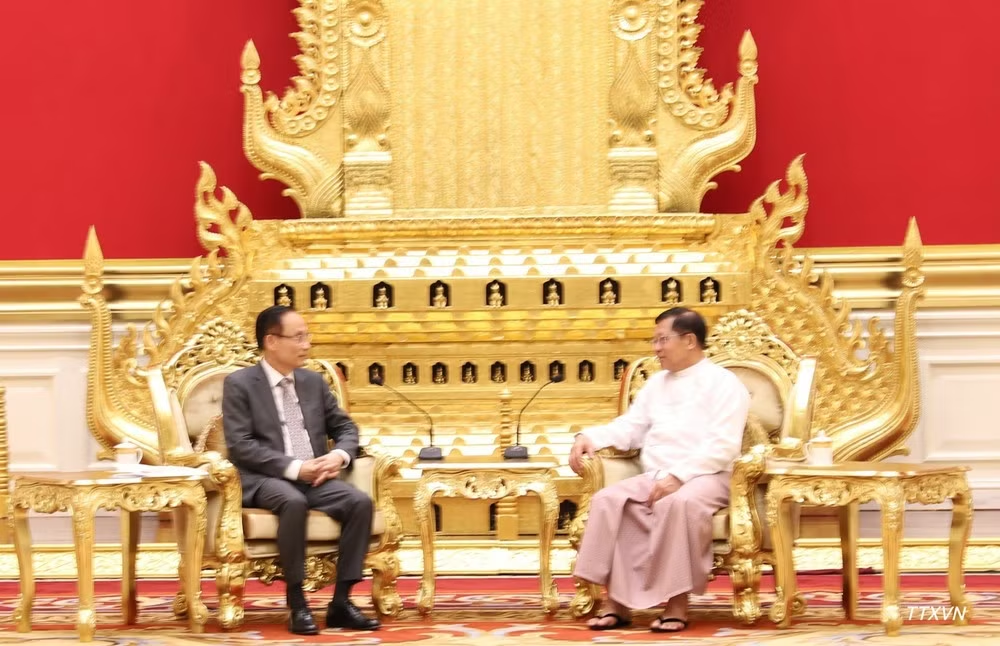
Most recently, Vietnamese Foreign Minister Le Hoai Trung paid an official visit to Myanmar and co‑chaired the 10th meeting of the Viet Nam–Myanmar Joint Committee for Bilateral Co‑operation on August 25–26. The visit’s success contributed to consolidating bilateral relations in the new context, maintaining high‑level contacts, promoting practical co‑operation in numerous fields, and sustaining Viet Nam’s role and contribution to regional stability.
Expanding future co‑operation
In the time ahead, the two sides should make effective use of their potential and strengths. They should continue consolidating political trust by increasing contacts and exchanges of delegations at all levels and between ministries and sectors, as well as promoting Party, parliamentary and people‑to‑people exchanges.
Economic co‑operation should be stepped up as an important pillar of bilateral ties, with priority given to high‑potential sectors such as agriculture, livestock farming, fisheries, agro‑processing and essential goods, telecommunications and electric‑vehicle manufacturing.
The two sides should organise business forums, trade fairs and exhibitions to enable enterprises from both countries to study the market and explore opportunities for co‑operation and investment. They should also further facilitate licensing, investment, international payments, import and export procedures.
In addition, the two sides should strengthen co‑operation in culture, tourism, people‑to‑people exchanges, twinning between localities and education and training, while opening more direct air routes between the two countries. They should also consult and co‑ordinate closely at regional and international forums, particularly within Mekong subregional and ASEAN mechanisms.
Myanmar remains a potential market
Following five years of political upheaval, Myanmar held a general election from December 2025 to January 2026 and formed a new government. The current government is working to promote the peace process and national reconciliation, restore and develop the economy, strengthen external relations and reintegrate into the region and the international community.
Myanmar remains a potential market for Vietnamese enterprises. With its vast land area, abundant natural resources—including forests, marine resources and minerals—population of more than 51 million and young workforce, Myanmar is considered to possess substantial natural and human‑resource potential.
Following its first 100‑day plan, the new government has achieved positive results, helping maintain stability and promote development in the period ahead.
According to Ambassador Nguyen Anh Duc, Myanmar remains a potential market for Vietnamese enterprises. With its vast land area, abundant natural resources—including forests, marine resources and minerals—population of more than 51 million and young workforce, Myanmar is considered to possess substantial natural and human‑resource potential.
The country is still in the early stages of reintegrating into the regional and global economy. Many manufacturing sectors remain underdeveloped, and Myanmar is unable to produce many essential consumer goods domestically. Vietnamese products are relatively well suited to the tastes of Myanmar consumers.
Moreover, following the period of political upheaval and the severe impact of the 2025 earthquake, Myanmar is in need of reconstruction, infrastructure improvements, economic recovery and development, and substantial external investment.
Alongside improvements in the political environment and the potential and prospects for co‑operation in the Myanmar market, Vietnamese enterprises also benefit from the favourable fact that Myanmar’s Government and people have held positive views of Vietnamese people and goods for many years. The current Myanmar Government continues to attach importance to strengthening the bilateral friendship and is eager to promote economic, trade and investment co‑operation with Viet Nam.
However, Ambassador Nguyen Anh Duc noted that, alongside these opportunities and advantages, Vietnamese enterprises investing and doing business in Myanmar also face numerous challenges. These include security and safety concerns, limitations and weaknesses in the economy, and shortcomings related to import policies, payments, profit repatriation and administrative procedures.
Vietnamese enterprises should therefore seize the current opportunities to explore investment and co‑operation with Myanmar, while conducting comprehensive research and due diligence to protect their interests and ensure effective, long‑term operations in the country.