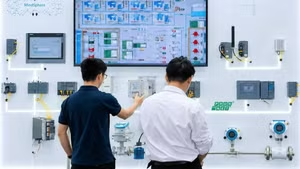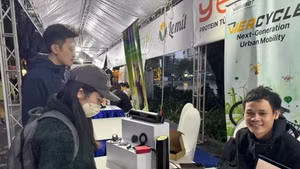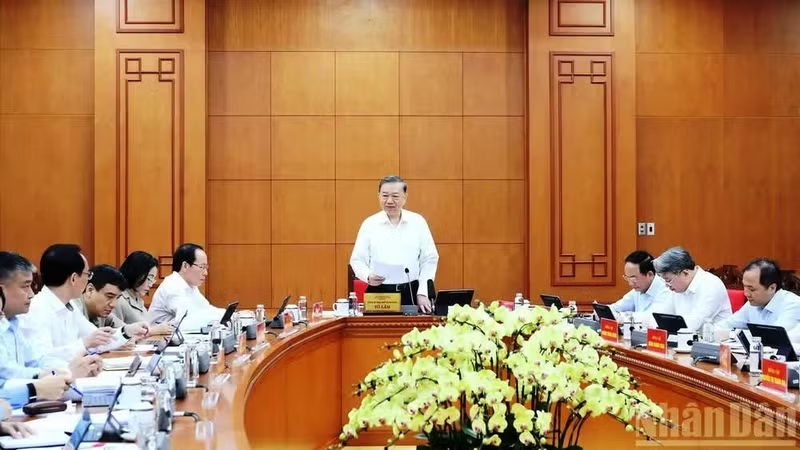
During the meeting on August 25, 2026, regarding the progress made in the first year of implementing Resolution 71-NQ/TW, General Secretary and President To Lam called for a substantive transformation from within the education sector. Education must take the lead in preparing high-quality human resources—specifically in science, technology, innovation, digital transformation, artificial intelligence, and other sectors of strategic importance to the nation.
This directive has direct implications for the training of human resources in strategic technological fields. While the number of new academic programs, curricula developed, and students enrolled reflects the scale of implementation, the nation’s technological capacity ultimately depends on the quality of its research personnel, their ability to solve complex problems, and the extent to which research outcomes are successfully translated into technologies and products for practical application.
From launching programmes to building the capacity to master technology
There has been significant momentum in training human resources for STEM fields, key engineering disciplines, and strategic technologies. Nguyen Tien Thao, Director of the Higher Education Department, stated that there are currently 771,475 students enrolled in STEM-related fields nationwide, accounting for approximately 29% of the total higher education student population.
This includes 475,833 full-time students across 15 groups of disciplines as defined by Decree No. 179/2026/ND-CP. The goal is to increase the proportion of STEM students to 35% by 2030, in order to meet the requirements for the development of science, technology, and innovation.
According to Notice No. 160-TB/VPTW, the enrollment of university students in STEM fields is set to increase by 33.6% by 2026. Approximately 110,000 students are expected to pursue studies in key engineering and strategic technology disciplines, with 90 specialised programmes—ranging from talent-track engineering to STEM master’s degrees—being implemented across 23 higher education institutions.
In parallel with expanding domestic training capacity, the Government has approved an initiative to provide 1,500 full scholarships for the development of human resources in strategic technology sectors at the world’s leading universities.
Beyond the aforementioned talent-track engineering and STEM master’s programmes, various collaborative models between educational institutions and enterprises are being rolled out; these integrate industry experts, real-world projects, and practical, on-site training within the curriculum.
Nevertheless, the General Secretary and President noted that improvements in the quality of education, student outcomes, and the overall human resource pool remain insufficiently pronounced. Consequently, bridging the gap between the scale of training and the quality of graduates is a critical challenge that must be addressed in the coming period.
For human resources in strategic technology, quality must be demonstrated through the ability to approach novel problems, devise strategies, organise research, conduct experiments, and develop solutions within real-world environments. Such competencies are difficult to cultivate if the training process is evaluated primarily based on the number of completed course modules or the sheer volume of knowledge imparted.
This requirement has become increasingly urgent as fields such as artificial intelligence, semiconductors, cybersecurity, quantum technology, and unmanned aerial vehicles (UAVs)—along with various other emerging technologies—continue to evolve rapidly. The demand for human resources in these areas can no longer be fully captured by traditional, well-established job roles. Many technologies are currently undergoing research, testing, the finalisation of standards, and market development.
Professor Nguyen Dinh Duc, former Chairman of the University Council at the University of Engineering and Technology, Viet Nam National University, Ha Noi, argued for stronger integration between human resource demand forecasting, student admissions, academic training, research, industry engagement, and employment.
He suggested that the effectiveness of higher education should be evaluated based on the quality of graduates, employment rates, research productivity, and the number of patents and technologies adopted by businesses. Shifting the focus from “measuring tasks” to “measuring impact” necessitates a corresponding change in how educational programmes are organised and implemented.
Consequently, learning outcomes should be defined in terms of a student’s capacity to solve problems and perform professional tasks. Beyond specialised theoretical knowledge, students must gain practical experience in research, working with data, equipment, infrastructure, and real-world technical requirements.
Research should also be integrated into the training process. Students must have opportunities to join research teams, collaborate with scientists, and contribute to scientific projects, intellectual property, prototypes, solutions, or products.
Businesses should be involved throughout the entire process—from identifying needs and defining specific challenges to providing expert input, facilitating practical training, and assessing student competencies. If businesses only engage during the internship or recruitment phase, their feedback cannot effectively or promptly influence academic curricula or teaching methodologies. Furthermore, if research activities are decoupled from training, students lack the environment necessary to develop the capacity to generate new knowledge and technologies.
Connecting resources for the development of strategic technology talent
Consequently, collaboration among enterprises, universities, and research institutes is essential to integrate real-world challenges, research capabilities, and technological resources into the educational process. FPT Corporation is one of the technology enterprises actively pursuing this approach.
Recently, FPT, FPT University, and the Quantum AI & Cyber Security Institute signed a memorandum of understanding (MOU) for a strategic partnership focused on human resource development, research, the mastery and application of strategic technologies, with a collaborative vision extending to 2041.
In this model, enterprises contribute real-world problems, expertise, data, infrastructure, and testing environments. Research institutes lead in-depth research initiatives and the development of scientific talent. Universities oversee education and student preparation, while also fostering an environment where students can engage in research, address practical challenges, and develop products.
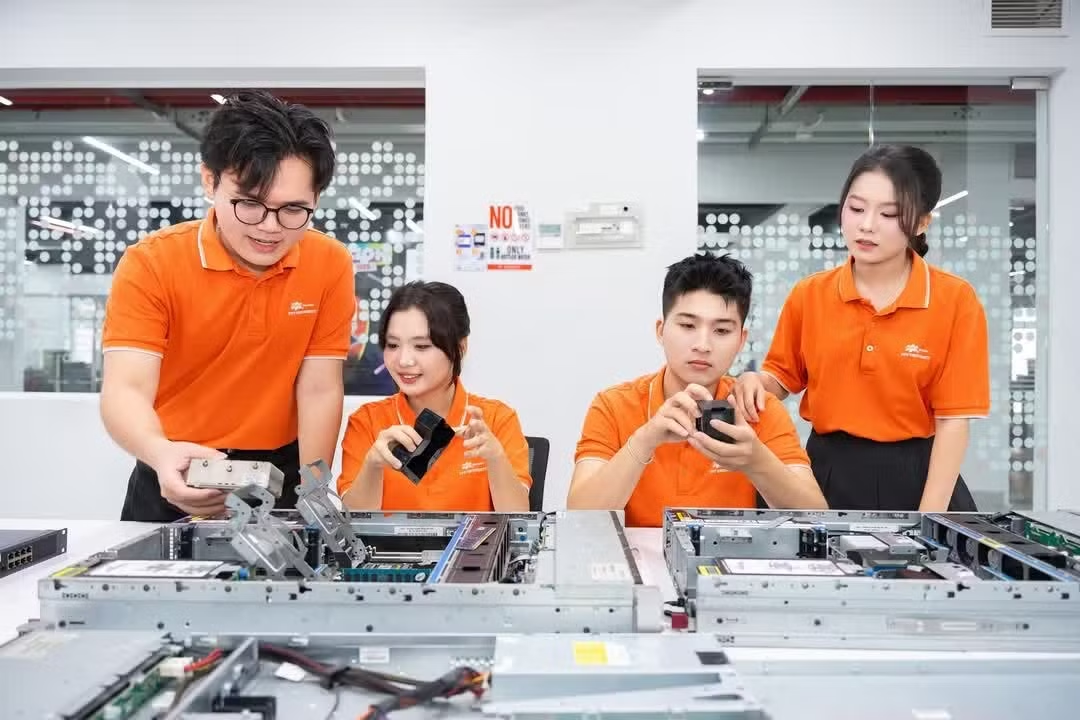
The three parties have set a goal to train a minimum of 30,000 strategic technology professionals by 2041. This scale-based objective is accompanied by targets to produce at least 100 PhDs; generate 1,500 scientific works and intellectual property assets—including at least 300 patents or practically applicable intellectual property assets—and develop at least 150 commercialised products, with three of these reaching the international market.
This framework allows real-world challenges to directly influence education and research. Students gain access to issues currently being addressed by businesses and research teams; research findings benefit from opportunities for practical testing; and companies gain a basis for evaluating the quality of human resources through the students' learning processes and project work.
This tripartite partnership builds upon existing initiatives already implemented by FPT in the areas of research, education, and technological infrastructure development. In the field of artificial intelligence (AI), FPT has developed an “AI Residency” programme designed to cultivate young talent through intensive, specialised research. As of 2024, the programme has produced nearly 90 research works, 29 of which have been accepted at A*-ranked AI conferences.
Over the course of a six-year research partnership between FPT and the Mila Institute, research teams have published 162 scientific papers, trained 80 young researchers, and secured five approved patents. These outcomes demonstrate that a talent development program can cultivate a research workforce and produce scientific outputs that meet international standards.
Regarding product advancement, FPT—in collaboration with the Au Lac AI Alliance—organised the “Au Lac Grand Prize” to identify and honor AI products developed and mastered by Vietnamese individuals. The inaugural edition attracted over 410 entries across 26 fields, signaling that the domestic AI development community has begun to create solutions that address various economic and social challenges.
Other higher education institutions across the country are also implementing various models to pool resources, identify and nurture STEM talent, and meet the development requirements for key technical sectors and strategic technologies.
At a recent seminar on the implementation of STEM human resource training programs and policies—organised by Ha Noi University of Science and Technology (HUST) and the Ministry of Education and Training—Professor Le Anh Tuan, President of HUST, noted that an ecosystem connecting education, research, innovation, and industry would help bring intellectual products—incubated within universities—to fruition, thereby creating value for society.
Professor Mai Thanh Phong, Rector of the University of Technology (Viet Nam National University, Ho Chi Minh City), also shared that his institution is developing talent training programs that are closely integrated with scientific research and the business sector. The “Corporate Semester” model enables students to undertake long-term internships and work within companies, thereby enhancing their practical skills and adaptability to the labor market.
Meanwhile, at Phenikaa University, students are provided with opportunities to engage in research within laboratories, as well as gain hands-on experience in corporate environments and technology startups throughout their studies.
Assoc. Prof. Dr. Le Anh Son, Vice President of Phenikaa University, asserts that integrating education, research, and entrepreneurship creates an environment where learners can develop their capacity for innovation and master new technologies.
A key objective is to cultivate a workforce with a solid scientific foundation, capable of participating in the research and development of new technologies.
Assoc. Prof. Dr. Tran Manh Cuong, Vice Rector of the University of Science, Viet Nam National University, Ha Noi, states that the institution remains committed to an educational philosophy rooted in scientific research and innovation, built upon a foundation of basic sciences.
Furthermore, the university has established a comprehensive talent development pipeline—spanning from specialised high schools to undergraduate and postgraduate levels—aimed at identifying and nurturing high-quality human resources.
Outcomes serve as the benchmark for the implementation process
These models demonstrate that the development of human resources in STEM and strategic technological fields is not solely the responsibility of higher education. It requires a continuous, interconnected process—spanning identification, training, and research, through to practical application and the eventual deployment of talent.
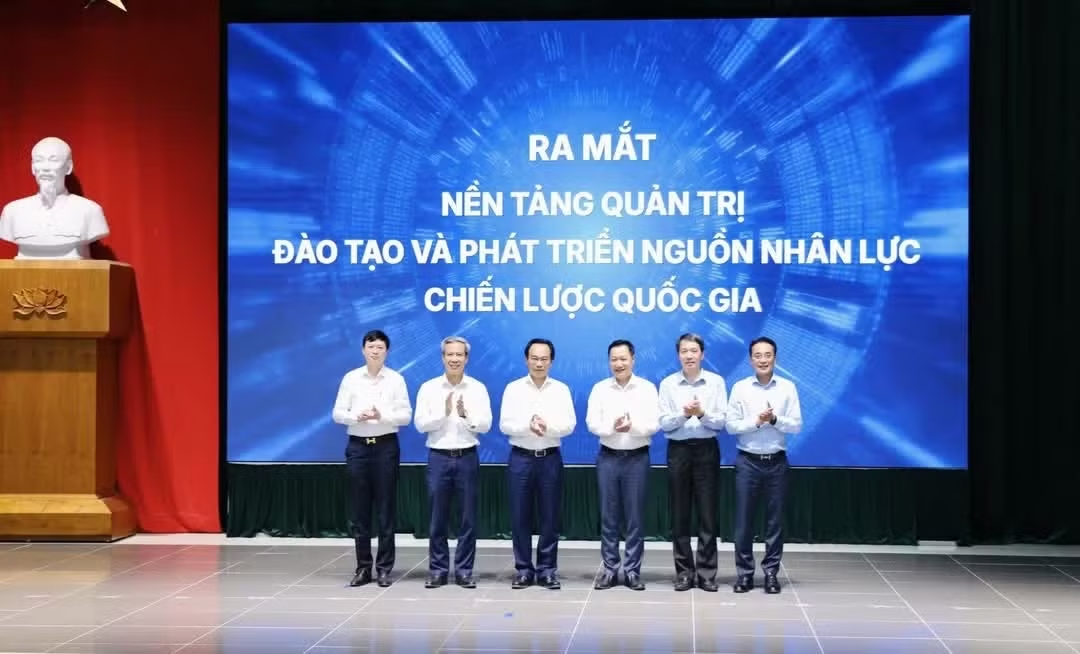
The Ministry of Education and Training has also established a national strategic human resource training and development management platform. This platform serves to build a database of the nation’s strategic human resources, tracking their educational progress, employment status, and how well they meet the workforce demands of fundamental sciences, key engineering sectors, and strategic technologies. In doing so, it helps connect stakeholders, supports policy-making, and fosters the development of high-quality human resources essential for the nation’s new phase of development.
Long-term goals for training human resources in strategic technologies must be translated into specific milestones and indicators for each phase. The number of individuals trained must be matched by their professional competence; scientific work must be evaluated based on quality and potential for further development; intellectual property must be applicable; and products must be validated through the effectiveness of their implementation.
The capacity to master technology must be linked to the ability to create value and a sense of social responsibility. When learners can demonstrate their competence through research, intellectual property, prototypes, and products, the shift in focus—from merely refining policies to achieving tangible, substantive results—becomes clearly evident within the nation’s education system and its technological development process.