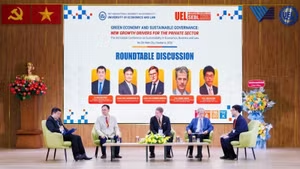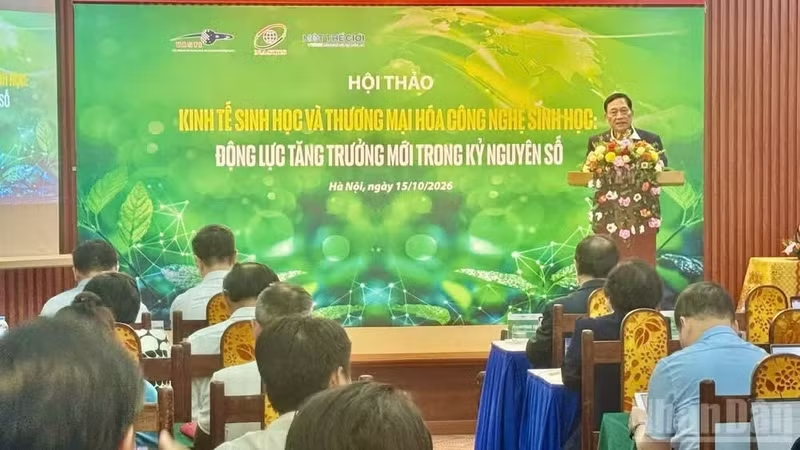
On the afternoon of October 15, the Viet Nam Association for Science and Technology Information (VASTI), in collaboration with the Department of Science and Technology Information and Statistics under the Ministry of Science and Technology, held a thematic seminar in Ha Noi titled: “The Bioeconomy and the Commercialisation of Biotechnology: A New Growth Driver in the Digital Era.”
The event aimed to foster connections between scientific and biotechnological resources and the market, while addressing bottlenecks in the valuation, transfer, and commercialisation of intellectual property.
The Bioeconomy: A strategic axis and new growth driver
During the seminar, participants reached a strong consensus that biotechnology has evolved far beyond academic laboratory research; it has now transformed into a direct productive force, generating immense economic value through modern biomedicine, smart agriculture, natural pharmaceuticals, and bio-based alternative materials.
According to reports from international organisations such as the OECD and the World Bioeconomy Forum, the global bioeconomy is currently valued at approximately 5 trillion USD and is projected to grow significantly, reaching 30 trillion USD by the middle of the 21st century (2050), accounting for nearly one-third of the global economic value.
In many advanced nations across Europe and North America, the bioeconomy already contributes between 10% and over 20% to their respective Gross Domestic Product (GDP).
In Viet Nam, the agriculture, forestry, and fisheries sector — which contributes 11%–12% to the country’s total GDP of approximately 514 billion USD — serves as a solid foundation for the development of an agricultural and medicinal bioeconomy. Under national strategic directives, Viet Nam aims for the biotechnology industry to contribute between 10% and 15% of the nation’s total GDP by 2045.
In the spirit of Resolution 57-NQ/TW, the development of science, technology, and innovation — particularly in cutting-edge fields such as biotechnology, genetic engineering, and biomedicine — is an essential step forward.
As emphasised by General Secretary and President To Lam at the National Conference on Breakthroughs in Science, Technology, Innovation, and Digital Transformation held in January 2026, the outcomes of scientific research must be applied in practice and successfully commercialised, effectively putting an end to the waste of knowledge left confined within laboratories.
The state shall establish mechanisms and policies that account for the inherent risks and time lags associated with scientific research, while positioning enterprises at the core to ensure that technology directly serves the economy.
Promoting an effective model of collaboration between the state, the scientific community, and the market within the realms of scientific research and innovation.
Identifying challenges in advancing the bioeconomy in Viet Nam
Although Viet Nam possesses abundant biological resources, and research teams at various institutes and universities have mastered key foundational technologies — such as genetic engineering, tissue culture, microbial fermentation, and vaccine development — the process of transforming research outcomes into commercial products still faces significant hurdles.
These include a lack of clear definitions and standardized metrics for measuring the bioeconomy’s contribution to GDP; legal concerns among public research institutions regarding the commercialisation of intellectual property; a disconnect between the domestic supply of and demand for technology; and a shortage of venture capital for the incubation stage.
Bui Duy Nghia, Head of the Science and Technology Statistics Division at the Institute for Science Statistics and Evaluation under the Agency for Science and Technology Information, Statistics and Evaluation, provided an overview of how the bioeconomy’s contribution to Viet Nam’s GDP is measured. He highlighted that variations in measurement methodologies across different countries lead to vastly different results.
Furthermore, he proposed a framework of indicators and an implementation roadmap for Viet Nam, aimed at ensuring that measurement outcomes are truly meaningful, accurately reflect the nation’s technological maturity, and provide the most precise guidance for capital investment flows.
Highlighting breakthrough biotechnologies with practical applications that are ready for transfer, Assoc Prof, Dr Phi Quyet Tien, Director of the Institute of Biotechnology at the Viet Nam Academy of Science and Technology, presented key applied research results prepared for commercialisation.
These include genetic engineering and breeding processes for disease-resistant crops and livestock, microbial agents for environmental treatment in agriculture and aquaculture, and advanced extraction technologies for bioactive compounds used in pharmaceuticals and health supplements.
Meanwhile, speakers Dr Nguyen Le Thu Ha, General Director of an international science and technology company, and Assoc Prof, Dr Nguyen Minh Tan from Hanoi University of Science and Technology, analysed the economic challenges and commercialisation risks from an investor’s perspective.
They specifically addressed the journey of transforming biotechnological research into export-ready products. Their insights covered the practical considerations investors face when evaluating biotech projects emerging from the laboratory, criteria for assessing commercial viability, the balance between R&D costs and risk management, and lessons learned from successful technology spin-off models.
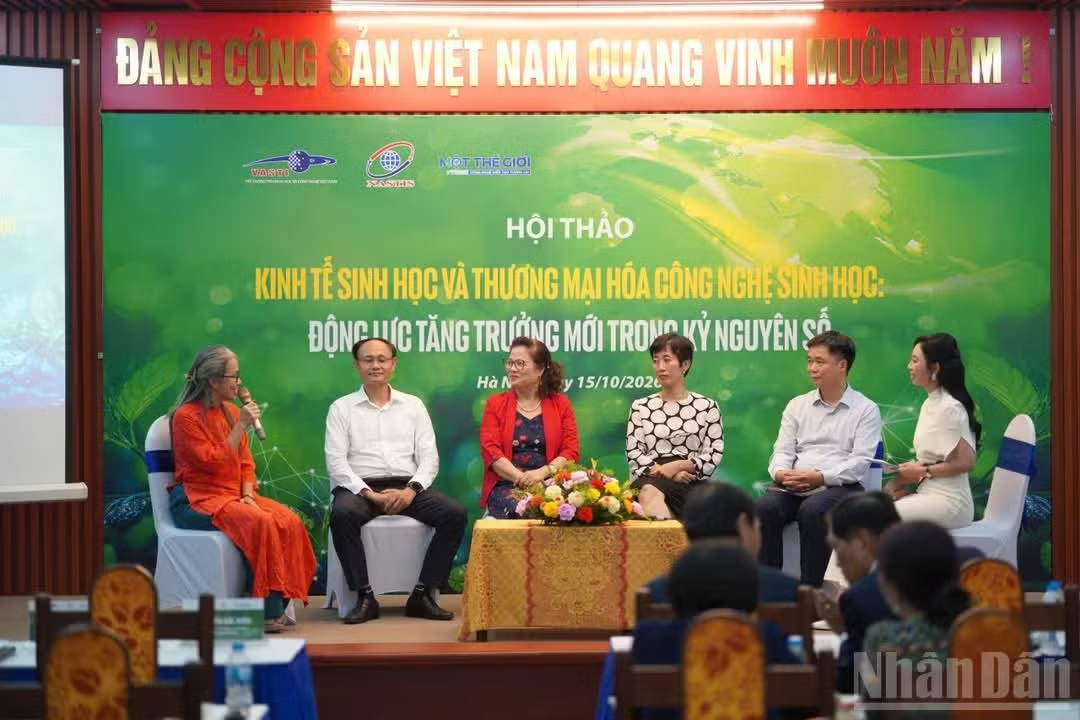
Notably, a highlight of the event was a live discussion session titled “Removing Bottlenecks in the Commercialisation of Biotechnology: From the Lab to the Commercial Market.”
With the participation of representatives from the Ministry of Science and Technology, the Viet Nam Academy of Science and Technology, key universities, and businesses involved in practical applications, the speakers engaged in an open dialogue to dissect existing barriers and propose policy recommendations for the government and relevant ministries and agencies, aiming to establish a favourable legal framework for Viet Nam’s bioeconomy.