#digital era

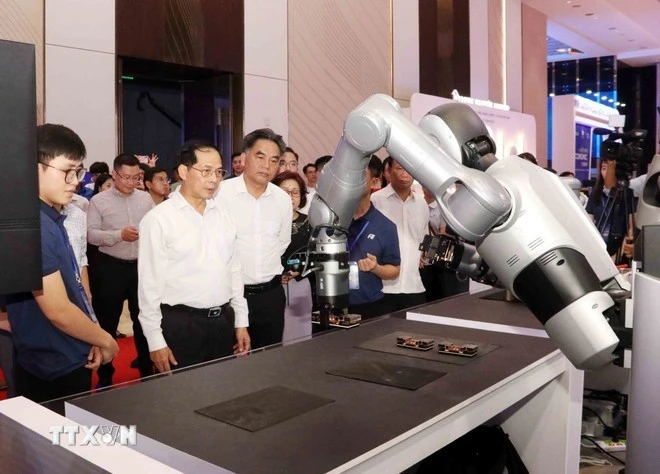
An exhibition introduces technology products during the inauguration of National Data Centre No. 1 in August 2025.
Sci-Tech

From digital resources to new drivers of development

In the digital era, data is present in almost every aspect of daily life, from healthcare, education, and transport to online public services. When standardised, connected, and effectively utilised, data not only helps improve services for citizens but also becomes a new resource for the digital economy.

General Nguyen Tan Cuong, Member of the Party Central Committee, Member of the Standing Committee of the Central Military Commission, Chief of the General Staff of the Viet Nam People's Army, and Deputy Minister of National Defence, visits initiatives displayed at the Party Congress of the Government Cipher Committee for the 2025–2030 term. (Photo: qdnd.vn)
Sci-Tech

Information security in the digital era

The Politburo’s Resolution No. 57-NQ/TW, dated December 22, 2024, on breakthroughs in science and technology development, innovation, and national digital transformation, has affirmed the strong determination of the Party and the State to build a new development foundation for the country.

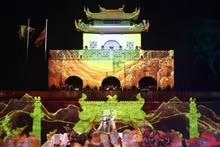
The “Light Concert – Welcome New Year 2026” event organised by Nhan Dan Newspaper in coordination with the Ha Noi People’s Committee. (Photo: THE DAI)
Features

Unlock cultural resources in digital era

The Government’s issuance of Decision No. 611 approving the Project “Digital transformation in the cultural sector to 2030, with a vision to 2045” is a timely concretisation of the Politburo’s Resolution No. 80-NQ/TW on cultural development in response to the requirements of the digital era, where technology has become one of the pillars shaping how national cultural values are created, preserved and disseminated.

Vietnamese researchers in discussion with a Japanese expert (right). Photo: Courtesy of the interviewee.
Sci-Tech

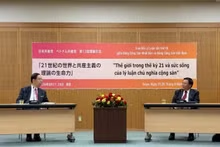
Viet Nam–Japan knowledge cooperation in the digital era

With a view to fostering high-quality human resources at home and abroad and promoting innovation, the annual conference organised by the Vietnamese Academic Network in Japan (VANJ), most recently held in Kyoto in December 2025, is among the practical solutions being pursued. The event also serves as a bridge for academic exchange between Vietnamese and Japanese scientists and researchers across a wide range of disciplines.

Launch ceremony of the national tourism data platform Visit Viet Nam. (Photo: HOANG HA/NDO)
Travel

Building a comprehensive and unified tourism data system

In the digital era, data is considered as a special resource that creates a driving force for socio-economic development. For tourism, an industry with strong connection and experience-based services, a standardised data system is a crucial condition to improve management capacity, competitive efficiency, and service quality.

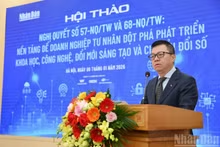
Comrade Le Quoc Minh, Member of the PCC, Editor-in-Chief of Nhan Dan Newspaper, Deputy Head of the PCC’s Commission for Communication-Education and Mass Mobilisation, and President of the Viet Nam Journalists Association, said the Party identifies the private economy as one of the most important driving forces of the national economy. (Photo: THE DAI)
Policy

Paving the way for private enterprises to enter the digital era

As the country enters a new phase of development, two important resolutions of the Party Central Committee – Resolution No. 57-NQ/TW and Resolution No. 68-NQ/TW – have been identified as key foundations to help the private sector unlock resources, expand its development space, and create new breakthroughs in science and technology and digital transformation.

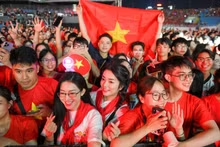
Young audience members were “filled with excitement” at every moment of the political art programme “To quoc trong tim”. (Photo: NDO)
Domestic

New way of political communication in digital era

Political communication in the era of social networks is undergoing fundamental changes in approaches, organisation and dissemination. In the past, political communication was mainly a one-way model. Today, it must involve dialogue, closeness, multiple platforms and transparency to gain effectiveness.

Back to top