The Project aims to build a modern, connected national digital cultural ecosystem capable of generating added value. It sets out the goal that by 2030, Viet Nam will strive for 100% of cultural sectors to have shared digital platforms; all heritage data will be standardised according to the national framework and gradually expanded for sharing; and about 80% of digital cultural heritage will be assigned identification codes to establish ownership and control exploitation.
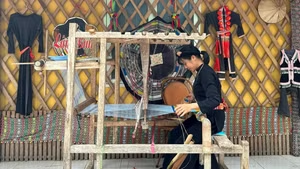
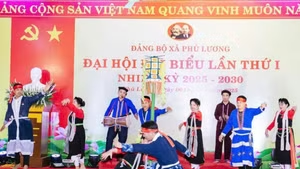
Notably, the digitisation of at least 80% of the intangible cultural heritage of ethnic minority communities will make an important contribution to preserving values at risk of fading, while enabling these communities to participate more deeply in the national digital cultural life.
At the same time, 100% of state management agencies in the cultural sector will connect and synchronise specialised databases; 100% of state management units and public service units in the cultural sector will have appropriate digital transformation plans and roadmaps. All national library systems, national museums of history and culture, and public museums will focus on completing digital libraries and digital museums. By 2045, a comprehensive, intelligent and highly interactive digital cultural ecosystem will be fully developed.

Previously, digital transformation in culture was often understood in a narrow sense, mainly involving the digitisation of artefacts, database building or the organisation of virtual tours. However, it has now expanded to restructuring the entire operational model of the cultural sector in the digital environment, requiring comprehensive modernisation of the national digital cultural ecosystem to preserve and promote Vietnamese cultural values.
The Project emphasises the role of cultural data as an important resource. Therefore, building a national cultural database with the ability to connect, share and be exploited is considered the foundation for forming creative industries.
Placing the Project in relation to major Party guidelines and policies shows consistency in thinking and synchronisation in implementation. Resolution No. 57-NQ/TW of the Politburo identifies science, technology, innovation and digital transformation as strategic breakthroughs.
Following that, Resolution No. 80-NQ/TW affirms that the development of science, technology, innovation and digital transformation creates new spaces and new momentum for cultural development. In that spirit, the Project is a timely concretisation, bringing major orientations into practice.
Commenting on the newly approved Project, Associate Professor, Dr Vu Thi Phuong Hau, Director of the Institute of Culture and Development (Ho Chi Minh National Academy of Politics), stated that the Project represents an important shift in thinking about cultural development in Viet Nam.
In the context where digital technology is reshaping the way values are created and disseminated, building a digital cultural ecosystem is not only a technical requirement but also a strategic choice. Digital transformation opens up the possibility of more effective preservation of cultural resources, while enabling heritage to be accessed and interpreted in new forms suitable for contemporary life.
The Project represents an important shift in thinking about cultural development in Viet Nam. In the context where digital technology is reshaping the way values are created and disseminated, building a digital cultural ecosystem is not only a technical requirement but also a strategic choice.
Associate Professor, Dr Vu Thi Phuong Hau, Director of the Institute of Culture and Development (Ho Chi Minh National Academy of Politics)
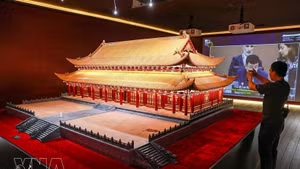
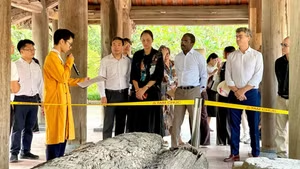
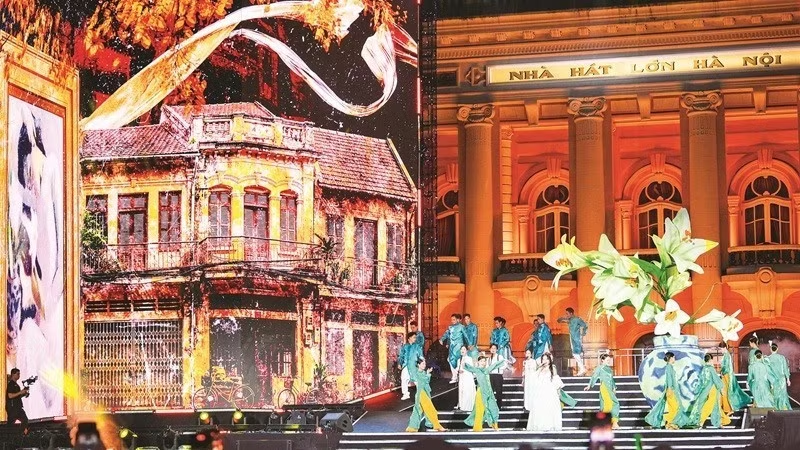
In recent years, digital transformation in the cultural sector in Viet Nam has made initial, noteworthy progress. For example, in Ha Noi, many museums have applied technology in exhibitions, implemented automatic audio guides and developed virtual tours. Some heritage sites such as Van Mieu–Quoc Tu Giam, the Thang Long Imperial Citadel and the Hoa Lo Prison Relic Site have developed digital products, attracting public attention, especially among young people.
However, from a comprehensive perspective, this process remains uneven across localities. In some places, there is still a lack of proper awareness of the necessity and urgency of digital transformation in culture, difficulties in selecting appropriate technologies, and shortages of financial resources as well as human resources capable of bridging culture and technology. Many projects remain at the pilot or demonstration stage, without creating substantial value for the community or the market.
According to experts, one of the major “bottlenecks” at present is human resources. Digital transformation in culture requires a workforce that not only understands professional expertise but also possesses technological capabilities, can work with data and digital platforms; however, this workforce remains limited and uneven. The Project’s goal of equipping 100% of officials, civil servants, public employees, artists and students in the cultural and arts sectors with digital skills is a correct direction, but to realise it requires specific roadmaps and solutions, linked with reforms in training programmes and human resource utilisation mechanisms.
Institutional and policy mechanisms are also issues of concern for many experts. Digital transformation cannot rely solely on state resources but requires the participation of the private sector, as well as technology and digital content enterprises. However, the legal framework for public-private cooperation in the cultural sector still has gaps, especially in issues related to data exploitation, benefit sharing and copyright protection.
Digital transformation in culture is not simply about “putting it online”, but requires ensuring that traditional values are not lost or distorted. Without proper standards and approaches, the digitisation process may lead to simplification, misrepresentation or the fading of the original meaning of heritage, especially when separated from its original cultural space.
Professor, Dr Tu Thi Loan, President of the Viet Nam Association for Community Cultural Development
Professor, Dr Tu Thi Loan, President of the Viet Nam Association for Community Cultural Development, analysed that digital transformation in culture is not simply about “putting it online”, but requires ensuring that traditional values are not lost or distorted. Without appropriate standards and approaches, digitisation may lead to simplification, distortion or dilution of the original meaning of heritage, especially when detached from its original cultural context.
Associate Professor, Dr Vu Thi Phuong Hau further analysed that as culture becomes increasingly linked with the creative economy and digital content industries, promoting digitisation, connectivity and exploitation of cultural resources will help form new development drivers.
From that perspective, the Project not only aims to modernise cultural management but also lays the foundation for promoting the soft power of Vietnamese culture in the digital space, while expanding opportunities for creativity and social participation in preserving and developing national cultural values in the digital era. Therefore, the next issue is to organise implementation in a synchronised and effective manner, with the participation of the whole society.
It cannot be denied that technology plays an important role in the process of digital transformation, but people - with their knowledge, determination to preserve identity and creative capacity - are the decisive factor. When these two elements are harmoniously and synchronously combined, Vietnamese culture will be given “wings” to spread strongly and affirm its position in the global digital space.