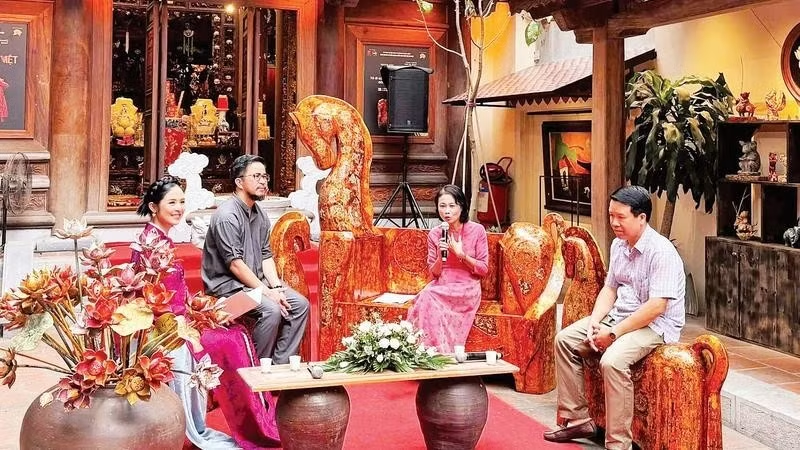
Ha Vi Communal House (Hang Hom Street) has become an attractive destination in the heart of the Old Quarter with its hosting of an exhibition titled “The Flow of Vietnamese Lacquer”. Here, the public can not only learn about the unique techniques of the traditional lacquer craft and the transition from traditional lacquer to lacquer art but also admire the beauty of many artworks and handicraft products created by artisans and artists.
Participating in activities at the exhibition, artisan Nguyen Tan Phat (Duong Lam Ancient Village, Son Tay Commune) said that the exhibition aims to promote the traditional lacquer craft and is also an opportunity to pay tribute to the founding master of the craft, Tran Lu, who laid the foundation for a distinctive traditional craft of the nation. Artisans spent two full months preparing to create a narrative connecting the lacquer craft of the past with contemporary products.
To mark the occasion, the Management Board of Hoan Kiem Lake and the Ha Noi Old Quarter organised two seminars: “Ha Vi Imprints - Memories of the Old Quarter” and “Ha Vi Imprints - The Ancient Soul of Vietnamese Craft”. These activities clarified the history of formation and development of Ha Vi Communal House on Hang Hom Street and helped the public better understand the relationship between craft streets and their original craft villages, as exemplified by Ha Vi Communal House – Hang Hom Street and Ha Vi Village (formerly under Thuong Tin Prefecture, Ha Dong Province, now Ha Noi).
The lacquer craft is one of Viet Nam’s distinctive traditional crafts. According to experts, from around the mid-19th century, craftsmen from Ha Vi Village brought the lacquer-coated woodcraft trade to Thang Long to establish their livelihoods, contributing to the formation of Hang Hom Street. The main products were lacquered chests and boxes. Villagers established Ha Vi Communal House to worship the founding master of the lacquer craft, Tran Lu, and to commemorate their origins.
A few years ago, when passing by this site, almost no one could recognise it as an ancient communal house. The heritage space had been encroached upon by households living there. It once seemed very difficult to “reclaim” the site, but the People’s Committee of Hoan Kiem District, with strong determination to restore heritage, negotiated with each household on relocation and clearance plans in 2022. Subsequently, Ha Vi Communal House was invested in, restored, and inaugurated in June 2023. Since then, activities to promote the value of the site have been continuously organised, especially exhibitions, displays, and seminars related to the lacquer craft and lacquer art. This has transformed Ha Vi Communal House from merely a place of worship for the craft’s founder into a cultural space within the Old Quarter.
Ha Noi’s Old Quarter is a space where “heritage exists within heritage”. Due to changes in living conditions, many households moved into heritage sites, especially after 1954. Sites that once housed many families include Kim Ngan Communal House (Hang Bac Street), Vinh Tru Pagoda (Hang Luoc Street), Trung Yen Communal House (Trung Yen Alley), Thanh Ha Communal House (Ngo Gach Street), and Truc Lam Ancestral Hall (Hang Hanh Street). Local authorities and the Management Board of Hoan Kiem Lake and the Old Quarter have gradually persuaded and encouraged residents to relocate, clearing the space to restore these sites.
Following the revival of major sites such as Kim Ngan Communal House, Huyen Thien Pagoda, and Vinh Tru Pagoda, more recently, sites such as Trung Yen Communal House, Ha Vi Communal House, and Thanh Ha Communal House have been returned to their original spaces and restored. Following their inauguration, these sites have become places for spiritual and cultural activities and for organising festivals to commemorate local tutelary deities (often the founders of crafts).
At present, Ha Noi’s Old Quarter still has several heritage sites that are being encroached upon or have degraded to varying degrees, such as Truong Thi Communal House (Hang Bac Street), Ba Moc Pagoda (Nguyen Thiep Street), and Dong Thuan Communal House (Hang Ca Street). From the cases of Ha Vi Communal House and Truc Lam Ancestral Hall, after relocation and restoration, they have become spiritual spaces and cultural bridges between the past and the present. It is therefore possible to expect further positive changes in the coming time, especially as Ha Noi continues efforts to reduce population pressure in the central area.