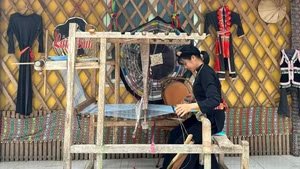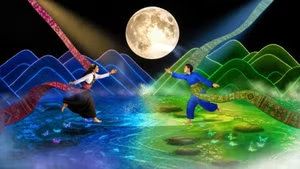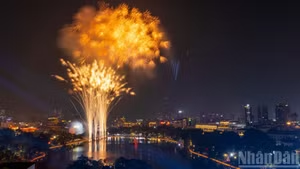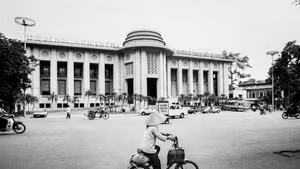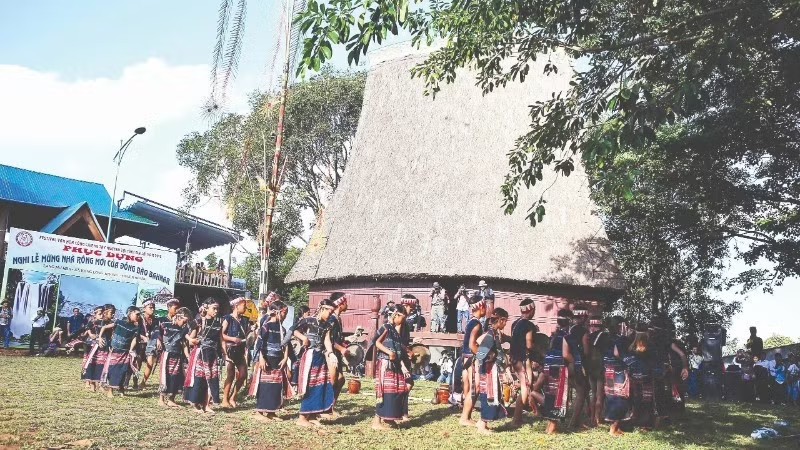
Traditional arts are the crystallisation of aesthetic concepts, philosophies of life and national identity, contributing to shaping an “aesthetic identity” and forming the foundational tastes of society. They are also creative materials and elements that directly participate in the cultural industries, notably in fields such as cinema, fashion, design, video games and digital content. For example, in music, many young artists are exploring and revitalising the heritage of their forebears, performing on major stages and in international arenas.
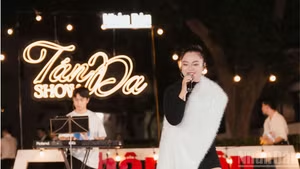
Musical products that combine traditional and modern elements have not only created a strong impact domestically but have also won prestigious awards and generated widespread influence on digital platforms, such as Duc Phuc with Phu Dong Thien Vuong, who won first prize at the Intervision 2025 international music competition; Phuong My Chi with a series of songs that delicately blend modern and traditional music, impressing international audiences and winning second runner-up at the Sing!Asia 2025 competition; Hoa Minzy with Bac Bling, which garnered numerous Vietnamese music awards in 2025; and so on. This is not a temporary phenomenon but reflects a new creative trend, demonstrating awareness and proactiveness from the artists themselves. Clearly, when placed in an appropriate creative context and given serious investment, traditional arts can fully their role in contemporary life.
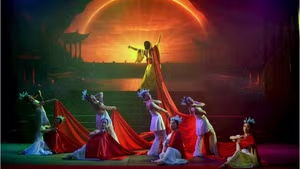
Globally, many countries have successfully transformed traditional arts into development resources: Japan with Noh and Kabuki theatre; South Korea with Pansori; China with Peking Opera… have been modernised and integrated into cultural and tourism industries, becoming products that generate high economic value. According to UNESCO, linking heritage with creative development is one of the sustainable approaches to both preserving and exploiting cultural values. Researcher Nguyen Quang Long, who has spent more than 30 years working with traditional music, shared: In the current context, when global cultural products dominate, the role of traditional arts becomes even more important. If cultural industries are the visible part of growth, then traditional arts are the root that ensures development with identity and depth.
In Viet Nam, the Party and the State have institutionalised cultural development orientations in general and traditional arts in particular through important documents such as the Resolution of the 5th Plenum of the 8th Party Central Committee on building and developing an advanced Vietnamese culture imbued with national identity; the Resolution of the 9th Plenum of the 11th Party Central Committee on building and developing Vietnamese culture and people to meet the requirements of sustainable national development; and others. More recently, Decision No. 2486/QD-TTg dated 14 November 2025 by the Prime Minister on the Strategy for the Development of Viet Nam’s Cultural Industries to 2030, with a vision to 2045, identifies priorities for developing certain types of traditional arts in line with market demand; applying modern technology to enhance experiential value; and gradually building cultural brands with competitiveness in the region and globally.
Resolution No. 80 of the Politburo on the development of Viet Nam’s culture affirms the viewpoint of focusing on traditional art forms, along with implementing appropriate remuneration policies for (folk) artisans. The documents of the 14th National Party Congress call for the preservation and effective promotion of cultural heritage values associated with heritage-based economic development, as well as support policies for traditional arts. Deputy Minister of Culture, Sports and Tourism Ta Quang Dong emphasised: Traditional arts are not only cultural heritage but also a source of endogenous strength that helps shape national identity; therefore, they need to be nurtured and harmoniously combined with modern elements to spread more widely and contribute to national development.
For these correct orientations of the Party and the State to be effective, they need to be promptly concretised and implemented in practice. Many experts propose repositioning traditional arts within the overall framework of cultural development - not at a “peripheral” position but at the centre of the creative ecosystem. Critic Nguyen Quang Long pointed out that traditional arts are no longer a “depressed area” that is neglected, yet they have not truly occupied a central position in cultural life. This requires close linkages among fields such as education, communication, tourism, creative cities and cultural industries.
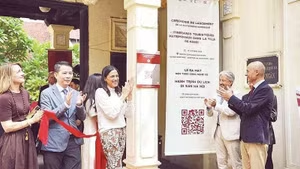
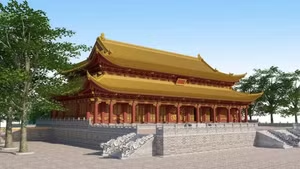
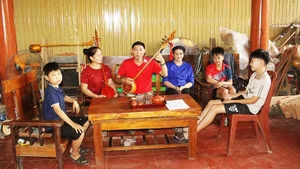
In education, models such as school theatre, traditional art workshops and experiential education programmes have initially proven effective in shaping aesthetic sensibilities and fostering cultural appreciation among the younger generation. Similarly, in urban spaces, integrating traditional artistic elements into architectural design and tourism products not only enriches spiritual life but also helps establish local brands, as seen in Ha Noi, Hoi An, Hue, and others. In the field of communication, the development of digital platforms opens up significant opportunities for traditional arts to reach wider audiences, while also placing higher demands on creativity and adaptability.
At the same time, traditional arts contribute to forming a “cultural immunity” for society. Amid increasingly strong waves of cultural exchange, without a sufficiently solid foundation, society can easily be swept along by fleeting trends and lose its core values. When the public, especially young people, are able to recognise and appreciate traditional values, this becomes a “soft shield” protecting identity in the process of integration. In socio-economic development, if properly cared for and effectively exploited, traditional art forms can become distinctive tourism products, create jobs, increase income for local people, promote local economic development, and become an important component in building and promoting the national brand.
More than merely “heritage”, viewed comprehensively, traditional arts have been and continue to create the depth of national culture. Long analysed that if “hard infrastructure” consists of institutions, policies and economic resources, then “soft infrastructure” comprises value systems, cultural memory and aesthetic identity. Competition among nations today is not only economic but also about image and cultural influence; a nation is truly strong only when it has a solid “soft infrastructure”. Traditional arts are one of the key pillars of that foundation. Folklore researcher Nguyen Hung Vi affirmed that, despite the complexities of global cultural acculturation, traditional arts will always remain the foundation for development, renewal and integration. When traditional arts truly become part of today’s rhythm of life, it is also evidence that the cultural lifeblood of the nation is being revived and enriched, creating endogenous strength for the future.