Pho Hien thrived from the 16th to the 18th centuries as a prosperous commercial port and an important trading centre for merchants from 12 nations. The legacy of the ancient trading port is still reflected in local architecture, religious practices, and the spiritual and cultural life of the people. In light of Hung Yen Province’s socio-economic development orientation, the heritage of Pho Hien requires systematic investment for comprehensive preservation and development in line with Politburo Resolution No. 80-NQ/TW on the development of Vietnamese culture.
The Pho Hien relic complex was recognised as a Special National Relic Site in 2014 and comprises 16 representative heritage sites.
Exceptional cultural value of the heritage
The Hung Yen Museum is currently displaying a large number of archaeological artefacts excavated over many years from archaeological sites within ancient Pho Hien. Numerous ceramic products made by Chinese and Japanese artisans discovered during excavations have confirmed the presence of foreign merchants who came to Pho Hien for trade and residence between the 16th and 17th centuries. More importantly, the cultural value of ancient Pho Hien is also reflected in valuable historical materials preserved in its ancient stele system.
Vu Nguyen Ly,
Deputy Director of the Hung Yen Museum
Deputy Director of the Hung Yen Museum Vu Nguyen Ly said that the museum is currently displaying a large number of archaeological artefacts excavated over many years from archaeological sites within ancient Pho Hien. Numerous ceramic products made by Chinese and Japanese artisans discovered during excavations have confirmed the presence of foreign merchants who came to Pho Hien for trade and residence between the 16th and 17th centuries. More importantly, the cultural value of ancient Pho Hien is also reflected in valuable historical materials preserved in its ancient stele system.
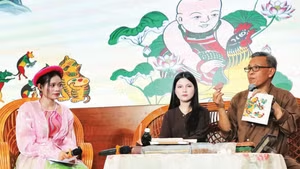
According to Deputy Director of the Hung Yen Department of Culture, Sports and Tourism Dao Manh Huan, many seminars have been held on the exceptional cultural value of ancient Pho Hien.
Experts, scholars, historians, and heritage managers have all affirmed the unique and comprehensive value of Pho Hien as a bustling international trading port from the 16th to the 18th centuries. The extensive body of historical and archaeological materials, along with the existing system of relics and cultural institutions, provides an important scientific basis for the restoration, reconstruction, and promotion of the heritage value of Hung Yen Province in the coming years.
Investment in preserving and promoting heritage values
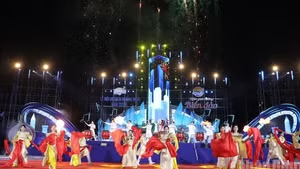
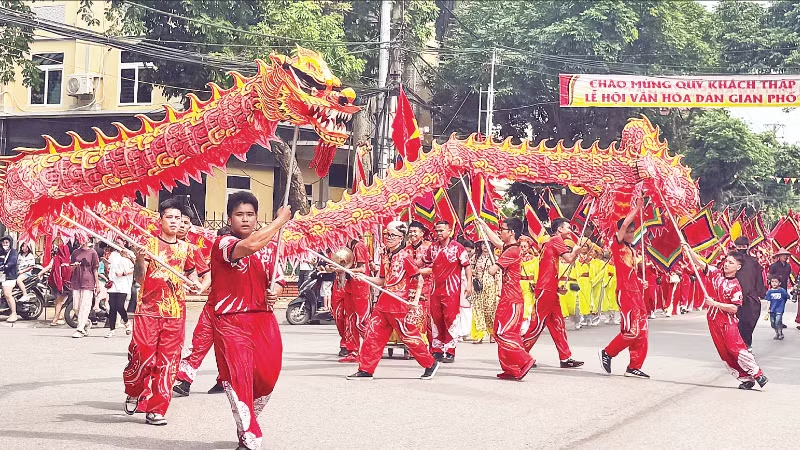
Director of the Hung Yen Relic Management Board Nguyen Thi Thu Huong said: “This year’s Pho Hien Folk Culture Festival has been upgraded to a provincial-level festival, demonstrating the province’s appropriate attention to promoting the exceptional cultural value of ancient Pho Hien. During the three-day festival, many cultural activities were organised in a professional and systematic manner. The festival welcomed more than 70,000 domestic and international visitors.”
According to Vice Chairman of the Hung Yen Provincial People’s Committee Pham Van Nghiem, Pho Hien today still preserves a rich system of relics, ancient religious and spiritual institutions, and many distinctive forms of folk culture. In recent years, the province has implemented numerous programmes and projects and allocated resources to restore and preserve relics within the Pho Hien Special National Relic Complex. The province is currently focusing on preparing and submitting for approval the project entitled “Investment in the Construction and Reconstruction of the Ancient Pho Hien Trading Port,” aimed at restoring the ancient urban space, reviving historical memories, and promoting the distinctive values of Pho Hien heritage.
On February 17, 2023, the Hung Yen Provincial People’s Council issued Resolution No. 341/NQ-HDND approving the investment policy for the restoration and conservation of the Pho Hien Special National Relic Site, with a total investment of 120 billion VND. To date, most of the relics have undergone restoration and conservation work.
Investment in preserving and promoting the cultural heritage value of Pho Hien in recent years has received significant attention from Hung Yen Province, generating positive results and contributing considerably to local socio-economic development.
However, restoration, conservation, and reconstruction efforts still face several limitations, including fragmented restoration work lacking overall coherence; the ancient cultural space of Pho Hien not yet being vividly recreated; limited integration between heritage, tourism, services, and the creative economy; some relics remaining underfunded and deteriorating; and although several enterprises have shown interest in investing in the ancient Pho Hien project, no large-scale project worthy of its significance has yet been approved.
Deputy Director of the Hung Yen Department of Construction Luu Van Duong said that the “Investment in the Construction and Reconstruction of the Ancient Pho Hien Trading Port” project is awaiting approval from competent authorities. The project covers nearly 1,709 hectares and has an estimated total investment of 47.421 trillion VND, including 19.608 trillion VND from the state budget and 27.813 trillion VND from mobilised capital sources.
Politburo Resolution No. 80-NQ/TW on the development of Vietnamese culture clearly states that investment in preserving, restoring, and promoting cultural heritage values must be integrated into sustainable development goals relating to the environment, culture, economy, and society, linked to community livelihoods, the formation of heritage cities, and the development of a heritage economy, thereby contributing to the completion of a cultural ecosystem.
In this spirit, the province hopes the project will attract interest and investment from major domestic and international enterprises so that the heritage of Pho Hien can be strongly preserved and promoted.