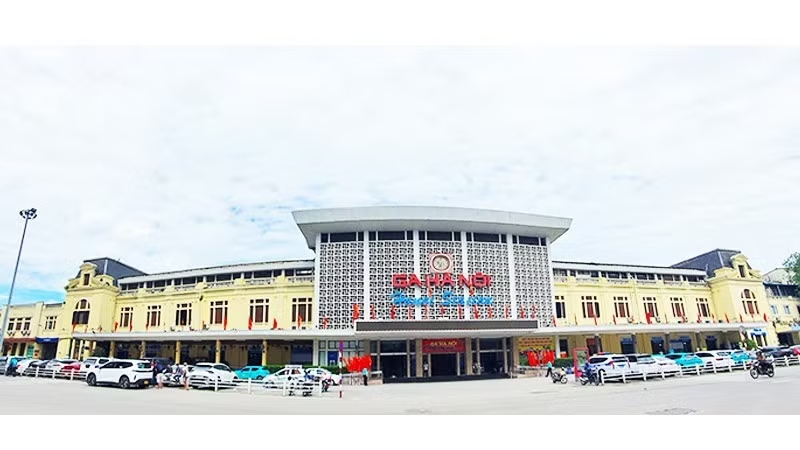
For more than 120 years, standing at the heart of the capital city, Ha Noi Railway Station has been more than a place where trains arrive and depart. Archival planning documents from the late nineteenth century reveal that the station’s location was a carefully considered choice within the development of modern urban infrastructure.
From railway tracks to an urban landmark
Before Ha Noi Railway Station took shape, railways had already been placed at the centre of infrastructure plans in Tonkin. Beginning with the Phu Lang Thuong–Lang Son railway line, which entered operation in 1894, the network was gradually extended towards Gia Lam, Dong Dang, and the Chinese border. To complete this connection, the administration of French Indochina approved the construction of a series of iron bridges across the Duong, Cau, Thuong, and Ky Cung rivers at the end of 1896.
Ha Noi Railway Station was one of the infrastructure projects along the railway route to the northern border. Within the railway network being established in Tonkin at the end of the nineteenth century, the station was not an isolated structure but formed part of a wider system of railways, iron bridges, and supporting facilities serving the Ha Noi–China border route. Its location should therefore be viewed within the broader context of a strategic transport corridor rather than as a standalone urban building. The technical plans were meticulously prepared by engineer Borreil and covered everything from bridges and tunnels to buildings along the route. It was through this collection of plans that Ha Noi Railway Station gradually emerged as a key link in the railway network being developed across Tonkin.
In 1897, Paul Doumer arrived in Indochina as governor-general. For Doumer, railways were a central component of his infrastructure development programme. In a report submitted to the Government of France on March 22, 1897, he identified railways alongside roads, seaports, and canals as essential public works. As a result, Ha Noi became integrated into a wider transport network connecting Tonkin with Annam, Cochinchina, the Chinese border regions, and other economic centres.
Within this broader vision, a central railway station in Ha Noi could not merely function as a departure and arrival point for trains. It had to serve as an intersection between the railway network and the city, linking regional transportation with a rapidly evolving urban landscape. Consequently, in April 1898, a committee was established to determine the station’s location. Four options were considered, centred around Gambetta Boulevard (now Tran Hung Dao Street), Mandarine Road (now Le Duan Street), and the racecourse area. Following a meeting on May 7, 1898, the option placing the centre of the station in line with Gambetta Boulevard was selected.
What is particularly noteworthy is that the station was not positioned as a technical facility on the urban fringe but was integrated into one of the most important spatial axes of the new district. From this location, Ha Noi Railway Station connected with boulevards, administrative quarters, and the French Quarter, becoming the gateway through which people, goods, mail, officials, and merchants entered and left the city.
Looking back, the decision to place the station on the Gambetta axis demonstrates that the railway was planned in close relationship with street layouts, urban functions, and future city expansion. As such, Ha Noi Railway Station grew to be more than merely a stopping point for trains, it became a significant element within the city’s overall structure.
An infrastructure landmark in today’s urban context
By the end of 1898, Ha Noi Railway Station had moved from planning documents to active construction. On September 15, 1898, the technical dossier was finalised and put out to tender, and on October 10 of the same year, the governor-general approved the selection of a contractor.
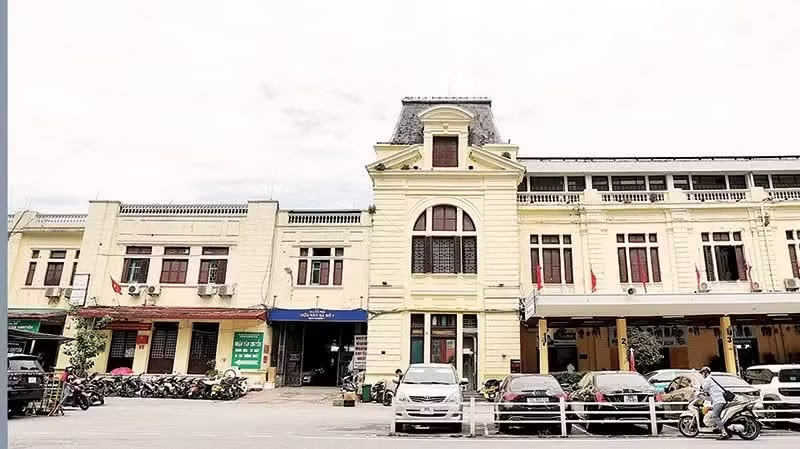
The station’s original architectural design incorporated several Asian-inspired elements, but it was later revised to feature a Mansard roof in the French style. By 1906, two symmetrical wings had been added, creating a more imposing appearance befitting a central railway station. This transformation not only reflected aesthetic considerations but also the way Ha Noi in the early twentieth century sought to shape public buildings within its emerging urban environment.
In November 1902, Ha Noi Railway Station was officially inaugurated during the tenure of Governor-General Paul Beau. From then on, it became an essential part of the city’s life as a major transport hub. The trains that passed through the station carried not only passengers, goods, and mail but also represented new patterns of movement within a rapidly changing Ha Noi.
Over more than a century of operation, the station has not remained entirely intact, yet it continues to play an enduring role in the life of the capital. From the Central Station of colonial Ha Noi to Hang Co Station in the memories of many generations, and later Ha Noi Railway Station after national reunification, the building has witnessed many of the city’s defining moments.
Associated with Many Layers of Urban Memory
The station witnessed soldiers departing for the front, wartime train journeys, the years of the centrally planned economy, and later continued serving as a vital passenger transport hub during the period of renewal and modernisation. The central building suffered severe damage during wartime, although the two architectural wings on either side still preserve part of their original appearance. This combination of loss and continuity means that the station’s value lies not only in its remaining architecture but also in the enduring vitality of a structure associated with multiple layers of urban memory.
The story of Ha Noi Railway Station also invites comparison with how cities around the world have treated historic transport infrastructure. In Paris, the Orsay railway station, designed by architect Victor Laloux and inaugurated in 1900 for the World Exposition, was once a major transport hub before becoming unsuitable for long-distance trains by 1939. After serving various functions and facing the possibility of demolition in the 1970s, the building was transformed into the Musée d’Orsay, which opened in 1986. This example offers an important lesson: preservation does not necessarily mean freezing a structure in time; it can also involve giving heritage a new purpose while respecting its architectural, historical, and cultural significance.
Today, as plans for reorganising railway space, developing the North–South high-speed railway and expanding urban rail networks continue to be discussed, the story of Ha Noi Railway Station once again raises important questions. Historical records from more than a century ago demonstrate that infrastructure decisions do not merely address the transport needs of a particular moment. They can have lasting impacts on urban space, daily life, and collective memory.
Viewed from this perspective, reflecting on Ha Noi Railway Station is not simply about looking back at an old railway station. It is also about revisiting a planning decision that helped shape modern Ha Noi and drawing lessons that may inform future urban development choices.
* Information compiled from archival documents from the French colonial period currently preserved at National Archives Centre No. 1 of Viet Nam and the French Overseas Archives.