Turning potential into value
In the tourism sector, cultural industries contributed only around 4-5% of GDP during the 2018-2025 period, while the target for 2030 is at least 7%. This is a gap that cannot be filled solely by the market’s natural growth momentum.
The report “Viet Nam’s Game Industry – Improving the Regulatory Mechanism to Unlock Development Potential” by the US-ASEAN Business Council points out a shortcoming: currently, around 80% of investment capital in Vietnamese start-ups has “flowed” into the hands of legal entities based in Singapore.
Meanwhile, according to the Viet Nam Animation and Visual Effects Association (VAVA), more than 60% of domestic animation and visual effects studios are participating quite deeply in international projects, mainly in outsourcing and post-production roles.
Although these figures do not represent the entire picture of the cultural industries, they nevertheless point to a reality that needs attention: Viet Nam has abundant creative resources and a market with great potential, however, the share of added value and property rights — considered the core components of any industry — is being dispersed.
Under the current legal system, fields such as cinematography, publishing, advertising, tourism, cultural heritage, and copyright are already regulated by separate laws. However, each law covers only a specialised field, while the cultural industries operate through an inter-sectoral value chain.
For example, a cinematographic work is not merely a story concerning filmmakers but also involves copyright, investment capital, technology, user data, the commercialisation of derivative products, and export potential.
According to the Ministry of Culture, Sports and Tourism, the drafting of the Law on Cultural Industries aims to promptly, fully, and consistently institutionalise the Party’s major guidelines on developing the cultural industries, and concretise the viewpoints, objectives, tasks, and solutions set out in Politburo Resolution No. 80-NQ/TW as well as Conclusion No. 18-KL/TW of the 2nd Plenum of the 14th Party Central Committee on the Socio-economic Development Plan, national finance and public debt borrowing and repayment, and the five-year medium-term public investment plan for 2026-2030.
Through the promulgation of the Law on Cultural Industries, the official legal status of the cultural industries within Viet Nam’s economic structure will be established.
The draft Law aims at three major objectives: establishing the position of the cultural industries within the economic structure; connecting value chains to increase economic value, exports, and investment attraction; and at the same time spreading Viet Nam’s identity, brands, and soft power internationally.
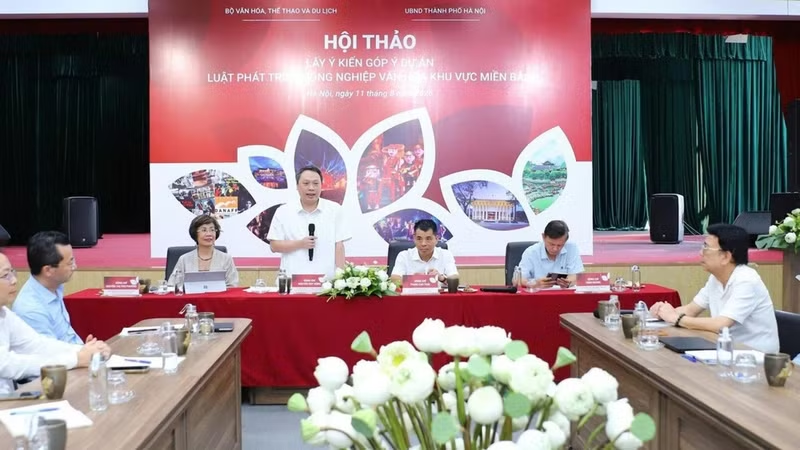
Pham Cao Thai, Director General of the Department of Legal Affairs under the Ministry of Culture, Sports and Tourism, assessed that this is a difficult and highly distinctive draft law: its scope of regulation extends across many sectors and many stakeholders, while the concept of “cultural industry development”, although it has appeared in Party resolutions, remains very new when incorporated into law.
Dr Nguyen Thi Quy Phuong, General Director of QP Viet Nam International Consulting Company, said that the cultural industries are a field where many disciplines intersect, each of which is already governed by separate laws, but there is still a lack of a convenient legal framework and an effective protection mechanism for intellectual property resources — the most fundamental resource of culture. Therefore, the introduction of the law at this time is necessary.
Sharing the same view, Nguyen Truong Son, Chairman of the Viet Nam Advertising Association, expressed strong support for the policy of developing the law, while proposing that the scope of regulation be expanded right in Article 1 by adding provisions on organising and implementing cultural industry development both within the territory of Viet Nam and overseas, in order to better align with the trend of integration and the ability to bring Vietnamese creative products and services to international markets.
Opening a “runway” for creativity to take off
The draft Law focuses on six major policy groups: the cultural industry ecosystem, intellectual property, human resources, infrastructure, markets, finance, and investment incentives.
Among them, the mechanism for exploiting intellectual property assets is a notable issue. The draft raises the issue of digitising the life cycle of assets, applying internationally compatible identification codes, and standardising records in digital form to serve identification, traceability, valuation, and transactions. Mechanisms for using intellectual property assets as capital contributions, collateral and for accessing credit are also addressed more specifically.
This is an issue of concern to many creative businesses because their largest assets may not be factories or machinery, but scripts, characters, brands, copyrights, designs, or intellectual products capable of generating revenue in the future.
Expert Huynh Phan Phuong Hoang, Deputy General Director of Vietravel, said that for the cultural industries to develop, there must be markets, capital, human resources, data, and experimental mechanisms.
The state needs to shift from direct support to market creation, establishing sandbox mechanisms (issuing a controlled experimental legal framework) for new models, and appropriately sharing risks between the state and businesses.
Around the world, many countries have focused on promulgating policies and legal regulations to create momentum for the development of the cultural industries.
Notably, the Republic of Korea enacted a framework law to promote the cultural industries in 1999. China, although it already has numerous subordinate legal documents for individual fields, is also currently developing a comprehensive law of a similar nature.
Japan, meanwhile, links the content industry with its national “soft power” strategy, coordinating consistently across ministries and sectors to support cultural exports. A common feature of these models is that the law opens a “runway” for creativity to take off, while policies continue to be measured and adjusted in line with market developments.
The drafting committee said that the biggest challenge at present is ensuring that the provisions of the law both intersect and connect with, while not overlapping, the existing system of specialised laws.
This challenge has become even more urgent as the cultural market rapidly shifts to the digital environment, where a creative product in one country can be distributed through a platform hosted on servers in another country and reach millions of Vietnamese users almost instantly.
Competition takes place between products themselves and between ecosystems that own technology, data, and distribution channels.
Experts analyse that protecting the domestic cultural industries does not mean erecting barriers against foreign products but rather ensuring ownership of intellectual property, the rights of creators, and opportunities for Vietnamese products to reach the public through effective distribution channels before confidently entering international markets.
The greatest value of the Law on Cultural Industry Development, if enacted in the spirit of creating an enabling environment, will lie in its ability to create seamless connectivity from cultural resources to creativity, from creativity to assets, from assets to markets, and from markets back to nurturing the culture that has produced those values.