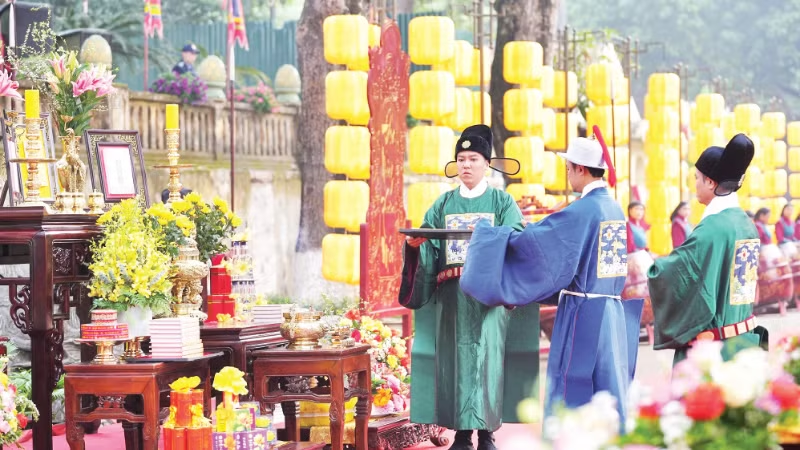
Despite the scarcity of historical records, scholars have worked tirelessly to rediscover Thang Long ancient ceremonies and music and gradually restore many traditional cultural practices, thereby contributing to the development of the cultural industries.
Efforts to revive former elegance
Although only the solar term Lap Ha (Beginning of Summer) has just arrived, the Thang Long–Ha Noi Heritage Conservation Centre has already begun preparations for activities celebrating the Doan Ngo Festival, commonly called “Tet giet sau bo” (pest-killing festival). Among the royal ceremonies of the past, the Doan Ngo Festival was one of the major seasonal observances, organised meticulously by the imperial court. It served as a reminder for people to protect their health and was also an occasion for the king to bestow fans as blessings upon mandarins and the people.
The Doan Ngo Festival at the Imperial Citadel of Thang Long encompasses various activities, with the most intricate being the royal rituals related to presenting fans to the king and the king granting fans to court officials. To recreate these ceremonies as authentically as possible, those assuming the roles of court mandarins must undergo extensive rehearsals before presenting the rituals to the public.
Nguyen Thanh Quang, Director of the Thang Long–Ha Noi Heritage Conservation Centre, said: “The Ha Noi authorities have committed to UNESCO to preserving and promoting intangible cultural heritage values alongside the tangible heritage values of the Imperial Citadel of Thang Long. The Centre has researched numerous ceremonies and court activities, successfully restoring and experimentally recreating rituals such as the Cung tao quan (Kitchen Gods Worship) Ceremony, the Thuong tieu (Pole-Raising) Ceremony, the Tien Xuan Nguu (Spring Buffalo Offering) Ceremony, the Tien lich (Royal Calendar Presentation) Ceremony, the Khai Ha (going to the fields) Festival, and the Ceremony of Offering Gifts and Bestowing Fans during the Doan Ngo Festival. More recently, the Centre successfully restored the Changing of the Guard Ceremony at the citadel gates."
The Ha Noi authorities have committed to UNESCO to preserving and promoting intangible cultural heritage values alongside the tangible heritage values of the Imperial Citadel of Thang Long. The Centre has researched numerous ceremonies and court activities, successfully restoring and experimentally recreating rituals such as the Cung tao quan (Kitchen Gods Worship) Ceremony, the Thuong tieu (Pole-Raising) Ceremony, the Tien Xuan Nguu (Spring Buffalo Offering) Ceremony, the Tien lich (Royal Calendar Presentation) Ceremony, the Khai Ha (going to the fields) Festival, and the Ceremony of Offering Gifts and Bestowing Fans during the Doan Ngo Festival. More recently, the Centre successfully restored the Changing of the Guard Ceremony at the citadel gates.
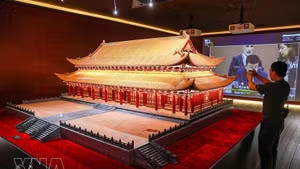
The Imperial Citadel of Thang Long has increasingly affirmed its stature as a World Heritage Site through research, conservation, utilisation, and promotional activities, and has been recognised by UNESCO as a model for heritage preservation. UNESCO has also approved Ha Noi’s plan to restore Kinh Thien Palace, the royal court space of the Le Dynasty. However, tangible heritage values represent only “half of the picture.”
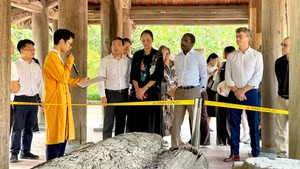
Professor Nguyen Quang Ngoc, Vice Chairman of the Viet Nam Association of Historical Sciences, noted that throughout a thousand years of history, countless court activities and royal ceremonies took place within these palaces. Researching, introducing, and restoring royal rituals and courtly life is therefore essential, as they represent the very soul of the heritage and offer the public deeper insight into the cultural values of the ancient royal court.
Viet Nam is home to several ancient capitals, yet the intangible cultural heritage of royal courts has survived mainly in Thang Long and the former imperial capital of Hue. However, after Thang Long lost its status as the national capital in the early 19th century, its court rituals also gradually disappeared. The scarcity of documentary sources on royal ceremonies and court life has made research into Thang Long’s intangible court culture an extremely challenging undertaking.
Overcoming these obstacles, scientists have sought materials from multiple sources, painstakingly “piecing together” fragments to gradually form a more complete picture. The Tien Xuan Nguu (Spring Buffalo Offering) ritual is one of the most representative examples.
As one of the researchers directly involved in studying and restoring the ritual, Master Dinh Thi Nguyet explained: “The Tien Xuan Nguu ceremony was particularly important, bearing both royal and folk characteristics as it became a major festival for the people of the imperial capital. The ritual symbolised the farewell to winter and the welcoming of spring. At the same time, the procession of the buffalo and the Than Cau Mang (God of Spring and Wood) embodied the spirit of encouraging agricultural production. The imagery of Than Cau Mang and the Spring Buffalo was highly intricate and elaborate, yet documentary sources were extremely limited. The Centre conducted extensive research, comparison, and cross-referencing of various materials from the Le Dynasty, foreign documents, Nguyen Dynasty records, and sources from several foreign countries with shared cultural traditions. It also applied the Nguyen Dynasty feng shui ruler system for measurements, while drawing on the principles of the Heavenly Stems, Earthly Branches, yin-yang, and the five elements to reconstruct the images of the Spring Buffalo and Than Cau Mang. These pieces of the puzzle enabled the Centre to restore the ceremonies in a manner as historically accurate as possible, winning strong support from scientists.”
After completing the documentary research, the Thang Long–Ha Noi Heritage Conservation Centre worked with the Thang Long Cultural Heritage Association and several theatres to rehearse and reconstruct the ritual before introducing it to the public for the first time in 2019.
This approach has also been applied by the Centre to restore several other rituals amid limited historical documentation. In addition to domestic historical records, accounts and illustrations left by Western merchants and missionaries have also provided valuable source materials.
Boosting cultural industry
Beyond their architectural and artistic values, communal houses and temples also derive significance from their spiritual and cultural activities, the deities they worship, and the associated rituals and ceremonies. Likewise, for towers, palaces, and royal buildings, without intangible cultural values, even the most magnificent structures would become soulless monuments. Many countries around the world have transformed restoration activities into cultural industry products. A notable example is the Republic of Korea, where the changing-of-the-guard ceremony at Gyeongbokgung Palace in Seoul has become a daily attraction eagerly anticipated by tourists.
In Viet Nam, a number of restored royal ceremonies in the former imperial capital of Hue have already been incorporated into tourism activities. At the Imperial Citadel of Thang Long, the recreation of court rituals has likewise become an occasion attracting large numbers of visitors and local residents, particularly during major traditional festivals such as the Lunar New Year, the Doan Ngo Festival, and the Mid-Autumn Festival. Several of these activities have gradually become closely associated with the image of the Imperial Citadel of Thang Long.
The restoration of heritages not only helps local people and visitors gain a deeper understanding of Thang Long–Ha Noi’s culture and history but also breathes new life into the heritage itself. Programmes recreating intangible cultural heritages through theatrical performances have generated significant tourism appeal for the Imperial Citadel of Thang Long Heritage Site, contributing to bringing the heritages closer to the public.
Associate Professor and Dr Tran Duc Cuong, President of the Viet Nam Association of Historical Sciences, stated: “The restoration of heritages not only helps local people and visitors gain a deeper understanding of Thang Long–Ha Noi’s culture and history but also breathes new life into the heritage itself. Programmes recreating intangible cultural heritages through theatrical performances have generated significant tourism appeal for the Imperial Citadel of Thang Long Heritage Site, contributing to bringing the heritages closer to the public.”
Due to various challenges, the Thang Long–Ha Noi Heritage Conservation Centre has so far mainly restored and experimented with several ceremonial activities from the Later Le Dynasty period. However, the treasury of Thang Long’s court culture still contains many other rich and diverse traditions, with each dynasty possessing its own distinctive characteristics. Examples include sacrificial rituals such as ceremonies at the Nam Giao Esplanade, the Xa Tac Altar, and the Imperial Ancestral Temple.
There are many other ceremonies such as royal enthronement rites, imperial decree conferments, receptions for foreign envoys, palace examinations, and reward ceremonies for newly successful doctoral laureates. If comprehensively restored, these rituals and ceremonies could become a powerful “magnet” for tourism.
Recently, the Ha Noi Municipal Party Committee issued Action Programme No. 08-CTr/TU to implement Politburo Resolution No. 80-NQ/TW dated January 7, 2026, on the development of Vietnamese culture. Among its key priorities is the restoration of Kinh Thien Palace within the Imperial Citadel of Thang Long, scheduled for implementation before 2030.
Nguyen Viet Chuc, Director of the Thang Long Culture Research Institute, said that research and restoration of Thang Long’s royal intangible cultural heritage still lag behind work on tangible heritage values. The need to revive Thang Long’s royal intangible cultural heritage has therefore become increasingly urgent, so that when Kinh Thien Palace and several other structures are restored, corresponding intangible cultural heritage values can also be presented to the public.
To further improve efforts to rediscover Thang Long ancient ceremonies and music, Professor and Dr Le Hong Ly, President of the Viet Nam Folklore Arts Association, proposed that it is essential to conduct systematic and methodical research into the Imperial Citadel of Thang Long, while compiling and systematising cultural materials from official records, missionary accounts, and folk sources alike.
On the basis of such research and collection efforts, suitable activities can then be selected for restoration and reconstruction. What is needed here is experimentation without excessive perfectionism, proceeding gradually in line with conditions at each stage and then refining and supplementing over time. Certain rituals and ceremonies should be fully utilised for the development of tourism in particular and the cultural industries in general.