Removing the “bottlenecks” in remuneration mechanisms is not only the aspiration of artists themselves, but also an urgent requirement to nurture and stimulate creative capacity.
Hardships of the profession
Having devoted 23 years to the profession, Meritorious Artist Loc Huyen is one of the prominent faces of Viet Nam’s tuong theatre stage. However, she still has to seek additional sources of income through teaching singing, performing, hosting events, composing, and directing epic and festival programmes in order to cover daily living expenses and continue pursuing her artistic passion.
Huyen said that, compared with many other performing arts, tuong theatre has many distinctive characteristics because it is highly symbolic, stylised and integrated. Performers have to endure extremely demanding physical labour, sometimes maintaining strenuous stances for hours during performances, carrying multi-layered armour weighing more than ten kilograms while singing, dancing and performing martial arts for extended periods. Many artists suffer problems with knee joints, the spine and vocal cords, yet the income from the profession is far too low to ensure daily living expenses amid rising prices.
Meritorious Artist Quang Khai from the Cai Luong Art Troupe under the Viet Nam National Traditional Theatre said that although he has been in the profession for more than 25 years, his monthly income as a third-rank performer, including salary, position allowance and hazardous performance allowance, amounts to only a little over ten million VND. For those who must rent accommodation or support children and family members, such income is extremely difficult to live on without taking on additional part-time jobs.
He said that the current allowance regime has become outdated, as the highest payment for a leading actor is only 200,000 VND per performance, while the highest rehearsal allowance is only 80,000 VND per session. The amounts allocated to secondary roles, supporting actors and backstage staff are even lower. Inadequate remuneration has also reduced the attractiveness of the profession. For many years, art schools have struggled to recruit students to study traditional arts, resulting in a shortage of young successor generations.
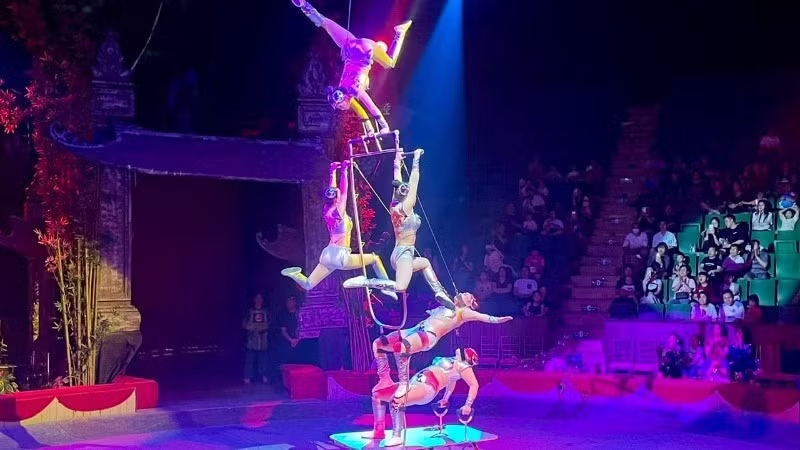
For circus artists, most of whom are fourth-rank performers, salaries of only a few million VND per month make the journey of preserving the profession even harsher. According to People’s Artist Tong Toan Thang, Director of the Viet Nam Circus Federation, artists wishing to move up to the third rank are required to pursue university studies. In reality, however, not everyone can afford the cost of education. Moreover, circus arts have a short career span, so during their peak years, most artists focus entirely on dedicating themselves to the profession. Meanwhile, this field requires rigorous training and constant exposure to accidents and occupational risks.
It is precisely the imbalance between the strict demands of the profession and the level of remuneration that has gradually eroded artists’ motivation to remain in the profession.
Many young artists, despite being highly talented, are forced to reluctantly leave the profession or accept taking on all kinds of outside work during the daytime just to continue shining on stage at night. The consequence of this situation is a “brain drain” and the risk of creating a gap in successor generations, affecting creative quality and the sustainable development of the arts.
Creating a “boost” through policy
In light of these long-standing shortcomings, the introduction of new provisions on remuneration policies in the Resolution on the Development of Viet Namese Culture, recently adopted by the National Assembly on April 24, 2026, is expected to create positive changes. The Resolution officially takes effect from July 1, 2026. Accordingly, public employees and workers engaged in specialised professional activities in public performing arts units and performing arts units under the armed forces are entitled to occupational preferential allowances and rehearsal and performance allowances until the implementation of the new salary regime.
Specifically, occupational preferential allowances range from 40% to 60% of the current salary, applicable to traditional arts, classical arts, circus arts and difficult, remote and isolated areas. In addition, rehearsal allowances range from 5% to 15% of the basic salary for each rehearsal session; and performance allowances range from 15% to 30% of the basic salary for each performance. Furthermore, the State will also support retraining costs for public employees in traditional arts, circus and dance fields who, after reaching retirement age for their profession, wish to study in order to change job positions.
This is considered an important step forward in remuneration policy, bringing great excitement and expectations to artists. Meritorious Artist Tran Quang Khai believes that this mechanism will significantly improve artists’ actual income, thereby encouraging creativity, dedication and increasing the attractiveness of the profession for younger generations.
From the perspective of managing an artistic unit, People’s Artist Le Tuan Cuong, Acting Deputy Director of the Viet Nam National Traditional Theatre, said that training artistic talents has long been difficult, while retaining them is even more challenging, especially as traditional and classical arts face intense competition from other forms of entertainment. Therefore, increasing allowances and benefits serves as a major encouragement, helping artists devote themselves to creative work with peace of mind. This is also regarded as an important policy decision supporting the revival of the nation’s traditional culture and arts.