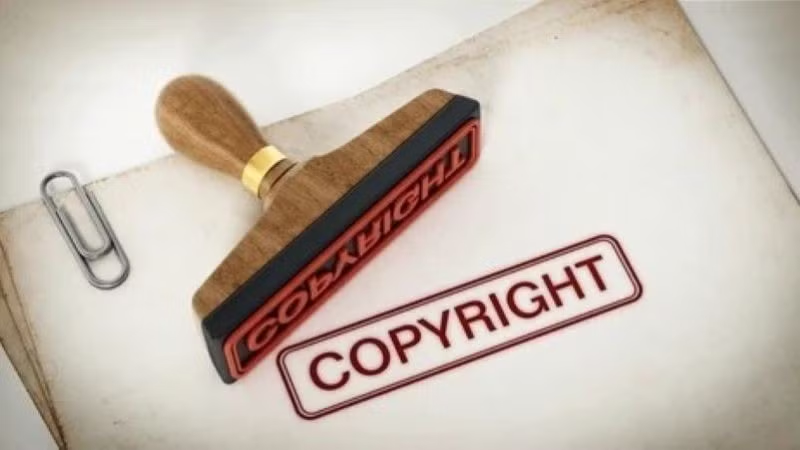
In recent years, from music to painting to photography, an increasing number of young artists have proactively studied legal frameworks, registered copyrights for their works, and protected their intellectual achievements as an essential part of their professional journey.
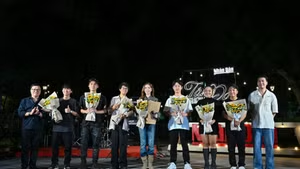
After more than 10 years of working in the arts, from live performances to online releases, singer Giang Pham (real name Pham Huong Giang, born in 1993) has observed that many independent artists have suffered disadvantages due to a lack of understanding of copyright and related rights. Drawing from her personal experience, in November 2024, she founded the Ha Noi Jam community, which is both a music playground and a space for connection and knowledge sharing. So far, more than 100 independent artists, mostly from Gen Z and based in Ha Noi, regularly participate, exchanging experiences on legal music distribution, contract interpretation, and revenue sharing on digital platforms.
According to Giang Pham, registering works with competent authorities, such as the Viet Nam Centre for Protection of Music Copyright (VCPMC), provides artists with a solid legal foundation in the event of disputes. Many Ha Noi Jam members said that by actively learning and mastering concepts and legal provisions of copyright, they no longer feel hesitant when signing contracts or collaborating with distribution partners.
Another example is the young music group Minh Toc and Lam, who believe that copyright should not be left only to lawyers or management companies. From the early stages of forming their idea in 2019, the group completed copyright registration, even though their music video was only officially released in 2025. After release, they continued to monitor usage on digital platforms. When signs of infringement were detected, they publicly disclosed the information and called on fans to report violating content. This transparent and decisive approach shows that young artists are no longer choosing silence in the face of unauthorised use.
It is noteworthy that copyright registration procedures have now become more accessible, enabling many independent artists to complete applications themselves. Seminars, training sessions, and specialised workshops on legal aspects in the arts are being organised regularly, providing creators access to official information. With a clear understanding of their rights and obligations, artists can proactively prevent risks rather than only dealing with consequences.
From an economic perspective, copyright is not only a protective tool but also a financial resource. Revenue from royalties helps artists to reinvest in new works, produce music videos, organise performances, apply modern technologies, and expand services for audiences. When financial flows are transparent and stable, the creative process is better sustained.
At the same time, the development of global digital platforms has opened opportunities to reach international audiences. From previously little-known “gateways”, artists now have additional revenue streams and can promote their image more widely. Tao Minh Hung, representative of the International Federation of the Phonographic Industry (IFPI) in Viet Nam, said that many domestic and international companies now support artists in distributing products on livestream platforms and promoting their work.
These organisations possess technological ecosystems capable of identifying, exploiting, and protecting copyrights effectively. However, these transactions directly relate to long-term interests, therefore, artists need to equip themselves with legal knowledge or consult experts to safeguard their legitimate rights.
Beyond music, photography — an area particularly vulnerable to online copying — has also seen a clear shift in awareness among young photographers. In the past, unauthorised use or modification of images was difficult to detect, and legal action was often complex and time-consuming, discouraging many photographers. Today, the situation has been improved.
More and more photographers are registering copyrights with the Copyright Office, applying watermarks, preserving metadata/EXIF data, and securely storing original files. They also utilise digital tools to monitor image usage and promptly detect violations.
In Da Nang, the Photography and Application Cooperative, which was established by a group of young artists from the Central region, represents a new model. Photographer Huynh Van Truyen, a founding member, said that the cooperative aims to build a copyrighted image database, combining AI, VR/AR technologies, and digital transformation to enhance both commercial and artistic value, while also providing legal support for members in the process of creation and distribution of works.
In the fields of painting and graphic design, forums for young artists with hundreds of thousands of members are actively sharing knowledge about digital copyright. Measures are widely shared, including registering works with authorities, storing original files (layers, sketches), using digital signatures and blockchain technology, and publishing works with clear copyright information. Many artists choose to upload low-resolution versions online and establish detailed contractual agreements to prevent clients from exceeding permitted usage, while also monitoring infringements to ensure they are dealt with in a timely manner.
In the world, in countries with developed cultural industries, copyright is considered a core factor promoting creativity. Systems for content identification, revenue sharing, and penalties for infringement are strictly enforced in cyberspace. Meanwhile, as artificial intelligence (AI) can replicate images, sounds, and even artistic styles in a short time, the need to protect human intellectual achievements has become increasingly urgent. Although legal systems vary across countries, the common principle remains transparency in ownership and clarity in usage agreements.
As Vietnamese artists enter an international market shaped by digital platforms, they carry not only their works but also the professional image of the nation’s culture. Awareness of respecting and protecting copyright is therefore no longer solely the responsibility of lawyers or management agencies, but a direct right and obligation of each artist. When creators understand and respect their intellectual labour values, the artistic environment becomes healthier, encouraging innovation and contributing to building a strong, integrated, but distinctive Vietnamese cultural industry.