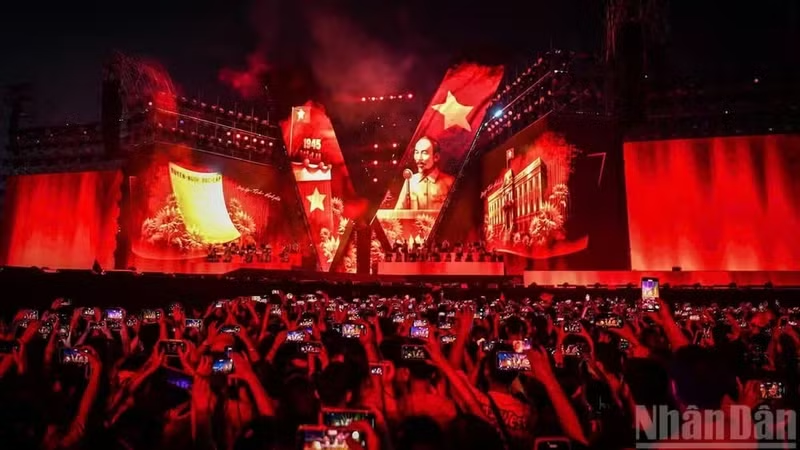
Music concerts, creative festivals, live shows, films, and reality television programmes have generated substantial revenues, contributing to shaping the national cultural brand and strengthening Viet Nam’s position on the international stage.
However, Viet Nam’s cultural industries have not developed in line with their potential and failed to form a sufficiently strong ecosystem to generate sustainable value and long-term influence. One of the main reasons identified is the lack of a legal framework that is both comprehensive and tailored to the specific characteristics of the sector.
Although Viet Nam has adopted the Strategy for the Development of Viet Nam’s Cultural Industries to 2030, with a vision to 2045, the institutional framework for cultural industry development remains scattered in different sector-specific laws and under the management of different State agencies. The absence of a unified coordination mechanism as well as tools to encourage investment, cooperation, and human resource development in the cultural industry sector, continues to create barriers to the creation, exploitation, and commercialisation of cultural products.
For this reason, many experts have called for the development of a Law on Cultural Industries, drawing on both the practical requirements of the sector and lessons learned from countries with well-developed cultural industries.
Recently, during a working session with the Ministry of Culture, Sports, and Tourism, Prime Minister Le Minh Hung directed relevant agencies to urgently build a Government Resolution on the development of Viet Nam’s cultural industries and to study to build a draft Law on Cultural Industries for submission to competent authorities.
The Politburo’s Resolution No. 80-NQ/TW dated January 7, 2026, on the development of the Vietnamese culture, also emphasises the task of focusing on building laws on artistic activities, literature, copyright, and cultural industries in a creative manner that unlocks resources for cultural development.
Cultural industries encompass a wide range of creative sectors and involve numerous specialised laws, including those related to intellectual property, tourism, cultural heritage, advertising, taxation, and e-commerce. Therefore, the drafting of a Law on Cultural Industries must ensure consistency and compatibility with the existing legal system, avoiding overlaps as well as overly general provisions that would be difficult to implement in practice.
The law should reflect the State’s creative role, helping pave the way for policies that support the development of cultural industries, integrate mechanisms to attract resources, particularly in fields such as public-private partnerships, tax incentives, land-use policies, human resource training, the establishment of creative support funds, and assistance for the export of cultural products.
Alongside measures to encourage and promote creativity, the law should also provide effective mechanisms for protecting cultural products, particularly in terms of copyright, thereby ensuring a fair and transparent environment for creative activities.
Along with specific regulations tailored to the unique characteristics of each industry, the law also needs to demonstrate leadership with the necessary openness to adapt to changes in technology and digital content, thereby creating a broad space for innovation.
With the cultural industry — a dynamic field rich in creative potential — if "paved the way" by a sufficiently strict and open legal framework, it will create genuine growth, contributing to the formation of a civilised cultural market with sustainable values and rich identity in the flow of integration.