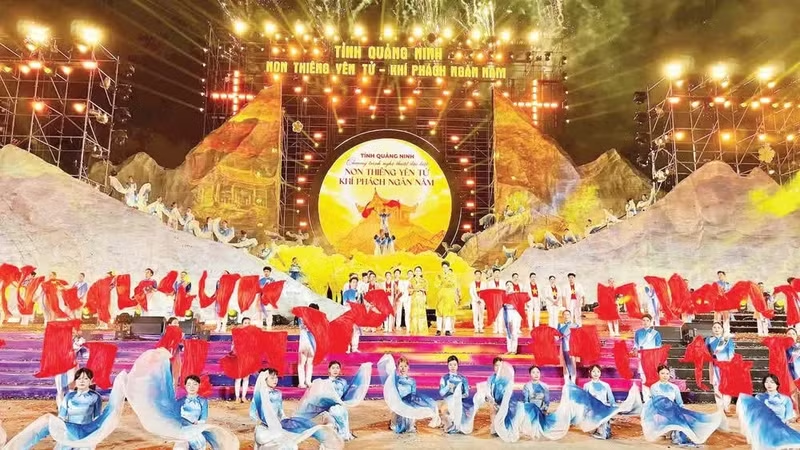
Recognising its core values as the foundation for a new development model, Quang Ninh Province is striving to transform Yen Tu into a unique heritage city – one where heritage values are preserved, promoted and harnessed as a driving force for sustainable development.
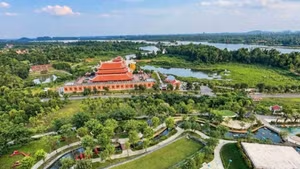
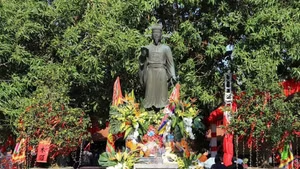
Over many centuries, Yen Tu has been regarded not only as the cradle of Vietnamese Buddhism, but also as a unique historical and cultural landscape closely associated with the Tran Dynasty and the lasting spiritual legacy of Dai Viet civilisation. Majestic, sacred and mystical, Yen Tu is considered a hallowed land, where breathtaking natural scenery meets millennia of accumulated historical and cultural heritage.
In July 2025, the Yen Tu-Vinh Nghiem-Con Son-Kiep Bac complex of monuments and landscapes was inscribed by UNESCO as a World Cultural Heritage Site, marking a significant turning point. This milestone has opened a new phase of development while also raising the bar for the preservation and promotion of heritage values alongside the pursuit of sustainable development.
Bui Hoang Giang, Secretary of the Yen Tu Ward Party Committee, stated: “The locality identifies heritage preservation and development as the cultural cornerstone; heritage economy as the driving force; and people and nature as the centre of sustainable development. Accordingly, Yen Tu will be developed into a city of heritage – by heritage, for heritage, with heritage and through heritage – aiming to become a model heritage city of Viet Nam, the region and the world, worthy of its status as an ancient sacred land.”
Professor Nguyen Quang Ngoc, Vice Chairman of the Viet Nam Association of Historical Sciences, noted: “In the long term, Yen Tu should be developed into a heritage city with a broad vision befitting its exceptional value, while ensuring the steadfast preservation of heritage as the soul of the city. It should not be confined to the boundaries of an administrative unit, but rather developed with a vision matching its unique significance. This requires comprehensive, balanced and sustainable solutions in both conservation and development, avoiding any negative impacts on the heritage in order to safeguard its integrity and truly establish a heritage city.”
Yen Tu Ward enjoys a particularly favourable geographical position, bordering Hai Phong City and Bac Ninh Province, with strong connectivity to Ha Noi. This opens up significant potential for it to become a new engine of growth for the province and the wider region. Developing a heritage urban model aligned with international standards is therefore of great importance not only for Yen Tu Ward and Quang Ninh Province, but for Viet Nam as a whole.
Kavivath Chhay, Creative Director of Viet Nam Heritage and Museum Solutions Company, commented: “Building a brand for Yen Tu heritage requires a thoughtful and distinctive approach. It is essential to integrate urban planning with the development of tangible heritage products. However, this also presents major challenges, as the site holds profound significance for Viet Nam’s identity, carries special religious importance, and offers tourism potential unmatched by any other site in the country.”
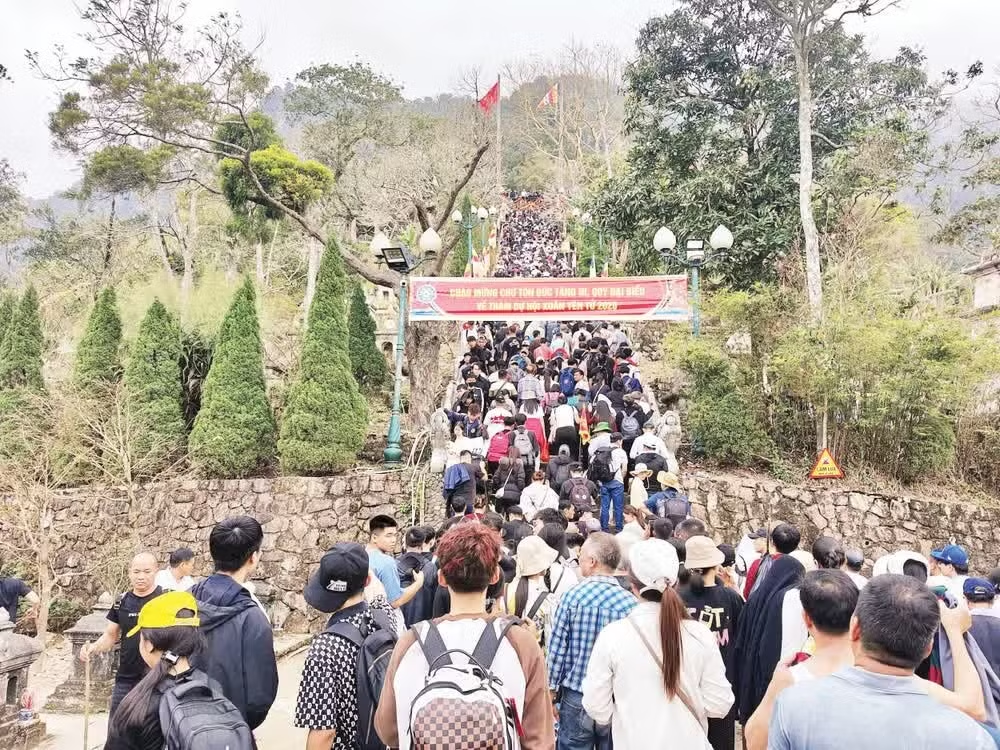
Drawing on a shared understanding of Yen Tu as a living heritage space where historical, cultural, spiritual and ecological values converge, experts have focused on shaping an integrated development framework. This approach places heritage, knowledge and creative experience at the centre, connected to the Dong A Heritage Corridor, which serves as a continuous axis of historical, cultural and creative connection. Together, these will form the foundation for a large-scale “living museum”, a space where heritage is not only preserved but also interpreted, shared and continually renewed in contemporary life.
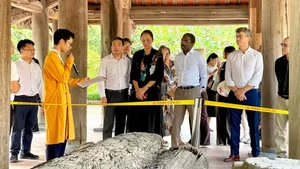
Professor Emeritus Shigeru Satoh of Waseda University emphasised that Yen Tu, as the nucleus of the local heritage corridor, must develop into a heritage city in close adherence to UNESCO recommendations. This will not only help preserve heritage values but also provide the impetus for its sustainable development.
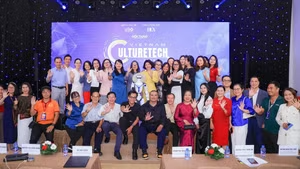
At the recent scientific conference titled “Expert Consultation on the Orientation for Developing Yen Tu Heritage City”, scientists, experts and local authorities set out their shared visions and objectives for building Yen Tu into an international heritage city by 2045, while also advancing efforts for UNESCO to honour Tran Nhan Tong as a figure of world cultural significance by 2058.
The overarching goal is to develop the greater Yen Tu-Dong Trieu-Bach Dang-Quang Yen area into a model symbiotic heritage urban system for Viet Nam and Southeast Asia, one where the preservation of outstanding universal value is closely linked with socio-economic development within a sustainable, distinctive and well-governed ecosystem
Experts believe that, to achieve this, it is essential to develop a UNESCO-compliant management plan for the Yen Tu-Vinh Nghiem-Con Son-Kiep Bac World Heritage complex; establish regulations governing architecture, landscape and heritage urban spaces; and build a green, multimodal, inter-regional transport system
With clear strategic direction, a systematic approach, and consensus among managers, experts and communities, the pathway to transforming Yen Tu into a unique heritage city is no longer merely an aspiration but is gradually becoming a tangible and well-grounded reality. In this vision, heritage is no longer just a “memory of the past”, but a living foundation that guides development, nurtures cultural and creative spaces, and projects its values to the world.
Professor Nguyen Van Kim, Vice Chairman of the National Cultural Heritage Council, remarked: “Building a heritage city does not mean creating a dense urban area, but rather establishing a cultural space in which heritage can thrive. It is therefore essential to properly identify and leverage the heritage’s distinctive assets and potential, and to develop the city on the principle of strict protection of its core zone. A heritage city can only succeed if it generates development outcomes that are uniquely superior to those of other heritage sites.”
Developing Yen Tu into a unique heritage city will not only preserve and promote the distinctive cultural values of Quang Ninh, but also offer a new development model for Viet Nam, one where culture, people and nature coexist at the heart of a sustainable ecosystem. In this way, Yen Tu will become not only a destination for pilgrimage and tourism, but also a hub of knowledge, creativity and inspiration: a heritage city of enduring global value and influence.