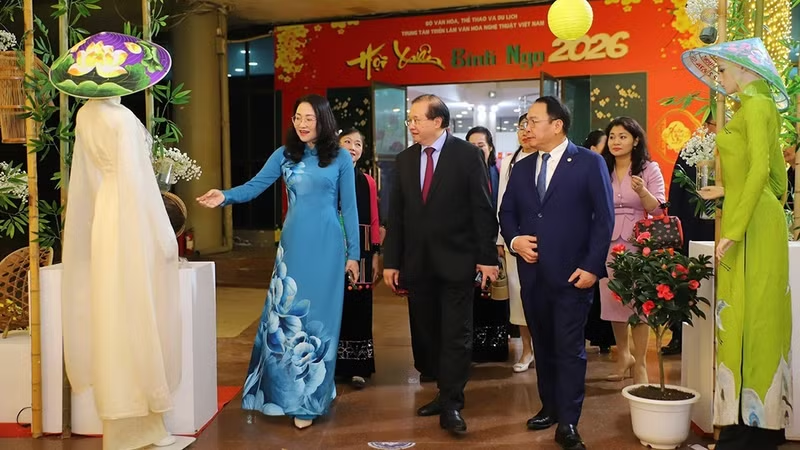
Q: In the context of implementing Resolution No. 80-NQ/TW on the development of Viet Nam’s culture, could you share the Centre’s main content orientation in organising the series of exhibitions and cultural festivals in 2026?
A: Established in 1958, originally named the Exhibition and Preservation Department, Museum, now the Viet Nam National Exhibition Centre for Culture and Arts, after nearly 70 years of formation and development, the Centre has successfully fulfilled its assigned tasks across different periods: disseminating the Party’s guidelines and policies, the State’s policies, serving the cause of national construction and defence, preserving and promoting the nation’s cultural heritage, creating spaces and environments for cultural and artistic exchange domestically and internationally, honouring and introducing the image of the country and people, and promoting Viet Nam’s tourism potential.
Especially after the Politburo issued Resolution No. 80-NQ/TW on cultural development, which emphasises the requirement to “build and develop an advanced Vietnamese culture imbued with national identity, becoming an endogenous strength and a driving force for national development”, the Centre has further clarified its role and responsibility as a national cultural institution in organising exhibition and promotional activities, contributing to bringing the Party’s guidelines into practical life, enriching, diversifying, making more vivid and refreshing the forms of introducing the image of the country and people, and contributing to enriching Viet Nam’s cultural identity.
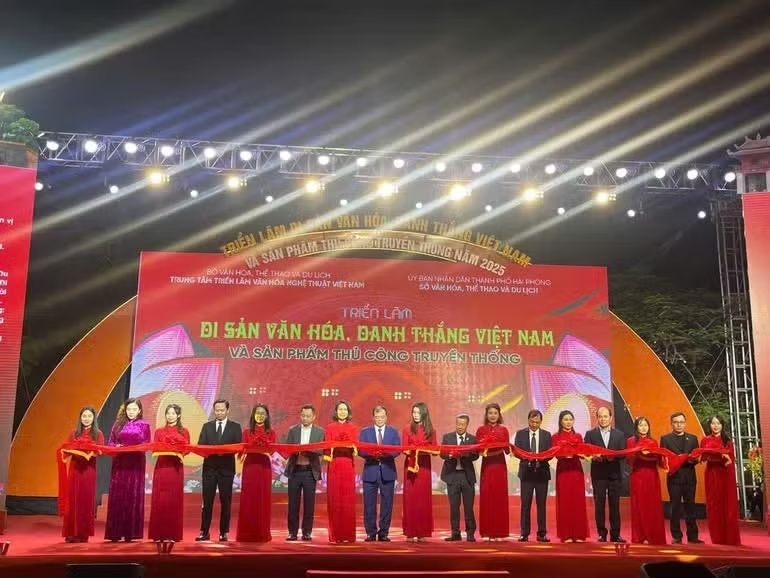
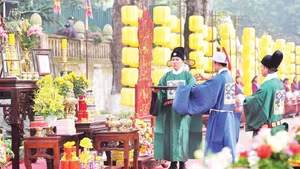
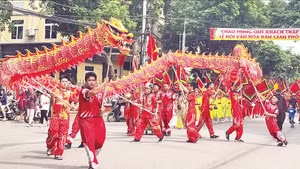
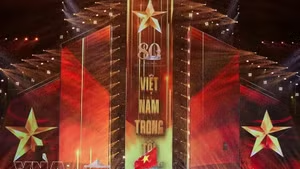
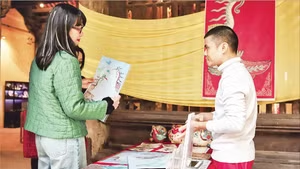
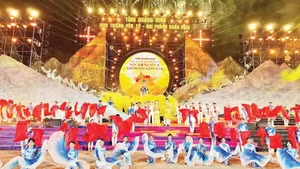
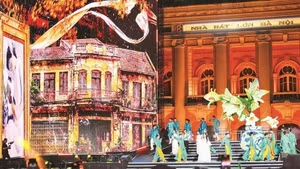
In 2026, the Centre will implement its activity plan with focus and key priorities aligned with the country’s political tasks, while ensuring systematic, connected, convergent and widespread impact. The series of activities is designed comprehensively, from early-year events such as the exhibition “The National Assembly of Viet Nam - 80 years accompanying the nation” commemorating the 80th anniversary of the first general election of the National Assembly of Viet Nam (6 January 1946 - 6 January 2026); the Lunar Spring Festival of the Year of the Horse 2026 enhancing cultural exchanges with the participation of representatives from ASEAN embassies and cultural centres of Japan, the Republic of Korea and India; the Viet Nam Tet Cultural Space introducing distinctive cultural features of Viet Nam, serving the Prime Minister Pham Minh Chinh in hosting diplomatic delegations on the occasion of the Lunar New Year, to thematic exhibitions organised nationwide to honour cultural heritage and promote the image of the country and people of Viet Nam such as: the commemorative exhibition “80 years since President Ho Chi Minh’s Call for National Resistance” within the framework of the Sen Village Festival 2026; the exhibition “Colours of the Highlands” in Son La; Viet Nam Family Day; the exhibition “Cultural Heritage of the Scholar Le Quy Don”; “Viet Nam Cultural Festival 2026”.
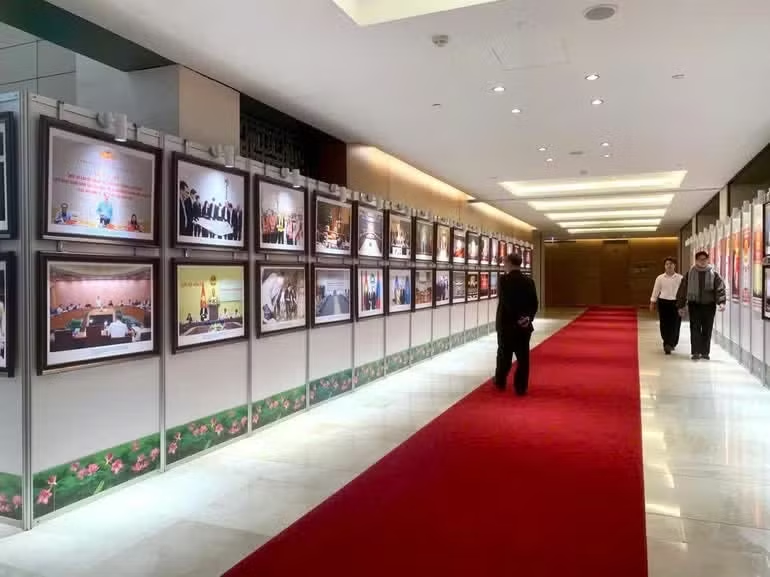
Among these, highlights include activities commemorating major historical events, thereby recreating the flow of revolutionary history, contributing to affirming historical values, fostering patriotism and the aspiration for national development and prosperity. These are not only professional activities but also important political tasks.
Q: It can be seen that in recent times, the Centre has actively coordinated with ministries, sectors and localities to organise thematic exhibitions. How do you assess the effectiveness of the linkage model in promoting regional culture? For thematic exhibitions in 2026 such as “Marine and Island Cultural Heritage”, “Heritage Tourism Space”. How will the Centre orient content and presentation so that national cultural stories can achieve wide dissemination?
A: Implementing the Party’s viewpoint on promoting the combined strength of the entire political system in cultural development, the Centre identifies coordination with ministries and localities in implementing professional activities as a key solution.
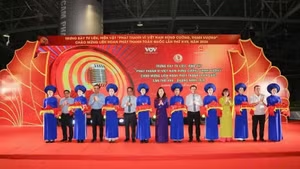
In reality, for many years, the Centre has cooperated with localities to organise thematic exhibitions and cultural festivals, achieving positive results, enabling deeper exploitation of regional cultural values and broader dissemination to the public. Examples include: the exhibition “Tourism Space, Cultural Heritage, Scenic Landscapes and Traditional Handicraft Products of Viet Nam” in Hue 2025 with the participation of 31 provinces and cities; thematic series celebrating Viet Nam Cultural Heritage Day on 23 November annually organised on a large scale in many provinces and cities; Viet Nam Family Day; exhibitions celebrating the National Tourism Year in host localities. Thereby, not only contributing to preserving and promoting cultural values but also closely linking culture with socio-economic development, especially sustainable tourism development, in line with the spirit of the Resolution on building and developing Viet Nam’s cultural industries.
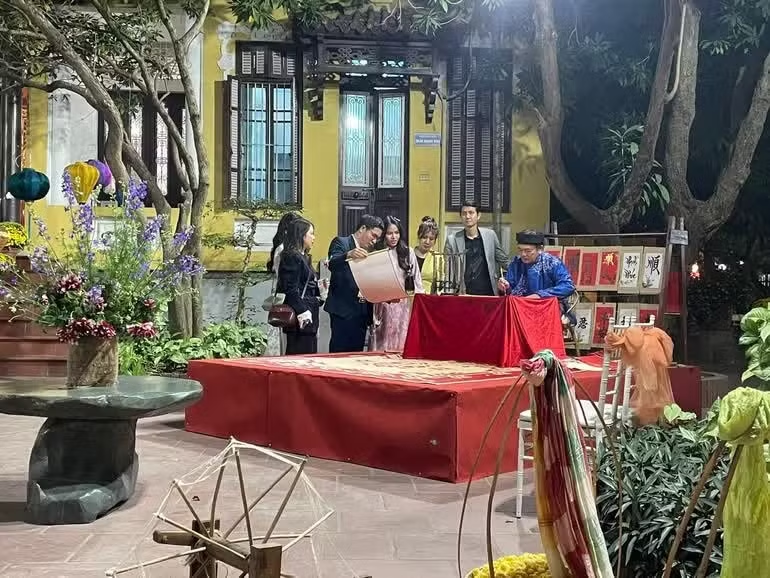
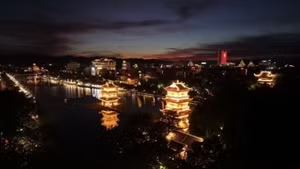
In 2026, the Centre will continue to promote its role as a focal point, taking the lead in content and professional aspects, while closely coordinating with localities to exploit and honour indigenous cultural values. Activities such as the exhibition “Colours of the Highlands” in Son La; the exhibition “Epic of History” on the occasion of commemorating “80 years since President Ho Chi Minh’s Call for National Resistance” within the framework of the Sen Village Festival (Nghe An); the exhibition on the scholar Le Quy Don in Hung Yen; Viet Nam Cultural Festival with the theme of marine and island heritage in An Giang; Heritage Tourism Space in Gia Lai celebrating the National Tourism Year, are all organised in this direction. At the same time, we are also innovating exhibition displays and organisational methods towards professionalism, enhancing interaction and real-life experiences to attract visitors.
Q: How are activities for families, children and youth in 2026 designed to both promote traditional cultural values and enhance experiential engagement for the public?
A: Human development is both the goal and the driving force of cultural development. Therefore, the Centre pays special attention to activities for families, children and youth.
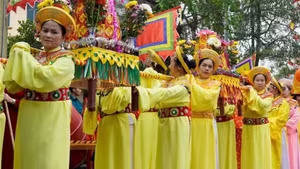
Events such as the World of Childhood Festival, Viet Nam Family Day, and the Mid-Autumn Festival are annual activities organised by the Centre with content designed to harmoniously combine education and entertainment, tradition and modernity. These activities have long become the Centre’s brand due to their scale, nature and effectiveness.
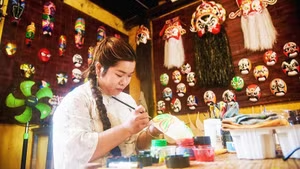
For the World of Childhood Festival and Mid-Autumn Festival, the Centre collaborates with departments, sectors and schools in Ha Noi and localities to launch competitions and exhibitions, thematic cultural learning activities, promote reading culture, and consult experts on child protection. Experiential activities such as practising handicrafts with artisans, folk games, and interactive performing arts are emphasised, thereby helping younger generations approach and absorb national cultural values naturally and sustainably.
For Viet Nam Family Day, the Centre closely follows the annual theme of the Ministry of Culture, Sports and Tourism to organise activities, contributing to strengthening Vietnamese family values through meaningful activities: exhibitions, family contests, art festivals with positive messages such as “Family meals - warmth and love”; “Building Vietnamese character through moral and lifestyle education in families”; “Preserving and promoting traditional cultural values and good behaviour in families”; “Exemplary grandparents, happy families”; “Preventing and combating domestic violence is the responsibility of all levels, sectors and the whole society”; “Family and gender equality”.
Q: From the practice of organising international cultural exchange programmes, how do you assess the effectiveness of promoting Viet Nam’s image to international friends? The Centre also participates in organising and arranging Vietnamese cultural spaces at high-level diplomatic events. What are the Centre’s orientations to expand cooperation and enhance cultural integration in the coming time?
A: It can be affirmed that international cultural exchange programmes in recent times have brought practical effectiveness in promoting the image of the country and people of Viet Nam, contributing to realising the Party’s viewpoint on building “cultural soft power” in international integration. Through exchanges with partners such as the Republic of Korea and India, and participation in organising Vietnamese cultural spaces at high-level diplomatic events in the United States, Poland, the Czech Republic and Laos in 2025, the Centre has contributed to vividly and visually introducing national cultural identity, from cultural heritage, traditional arts, cultural life to contemporary values of Viet Nam.
The outstanding effectiveness is reflected in three aspects. In external relations: contributing to enhancing mutual understanding and trust between Viet Nam and other countries, thereby strengthening cooperative and friendly relations. In national image: affirming Viet Nam as a country rich in cultural identity, stable, friendly, and dynamically developing. In the dissemination of cultural values: creating attraction for international friends, promoting tourism, investment and people-to-people exchanges.
In 2026, the Centre will continue to plan participation in organising Vietnamese cultural spaces in Switzerland, Norway, Denmark and Thailand within the framework of external affairs events; producing photo sets and exhibition products on the country’s development achievements over 80 years; coordinating to build photo collections introducing the country and people of Viet Nam in multiple languages. The Centre’s orientation is to develop standardised, mobile exhibition products that meet both domestic and international display requirements, thereby contributing to promoting Viet Nam’s image and enhancing the country’s cultural position on the international stage.
Q: In the context of accelerating digital technology application, how does the Centre plan to innovate content, format and methods of organising exhibitions to improve promotional effectiveness and attract audiences?
A: Innovation is an inevitable requirement to impIn the context of accelerating digital technology application, how does the Centre plan to innovate content, format and methods of organising exhibitions to improve promotional effectiveness and attract audiences?rove exhibition effectiveness in the context of integration and digital transformation. However, innovation must be based on maintaining ideological orientation, ensuring educational, aesthetic and cultural values.
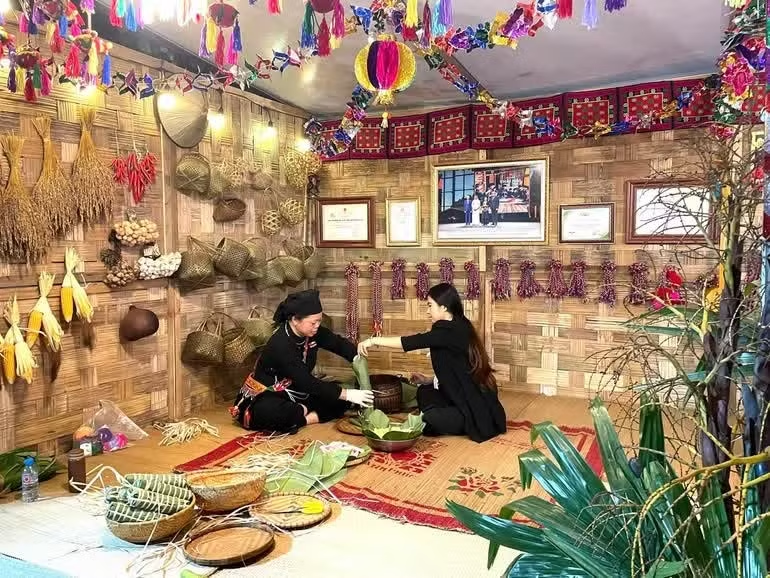
The Centre focuses on improving quality from script development, content selection to design and organisation of exhibition spaces. The application of technology, installation art and performance has been implemented, including 360-degree virtual exhibitions using VR technology to serve the public on online platforms in selected display contents, carried out selectively to better convey content rather than merely following trends.
The Centre is also gradually implementing data digitisation, applying technology in design, exhibition and communication. Each exhibition is oriented to become a comprehensive cultural space with depth, attractiveness and dissemination capacity, contributing to raising awareness and nurturing emotions and aesthetics among the public.
Q: In the process of implementing tasks, in your view, what specific mechanisms and policies are needed for exhibition institutions to improve effectiveness and meet development requirements, commensurate with their role as part of Viet Nam’s cultural industries?
A: Through organising exhibitions, fairs and cultural promotion activities domestically and internationally, we recognise that completing specific mechanisms and policies for the exhibition sector is necessary to fully realise its role as an important cultural institution and gradually affirm its position within Viet Nam’s cultural industry ecosystem. In particular, it is necessary to focus on increasing investment in modern exhibition infrastructure; promoting socialisation; and developing policies to encourage socialisation and public-private partnerships in exhibitions.
In practice, exhibition activities today are no longer limited to propaganda tasks but have become cultural products with economic value. Therefore, mechanisms are needed to encourage enterprises and creative organisations to accompany the State in organising events and developing exhibition services. Private entities (creative agencies, technology companies) should be allowed to operate parts of exhibition spaces to innovate content and marketing methods. There should be focused investment policies for infrastructure and digital transformation in the exhibition sector. In current trends, exhibitions are not only held in physical spaces but also expand into digital environments. Therefore, synchronous investment in facilities, presentation technology, online exhibition platforms and data digitisation is a key factor in enhancing audience experience.
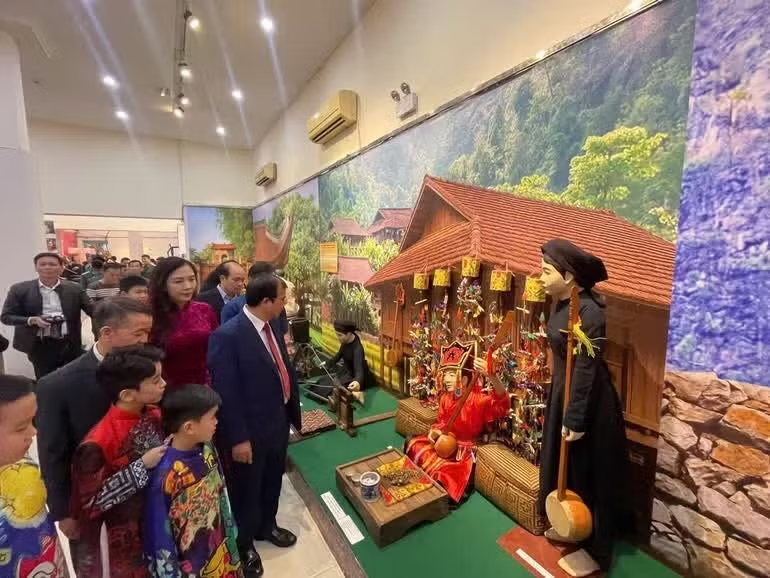
In addition, attention should be paid to mechanisms for developing specialised human resources in the exhibition sector. This is an interdisciplinary field requiring personnel who not only understand culture and arts but also possess capabilities in event organisation, exhibition design, communication and technology. Therefore, policies are needed for training, fostering and attracting human resources, gradually professionalising exhibition activities in a modern direction.
In the coming time, the Centre will continue striving to build a professional, modern, internationally integrated system of cultural and artistic exhibitions, contributing to making exhibitions an important channel for promoting the national image and developing Viet Nam’s culture and creative economy in the new period.
Q: Thank you very much for this interview!