Thang Long was born from that moment. For more than one thousand years, that land has never lost its role as the nation’s centre.
The Ha Noi Capital Master Plan with a 100-year vision is the longest-term strategic document ever issued, integrating for the first time both urban space and socio-economic development orientation into a unified document, with a vision extending to 2125.
The height of the vision
The master plan has achieved what many previous plans could not — setting out a vision with vitality.
“A global city, a cultured - smart - creative - ecological metropolis” is not merely rhetoric. These four attributes – cultured, smart, creative, and ecological – are four reasons why Ha Noi exists differently from any other city in the world. Not because it is the largest or the wealthiest, but because it is the most distinctive.
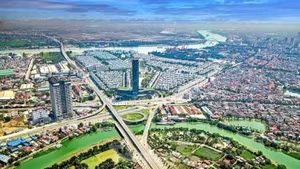
The spatial model of “Multi-polar – Multi-centre, Multi-layer – Multi-class” with nine poles, nine axes, and nine centres marks a breakthrough from the single-centre mindset that lasted for decades. Instead of everything converging into the inner city, future Ha Noi will spread in nine directions: from the Hoa Lac technology pole in the west to the Phu Xuyen logistics pole in the south, from the Dong Anh–Noi Bai global connectivity pole in the north to the Red River pole — the most distinctive ecological – financial – creative axis, an axis that generations of Hanoians have long looked toward without knowing how to develop it commensurately.
The spirit of “infrastructure guiding planning” and the image of “Forest within the City – City within the Forest” are genuine breakthroughs in thinking — not a compressed urban model in the old style, but a city that can breathe, a city with space for people rather than merely vehicles and concrete.
These are strengths worthy of recognition.
The strength of tens of millions of residents
The plan speaks much about high-tech zones, financial centres, and next-generation urban complexes. Correct and necessary. But there is another economic force — larger, older and more enduring — that the plan has not yet examined deeply enough: Ha Noi, with tens of millions of residents carrying within them a thousand-year-old tradition of household business. The small-scale private economic sector — household businesses, micro-enterprises, and one-person companies — needs to be systematically positioned within the planning framework. In highly developed countries, this force has always been the core reflecting the genuine and endogenous capacity of each nation.
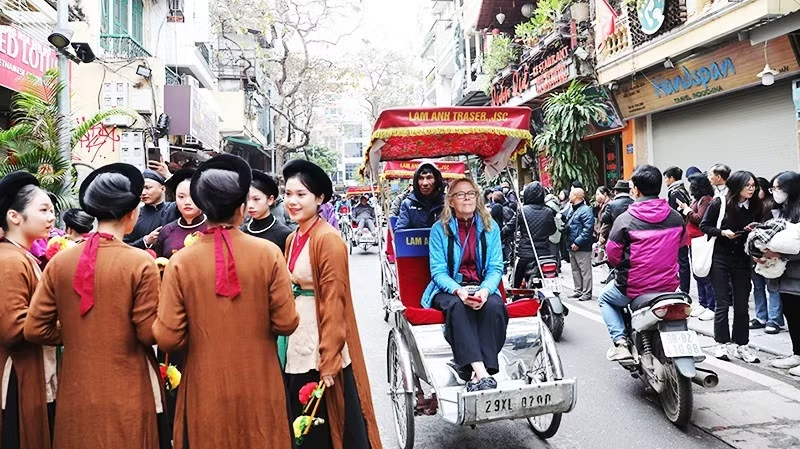
From Bat Trang pottery village to Van Phuc silk village, from Hang Ngang and Hang Dao streets to hundreds of craft villages across the Red River Delta — this is a gigantic informal economic system that is flexible, adaptive, requires no major public investment capital, and is tightly connected to cultural identity in a way no university or research institute can create.
Politburo Resolution No. 68-NQ/TW dated May 4, 2025, on private economic development laid the correct foundation. The master plan needs to concretise this through urban space: digital-integrated commercial streets and trade markets, modern craft villages connected to global e-commerce, and ecosystems supporting household businesses on digital platforms. Not to “upgrade” them into large enterprises — but to allow them to continue being themselves, only with broader markets and stronger competitiveness.
Ho Guom Lake — a boundary that must not be crossed
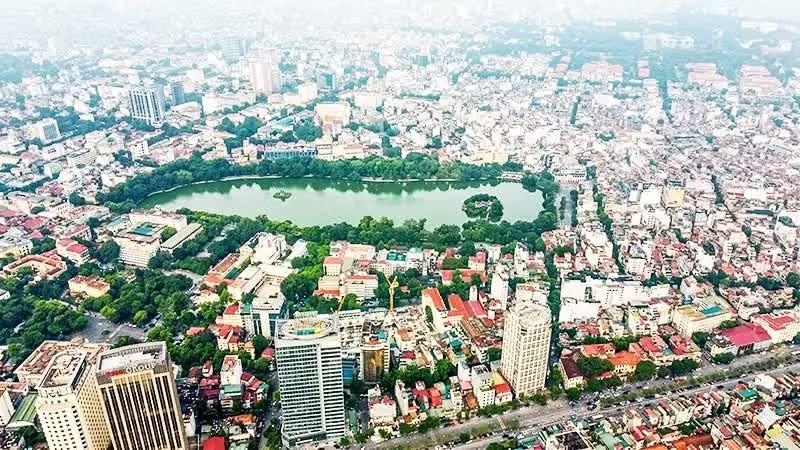
Ha Noi is not an ordinary capital city. Within today’s city lie three sacred ancient capitals of the nation: Co Loa — the capital of the Au Lac State; O Dien — the capital of Van Xuan; and Thang Long — the capital of Dai Viet. This miraculous continuity is not accidental. Therefore, when considering the master plan, there is one unavoidable question: Will the alignment plan for Metro Line No. 2 passing through the sacred Ho Guom Lake area help Ha Noi endure? Will it truly make Ha Noi prosperous? More importantly — will it bring spiritual peace to the people?
For that reason, what is concerning is that the urban railway Line No. 2 plan in the master plan still maintains the route through the Ho Guom Lake area, running underground to Ba Kieu, only 1.3 metres from the foundation of Thap But. This is an internal contradiction: the same planning document identifies Ho Guom Lake as the “heart,” while allowing excavation through that heart and turning Ho Guom Lake into a chaotic transport junction.
An alternative solution is already available: adjusting Metro Line No. 2 toward the Nguyen Huu Huan – Ly Thai To – Ngo Quyen (or Le Thanh Tong) route to Tran Hung Dao Station, which would both directly serve the financial, banking, and commercial centre with higher economic efficiency and completely protect the sacred Ho Guom Lake area. A solution without trade-offs.
Protecting entire sacred system as integrated whole
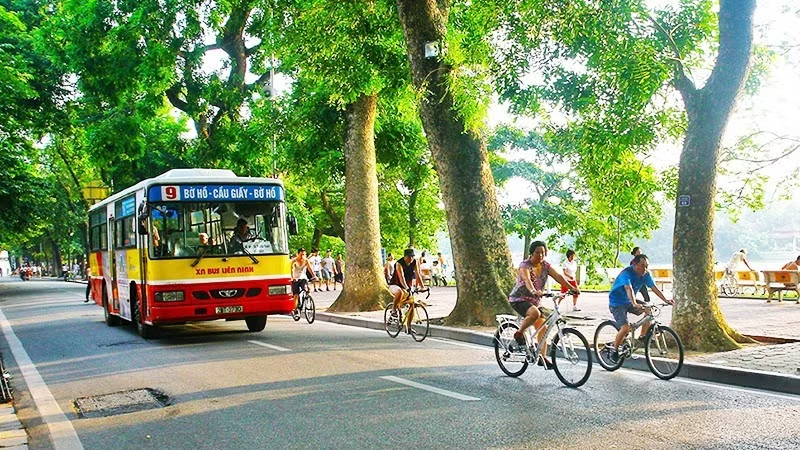
Ho Guom Lake does not stand alone. It is part of the Thang Long sacred system — the spiritual foundation that has preserved Ha Noi as the capital for more than a thousand years.
This sacred system consists of two complementary groups. Regarding the water system: Ho Guom Lake (the sacred centre — where the Turtle God returned the sword, symbolising the people’s will and righteousness), West Lake (the largest water system in the capital, the West Lake – Red River – Co Loa spatial axis), and the To Lich River — a historical lifeline currently under enormous pressure from pollution, land filling, and potentially destructive underground works that could damage its natural flow and erase the river’s thousand-year-old spiritual significance in the national consciousness. Regarding the mountain system: Tan Vien – Ba Vi Mountain (the national sacred land, where Saint Tan Vien – Son Tinh is worshipped, the “northwestern shield”) and Soc Son Mountain (Ha Noi’s sacred land, where Saint Giong left sacred marks, the “northern shield”).
The master plan preserves each site relatively well. What needs to be added is a principle for protecting this entire system, together with redefining protection areas and buffer zones in line with reality, ensuring integrity for generations to come. Living heritage is not only physical structures — it is also the communities of original residents in the Old Quarter, ancient villages and craft villages.
A guiding vision
Ha Noi is now gathering sufficient heritage to serve as its foundation, enough endogenous strength, the right position in the era of creativity, and is standing in the most favourable period ever. What remains is destiny — created by timely decisions and by a community capable of sustaining that momentum across generations.
A good master plan requires a sufficiently strong community to operate it over 100 years. This demands social capital — trust and civic consensus strong enough to prevent major projects from turning into conflicts. It requires citizens to participate substantively in supervising implementation. It requires ward and commune-level administrations to be trained adequately for their new roles. And it requires mechanisms to transform Ha Noi’s enormous intellectual human resources into a genuine driver of urban innovation. Social capacity is the “strength” within the framework of Heritage – Strength – Position – Timing – Destiny, and is the condition ensuring that destiny is not interrupted after each term.
With a 100-year vision, Ha Noi needs breakthroughs in thinking before breakthroughs in infrastructure. The centre of the capital is not a place to “push” modern infrastructure at all costs — it is a place where identity and sacredness must be preserved. Only by protecting the entire sacred water and mountain system can Ha Noi truly become a cultured – distinctive – creative – globally connected capital of the 22nd century. That is how the descendants of Thang Long can provide a worthy answer to a thousand years of history.
“Thang Long one thousand years ago was chosen because it was a land of sacredness and outstanding people. What Ha Noi 100 years from now will be remembered for depends on the decisions being made today.”