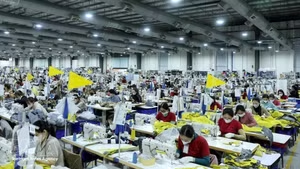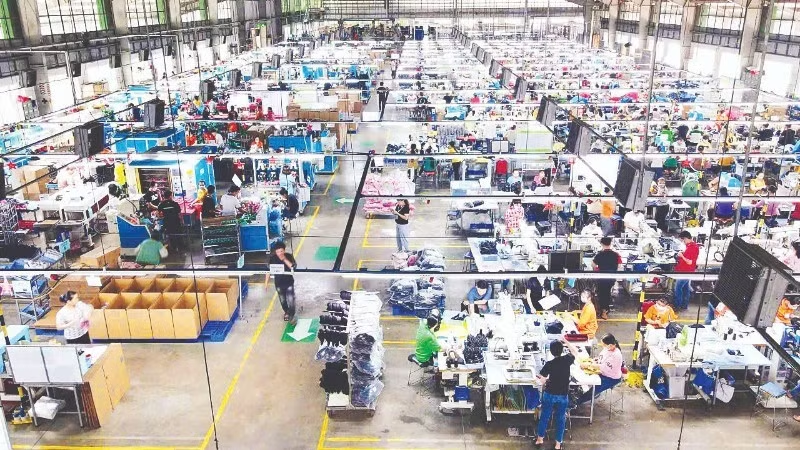
To boost exports, enterprises need to secure a more stable supply of raw materials and transition towards greener manufacturing practices in order to enhance competitiveness and strengthen their position within global supply chains.
According to Vice Chairwoman and Secretary-General of the Viet Nam Leather, Footwear and Handbag Association (Lefaso) Phan Thi Thanh Xuan, the leather and footwear sector remains one of Viet Nam’s key export industries, playing an important role in the country’s industrial production structure, generating employment for millions of workers and making a substantial contribution to national export earnings.
With export turnover reaching nearly 29 billion USD in 2025, Viet Nam’s leather and footwear industry has maintained its position as one of the world’s major footwear manufacturing hubs, deeply integrated into the global supply chains of international brands.
In addition to its advantages in terms of a skilled workforce, the sector’s flexible production capabilities have enabled it to fulfil large-volume orders with demanding delivery schedules and high-quality standards.
However, the industry continues to face significant pressure from rising input costs, including raw materials, logistics and energy expenses. The traditional advantage of low labour costs is gradually eroding, while low export prices, weakening consumer demand and fierce competition are further narrowing corporate profit margins.
Moreover, major export markets such as the US and the EU continue to tighten requirements for leather and footwear products. These include the expansion of REACH regulations on chemical control, compliance with ZDHC certification requirements for chemical management, and various environmental and social assessment criteria imposed by international brands.
“To expand exports, businesses must invest in modern equipment, upgrade management systems, strengthen chemical control, enhance product testing capabilities and improve supply chain transparency in order to meet increasingly stringent customer requirements,” Xuan emphasised.
At the same time, Viet Nam’s leather and footwear industry remains heavily dependent on imported raw materials and components, making it difficult to comply with increasingly stringent rules-of-origin requirements under free trade agreements as well as traceability demands from importing markets.
Limited self-sufficiency within the supply chain also leaves businesses vulnerable to supply disruptions, fluctuations in raw material prices and changes in trade policies among supplier countries.
In addition, risks associated with trade defence measures, technical barriers and evolving tariff policies in major markets such as the EU and the US remain a concern. As international brands pursue strategies to diversify manufacturing locations, the potential relocation or redistribution of orders continues to intensify competitive pressures on Viet Nam’s leather and footwear sector.
Tran Huu Linh, Chairman of the Board of Vien Thinh Footwear Company, said that achieving self-sufficiency in raw materials and developing supporting industries are crucial to the sector’s long-term growth.
For example, sourcing a particular material from overseas can take between 20 and 30 days, whereas securing the same material domestically would require only 10 to 15 days. This not only helps reduce transportation costs by approximately 7–10%, but also shortens production cycles, allowing products to reach export markets more quickly and at more competitive prices.
Therefore, over the next five years, the industry should strive to raise the localisation rate of raw materials and components to more than 70%. Achieving this target would enhance competitiveness, strengthen export capacity and enable enterprises to meet increasingly demanding market and customer requirements.
Phan Thi Thanh Xuan, Vice Chairwoman and Secretary-General of Lefaso, also proposed that, alongside traditional markets such as the US and the EU, businesses should place greater emphasis on expanding exports to emerging and high-potential markets across Asia and Africa.
Diversifying export markets would help minimise dependence on a limited number of major destinations while enabling firms to capitalise on opportunities in markets with growing demand and standards that are more compatible with the capabilities of domestic enterprises. This represents an important strategy for maintaining stable production and order volumes amid ongoing volatility in global markets.
Furthermore, to increase value-added output and strengthen the industry’s position within global value chains, enterprises need to gradually move beyond the traditional contract manufacturing model and invest in developing Vietnamese footwear brands.
Building strong brands based on design, quality and appropriate market positioning will help businesses reduce their reliance on OEM (Original Equipment Manufacturing) orders, expand distribution channels, enhance competitiveness and establish a stronger presence in international markets.