The Khanh Hoa Provincial People’s Committee has recently issued Decision No. 1577/QD-UBND approving the Project on Developing OCOP Products into Tourism Ambassadors of Khanh Hoa Province for the 2026–2030 period.
The project is based on the principle of developing agriculture through an integrated, multi-value, green, ecological and circular approach; leveraging the strengths of each region and locality; and closely linking agriculture with tourism and local brand building.
Its objective is to transform OCOP products into tourism ambassadors for Khanh Hoa, closely integrating them with tourism activities and cultural experiences that showcase local identity. Through this approach, the province aims to increase product value, create sustainable livelihoods for local communities and enhance the attractiveness and distinctiveness of Khanh Hoa.
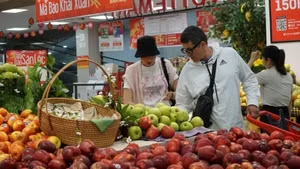
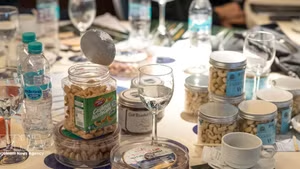
Specifically, under the goal of linking OCOP products with tourism, at least 10% of OCOP products are expected to be associated with tourism activities. The province will select distinctive and unique products that reflect local identity and possess the potential to become tourism ambassador products. Priority will be given to OCOP products rated four stars and above, as well as unique three-star products unavailable in other localities, including bird’s nest products, sea grapes, agarwood, grapes, apples, mangoes, pomelos, durians, asparagus, garlic, seaweed varieties, goat meat and lamb.
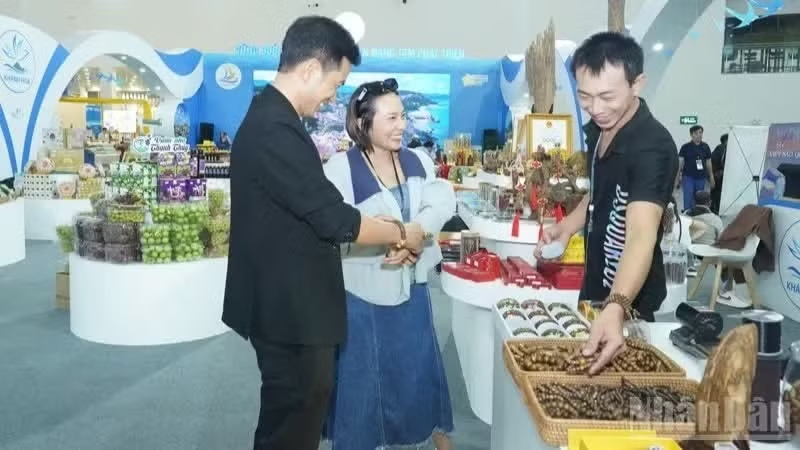
Under the plan, at least 30 OCOP tourism introduction and experience centres will be established. Priority will be given to locations in communes and wards with convenient transport links to create inter-regional connections between tourism routes and destinations. One site will also be selected as a provincial-level exhibition and display centre. In addition, OCOP products will be integrated into tourism distribution channels and digital platforms.
To promote digital transformation in marketing and sales, the province aims for 100% of OCOP tourism experience centres to feature QR codes allowing visitors to access product information and cultural stories. All tourism-linked OCOP products will be available on e-commerce platforms, smart tourism applications and the provincial tourism website. The province will also pilot 360-degree videos for at least 10 signature products to create engaging digital experiences for visitors. Revenue generated from tourism-linked OCOP products is expected to account for at least 15% of total OCOP revenue across the province.
The project for the 2026–2030 period focuses on 9 key areas: launching the project; compiling a list of tourism-linked OCOP products; developing a digital OCOP tourism map; supporting the development of OCOP products serving tourism; completing the OCOP database and applying information technology in OCOP business activities; developing OCOP product introduction centres; building rural tourism models; implementing broader OCOP programme development activities; and conducting annual and period-end evaluations of the project.
Measures to promote the integration of OCOP and tourism focus on seven main areas. First, in terms of planning and organisation, OCOP products should be reviewed and categorised by product sector and geographical area, including mountainous, lowland, coastal and ethnic minority regions. Product clusters should then be developed in connection with tourism routes and destinations. The province also plans to utilise GIS technology to create a digital OCOP-tourism map linked to craft villages, cultural sites and tourism information portals.
Regarding product development, support will be provided to upgrade product designs and packaging in a modern yet locally distinctive and environmentally friendly manner, making them suitable as tourism gifts. At the same time, a set of criteria for “OCOP Gift and Experience Products” will be developed to identify products with strong potential to promote the province’s image.
For tourism service-related OCOP products, the province aims to develop authentic local experience models such as sea grape tourism, agarwood craft village tours, Cham brocade weaving experiences and visits to specialty crop production areas. Cultural elements and local stories will also be incorporated into products to increase their appeal.
From a market perspective, stronger linkages with travel agencies, hotels and resorts are encouraged, alongside the development of OCOP-themed tours, expansion of retail outlets at airports, railway stations and tourist attractions, and greater utilisation of e-commerce and online travel agency (OTA) platforms. In terms of digitalisation, QR-code-based traceability systems, digital storytelling and dedicated OCOP-tourism websites and communications platforms will be developed.
Human resource development will focus on training in product development, marketing and community-based tourism, providing direct advisory support to OCOP producers and promoting the role of artisans in preserving and promoting cultural heritage. Finally, policies and support mechanisms for tourism-linked OCOP development will be strengthened and incorporated into local socio-economic development programmes.
The Khanh Hoa Provincial People’s Committee has emphasised that implementation of the project must align with the Party’s guidelines, State laws and the province’s development strategies, planning frameworks and programmes, while ensuring coherence, feasibility and sustainable development.
The implementation process should also strengthen coordination among departments, agencies and local authorities; mobilise and utilise resources effectively in accordance with regulations; and encourage participation from businesses, cooperatives and local communities. These efforts should be accompanied by effective communications and promotional activities to spread cultural values, foster pride in local products and raise public awareness of preserving and promoting local identity.

![[Infographic] VN-Index rises 0.34% on October 6](https://en-cdn.nhandan.vn/images/j0QNt7m_5iy1OXpnUKiwG61aYhTv_B140GWhfriF26IM-hJLr-YyB-igcHJ7cLRKshCXmgI3hJXGVRYJMfGPzA/chung610-8460.jpg.avif)