AI now embedded across the logistics chain
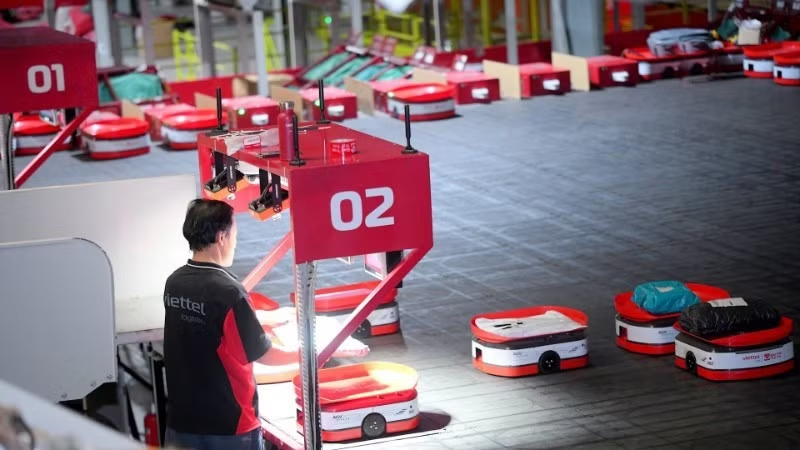
Experts note that AI has penetrated almost every link in logistics operations — from optimising delivery routes, forecasting demand, managing inventory and handling import–export paperwork, to warehouse automation and real‑time data analytics.
Associate Professor Dr Nguyen Thanh Chuong, Chair of the Viet Nam Association for Logistics Manpower Development (VALOMA), observes that technology is redefining the global supply chain, elevating logistics from a “back office” function to a cornerstone service industry of the digital economy and modern trade.
“AI will not replace people in logistics, but firms that apply AI effectively will replace those slow to innovate,” he emphasised.
From a business perspective, Ngo Ngoc Ha, Asia‑Pacific Sales Representative at Samsung SDS, says AI has become indispensable to the company’s logistics operations. According to him, Samsung SDS applies layered technologies extensively, from automating repetitive processes and updating inventory and order status in real time, to data analytics for forecasting supply chain risk.
Experts note that AI has penetrated almost every link in logistics operations — from optimising delivery routes, forecasting demand, managing inventory and handling import–export paperwork, to warehouse automation and real‑time data analytics.
“We apply AI and automation deeply in daily operations to forecast risks, optimise processes and enhance decision‑making performance,” he said.
Not only large corporations but also many Vietnamese logistics companies have begun using AI for warehouse management, automated operational risk alerts and document processing.
Nguyen Anh Dung, representing a logistics firm in the parcel delivery sector, argues that logistics today involves not only flows of goods but also “flows of data” that play a critically important role.
“Whereas businesses once operated mainly on experience and manual processes, now — with market expansion — AI becomes the tool to make faster, more optimal decisions and reduce errors,” he noted.
Bridging the gap between potential and reality
Despite the opportunities AI presents, implementation in Viet Nam still reveals a significant gap between expectations and practical capability. At the VALOMA LogTech Forum 2026 held on May 9 in Ha Noi, many experts, businesses and officials acknowledged that while AI is reshaping Viet Nam’s logistics, the transformation journey continues to face bottlenecks.

Pham Thi Lan Huong, Secretary General and Vice Chair of the Ha Noi Logistics Association, and Head of the Logistics Committee at the Viet Nam Logistics Business Association, admitted that logistics remains one of the lagging sectors in AI adoption.
She explained that logistics is primarily about managing the physical flow of goods, so for a long time many firms faced less immediate pressure to transform compared with sectors such as banking or finance.
“There is a wide divergence in technology adoption among groups of enterprises. Large firms and those with foreign investment typically apply technology well because they have the technological foundation and investment resources. But among the majority — domestic small and medium enterprises — the adoption level remains quite low,” she stated.
In her assessment, only a very small proportion of companies have truly integrated AI at a high operational level.
In an increasingly competitive global environment, AI is no longer a future issue. For Viet Nam’s logistics sector, it is a present‑day imperative: the speed of adaptation will determine firms’ competitiveness and, more broadly, the nation’s economic standing.
One of the biggest barriers is data. Nguyen Tien Dong, AI Engineering Director at CMC Group, argued that many logistics firms have digitised piecemeal, leaving data fragmented and poorly connected between departments.
“Businesses still operate linearly and react slowly to market fluctuations. AI only performs well when data are standardised, reliable and connected into an end‑to‑end ecosystem,” Dong observed.
He warned firms cannot “skip stages” by investing in AI while their data remain scattered or processes unstandardised.
“AI is not a miracle. If the data are not clean or trustworthy, the results produced will not create value,” he stressed.
Experts agree that Vietnamese logistics companies need not make large‑scale AI investments immediately; they should begin with small but practical problems such as optimising delivery routes, document handling, inventory control or demand forecasting. More importantly, they should build reliable data foundations, train staff in digital skills and cultivate new management mindsets.
In an increasingly competitive global environment, AI is no longer a future issue. For Viet Nam’s logistics sector, it is a present‑day imperative: the speed of adaptation will determine firms’ competitiveness and, more broadly, the nation’s economic standing.