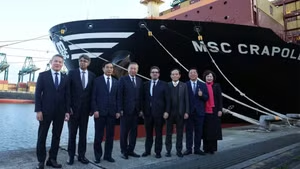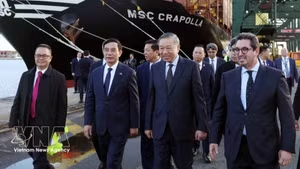
The development of modern, green, and smart logistics centres is opening up new opportunities for Viet Nam to integrate more deeply into regional and global supply chains. At the same time, it is creating momentum for rapid and sustainable growth in the country’s new development phase.
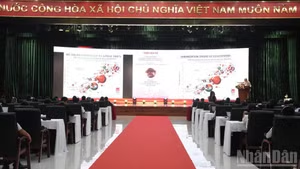
At the seminar titled “Building modern logistics centres to drive production and imports- exports,” organised by the Ministry of Industry and Trade Newspaper, experts, policymakers, and businesses shared the view that the logistics sector is facing its greatest transformation opportunity ever.
Forming an interconnected regional logistics network
According to Dr. Bui Ba Nghiem, Senior Specialist at the Import-Export Department under the Ministry of Industry and Trade, the Viet Nam Logistics Services Development Strategy for 2025–2035, with a vision toward 2050, not only opens a new chapter for the logistics industry but also reflects a fundamental shift in development thinking. “Logistics is no longer simply a supporting service sector; it has become a strategy for enhancing national competitiveness,” he emphasised.
The strategy sets out several specific targets, including reducing logistics costs to around 12–15% of GDP, increasing the outsourcing rate of logistics services to 70–80%, ensuring that about 80% of logistics enterprises adopt digital transformation, and establishing five internationally scaled logistics centres in the coming years. These are ambitious goals considering that Viet Nam’s logistics costs remain relatively high compared to many countries in the region.
However, with its favourable geo-economic location along major international shipping routes and an extensive network of free trade agreements, Viet Nam possesses strong conditions for a breakthrough.
In 2025, Viet Nam’s import-export turnover surpassed 930 billion USD. The logistics market is currently valued at approximately 50 billion USD, growing at an annual rate of 14–16%, and ranked among the world’s top 10 emerging logistics markets. These figures demonstrate the sector’s enormous growth potential.
More importantly, experts stressed that Viet Nam needs to shift its approach—from being merely a transit point for goods to becoming a hub for supply chain organisation. To achieve this, logistics must go beyond simple warehousing and transportation to evolve into an integrated ecosystem connecting seaports, airports, railways, roads, e-commerce, digital data, and value-added services.
One key issue highlighted at the seminar was the need to develop logistics centres based on regional connectivity rather than fragmented and scattered planning as in the past.

Bui Nguyen Anh Tuan, Deputy Director General of the Agency for Domestic Market Management and Development, said the Ministry of Industry and Trade is formulating a development orientation for a tiered logistics centre system, including national-level, regional-level, local-level, and specialised logistics centres.
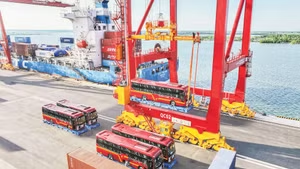
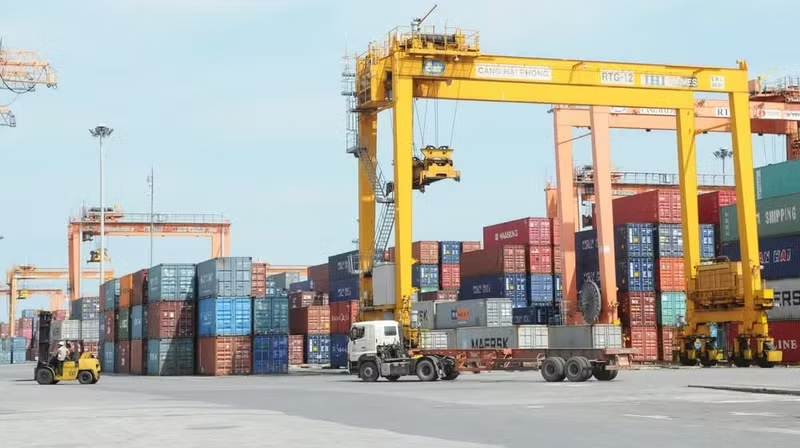
Accordingly, the Hai Phong–Quang Ninh area is expected to become a national and international logistics hub associated with deep-water seaports and the northern coastal economic corridor. Ho Chi Minh City, Dong Nai, Binh Duong, and Ba Ria–Vung Tau are planned to develop large-scale logistics centres linked to Cai Mep–Thi Vai Port, Long Thanh International Airport, and the Southeast industrial region. Meanwhile, the Mekong Delta is envisioned to develop agricultural logistics centres, cold storage facilities, and processing hubs to increase the value of export goods.
According to Bui Nguyen Anh Tuan, the core issue is shifting from the mindset of developing isolated logistics projects to building an “integrated logistics network” that ensures synchronised connectivity between hard and soft infrastructure. While hard infrastructure includes seaports, highways, railways, border gates, and warehouses, soft infrastructure refers to data systems, digital platforms, operational standards, and transport and warehouse management systems.
“A logistics centre cannot merely be a place for goods transshipment, it must become a strategic infrastructure for production and exports,” he stressed.
The establishment of modern logistics centres is expected to create new “growth poles,” reduce transportation costs, accelerate the circulation of goods, and improve the competitiveness of Vietnamese enterprises in international markets. Whereas green transformation in logistics was previously encouraged on a voluntary basis, it has now become a mandatory requirement in global markets. Standards related to carbon emissions, traceability, data transparency, and clean energy use are increasingly becoming prerequisites for deeper participation in global supply chains.
Nguyen Le Hang, Director of External Affairs at SLP Viet Nam, said that green and smart logistics would create “new competitive advantages” for Vietnamese enterprises.
According to her, the first benefit lies in cost savings through optimised operations, data management, and efficient energy use. The second is greater responsiveness to market fluctuations amid an increasingly unpredictable global environment. More importantly, enterprises can improve their ability to comply with green and digital standards that international partners are applying more rigorously.
“Many foreign investors today are not only concerned about prices, they also ask whether enterprises have green certifications, use renewable energy, and maintain transparent emissions data,” she noted.
Removing bottlenecks for logistics breakthroughs
In this new competition, enterprises that meet green standards effectively will gain significant advantages in attracting customers, investment capital, and international partners. In reality, many Vietnamese logistics companies have already begun the transition.
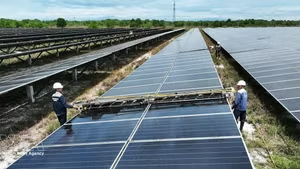
Tran Ngoc Khanh, General Director of OPL Logistics Joint Stock Company, said his company is operating more than 120,000 square meters of warehouse space equipped with rooftop solar power systems and is gradually investing in green-standard transportation vehicles such as LNG trucks and electric vehicles.
According to him, green transformation is “no longer a recommendation but a mandatory requirement.” However, the transition also poses considerable pressure on businesses, especially small and medium-sized enterprises with limited financial and technological resources.
Despite the great opportunities, Viet Nam’s logistics sector still faces numerous bottlenecks that need to be addressed promptly. One of the biggest challenges is the lack of synchronised infrastructure. Many logistics centres lack effective connections with seaports, railways, border gates, or industrial zones. Fragmented planning has also reduced operational efficiency. According to Tran Ngoc Khanh, businesses urgently need clear and transparent planning in order to confidently make long-term investments in large-scale logistics centres.
Another challenge is financing for green and digital transformation. Many enterprises wish to invest in clean transport vehicles, green warehouses, or digital data platforms but struggle to access preferential credit sources.
In addition, the lack of unified data connection standards has made logistics digitalisation fragmented. Enterprises are currently using different platforms that are not effectively interoperable. Experts warned that unless data standards are unified and shared connectivity platforms are developed, smart logistics will struggle to achieve industry-wide effectiveness.
From the perspective of state management, Bui Ba Nghiem said the Ministry of Industry and Trade is implementing several key tasks to complete the legal framework for the logistics industry. These include revising Decree 73 on logistics service business operations, developing criteria for classifying and ranking logistics centres, implementing digital and green transformation programmes in logistics, and promoting e-commerce and cross-border logistics development.
Notably, the ministry is also coordinating with Hai Phong City to develop a proposal for transforming Hai Phong into a modern international logistics centre associated with its seaport system.
According to Bui Ba Nghiem, the ultimate goal is not merely to build isolated logistics centres but to establish a comprehensive modern logistics ecosystem where goods are stored, distributed, processed, traced, and directly connected to global supply chains.
As Viet Nam aims for rapid and sustainable growth in the coming years, logistics is considered one of the most important “growth infrastructures.” Developing a green, smart, and interconnected logistics system will not only help reduce production costs and improve supply chain quality, but also attract investment, expand markets, and enhance Viet Nam’s position within global trade networks.
More importantly, this is an opportunity for Vietnamese enterprises to gradually move away from competing based on low costs and instead compete through service quality, speed, and the ability to meet international standards.
The road ahead remains challenging, from financing and technology to infrastructure and institutions. However, with coordinated efforts from the government, local authorities, associations, and the business community, green logistics can become the “gateway” to new supply chains for Viet Nam’s economy. At that point, Viet Nam will no longer simply be a place through which goods pass, but will become an important link in organising and operating global supply chains.