From collateral assets and mechanisms for valuing agricultural land assets to the risks of supply chain linkage models, many businesses, cooperatives, and farmers are still struggling to access credit. Unlocking resources for agriculture, rural areas, and farmers requires more decisive steps in reforming the mechanisms.
Overcoming collateral and legal barriers
The biggest obstacle currently facing businesses and cooperatives is the issue of collateral assets. Le Dinh Tu, Director of Aeroco Coffee Co., Ltd., lamented: “Many times, businesses invest heavily in factories and machinery, but no longer have enough collateral assets to meet bank requirements, forcing them to fend for themselves during the most difficult times.”
Sharing the same view, Nguyen Thi Dung, Director of Viet Thang Production, Trade and Service Company, said that when businesses act as the “link” to lead the linkage with farmers from organising production to guaranteeing product sales, the biggest difficulty remains collateral. Agricultural land is often valued much lower than residential or commercial land, while its liquidity is limited.
In the linkage model, land use rights belong to the households, and businesses only play the role of organising and coordinating production, so there are no assets in their name to use as collateral. Even assets on the land such as greenhouses, orchards, irrigation systems, or livestock pens are difficult to value. This makes it difficult for many projects, even those that are effective, to obtain loans or only receive low levels of credit. Many cooperatives are in a similar situation.
Nguyen Tan Cong, Chairman of the Board of Directors of Nam Yang Agricultural and Service Cooperative, believes that units with stable production, revenue, and full fulfilment of financial obligations should be considered as a basis for assessing their ability to borrow capital, instead of relying solely on collateral.
Most high-tech agricultural models currently require large capital investments and long payback periods. However, many households and cooperatives mainly only have access to short-term capital, creating a paradox: long-term investment but short-term capital.
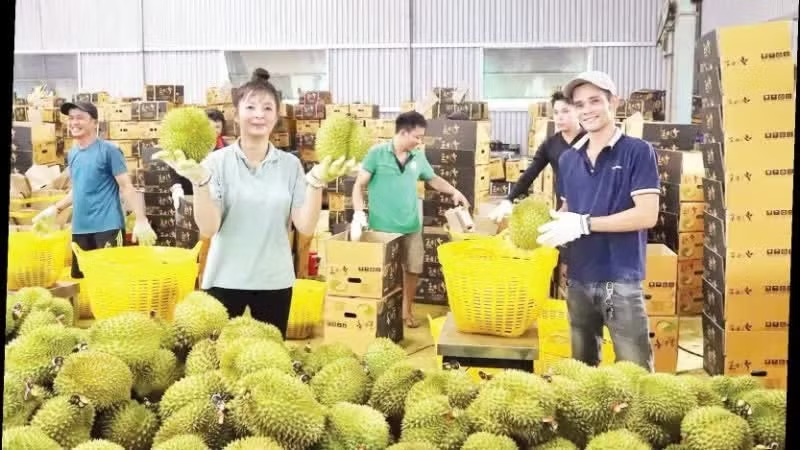
Vu Dai Dung (Ea Kar Commune, Dak Lak Province) has long harboured a plan to build a durian freezing warehouse on an area of approximately 6,000–7,000 sq m. With a total estimated capital of up to 20 billion VND, this is a huge amount, and without a loan source, the plan cannot be implemented. Dung recognised that a large amount of by-products such as durian peels and passion fruit peels are being discarded, which is wasteful and harmful to the environment.
He himself has ambitions to develop a circular economy in agriculture because these are potential raw materials for producing organic fertilisers, but transforming by-products into inputs for production requires significant investment in production lines and capital. “Therefore, just like the cold storage facility, this idea remains only a plan in our minds,” Dung shared.
According to a representative of a bank in Dak Lak, mortgaging assets formed from high-tech investments on agricultural land still faces legal and valuation obstacles. Many households still operate traditionally, lacking proper documentation, making it difficult to meet the requirements of some credit programmes.
Another difficulty is the very high risk inherent in agriculture. In Dak Lak, several floods have caused damage to thousands of customers, affecting outstanding loans amounting to hundreds of billions of VND.
Sustainable supply chain — A way out for capital flow
In the context of agriculture gradually shifting to a value chain production model, many believe that the approach to credit also needs to change. To overcome the ‘bottleneck”, the fundamental solution proposed by experts and industry leaders is to shift from asset-based lending to lending based on cash flow and the efficiency of the supply chain.
According to Tran Van Hien, Head of the Economic and Trade Promotion Committee (Viet Nam Association of Small and Medium Enterprises), besides interest rates, the most important concern for people and businesses remains access to capital.
“Banks need to innovate their lending criteria. Instead of relying too heavily on fixed collateral, they should assess businesses based on their actual cash flow. Currently, most of a business’s financial activities are managed digitally, making them much more transparent than before. Furthermore, contracts and orders signed by businesses with partners should be considered as a basis for credit assessment. For businesses participating in stable supply chains with regular and continuous cash flow, this is a valuable factor, giving banks more confidence in providing funding,” Hien emphasised.
Chairman of the Dak Lak Durian Association, Le Anh Trung, proposed that credit relationships should be reorganised along a broader value chain, with leading enterprises, cooperatives, and banks jointly developing a comprehensive financial plan. Capital flows should be designed based on the future cash flow of the entire production chain.
Enterprises could participate in payment guarantees, procurement guarantees, or co-borrowing with cooperatives to reduce risks for banks and expand access to capital for farmers. Relevant entities need to build a sustainable linkage between enterprises, cooperatives, and farmers to ensure product procurement responsibility and to help credit flows be used more effectively.
Many suggestions were made to improve the legal framework, recognising and allowing the mortgage of investment assets on agricultural land such as greenhouses, smart irrigation systems, or assets formed from high-tech projects, so that enterprises and cooperatives can access long-term capital. Another approach being considered by banks is evaluating the ability to generate cash flow instead of just looking at the value of collateral.
According to Trinh Thi Kim Lien, Deputy Director of Agribank Nam Thanh Hoa, the bank currently prioritises considering the effectiveness of the business plan and the ability to generate cash flow when granting credit. At the same time, the bank is also diversifying collateral, accepting assets formed from loan capital or other legally recognised assets as stipulated.
Economic experts believe that for capital to flow strongly into modern agriculture, additional support tools such as agricultural insurance, development of planting area codes, green standards, and improved management capacity for cooperatives and businesses are needed. Because in an agricultural sector rapidly shifting towards large-scale production, deep processing, and export, credit cannot simply remain at the role of “lending”.
Capital flows need to become part of a modern agricultural development ecosystem, where banks, businesses, cooperatives, and farmers share responsibilities and benefits in the value chain. Once the institutional bottlenecks are removed, capital flows will pave the way for Vietnamese agriculture to enter a new phase of development: more modern, more sustainable, and more competitive in the international market.