Although it has brought remarkable achievements, the old model cannot last forever
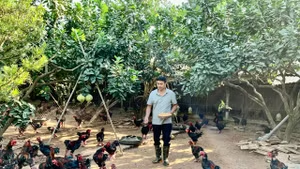
For many years, agricultural growth in Viet Nam has been driven primarily by expanding output, exploiting natural resources, and capitalising on low-cost advantages. This model has delivered remarkable achievements, transforming the country from one struggling with food shortages into a major global supplier of a wide range of agricultural commodities. Over time, however, the limitations of this development model have become increasingly apparent: exports are substantial, yet value addition remains modest; raw commodity exports are still widespread; pressure on land, water resources, and the environment continues to intensify; and Viet Nam’s ability to control markets and capture the higher-value segments of global supply chains remains limited.
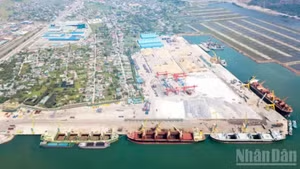
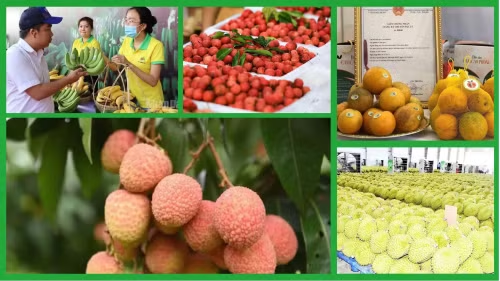
There is no denying that agriculture has been one of the most notable successes of Viet Nam’s reform process. In 2025, the country’s exports of agricultural, forestry and fishery products exceeded 70 billion USD. Ten product categories generated export earnings of more than 1 billion USD each, while commodities such as rice, coffee, pepper, cashew nuts, fruit and vegetables, and seafood continued to rank among the world’s leading products in terms of both output and exports. Yet behind these impressive growth figures lies a reality that must be acknowledged: Viet Nam remains strongest in the production of raw materials, while the greatest value is generated through deep processing, logistics, standards compliance, market intelligence, branding, and global distribution networks.
In modern agriculture, the country producing the largest quantity of raw materials is not necessarily the one that retains the greatest value. A nation that exports only raw commodities will struggle to secure a position at the upper end of the global value chain.
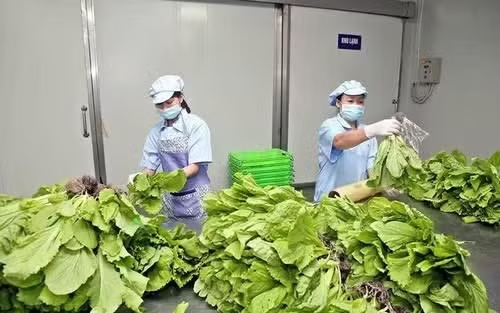
This helps explain why several countries with relatively limited land or natural resources have become agricultural powerhouses. The Netherlands did not achieve its success through vast land resources. Japan does not compete on production volume. Israel has not built its agricultural sector on favourable natural endowments. Their strengths lie in their ability to control their entire agricultural ecosystem, from science and technology, quality standards, and logistics to processing industries, branding, and market systems.
More concerning is the fact that a growth model heavily dependent on resource exploitation is placing increasing pressure on the very foundations of Viet Nam’s long-term agricultural development. The Mekong Delta, the country’s most important agricultural production region, is facing increasingly severe challenges from land subsidence, saltwater intrusion, and climate change. Soil quality is deteriorating, water resources are under mounting strain, and natural ecosystems in many areas are being degraded.
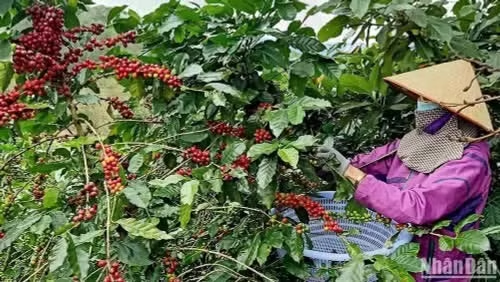
Behind every harvest lies the health of the soil, the sustainability of water resources and the long-term livelihoods of millions of farming households. No agricultural system can remain sustainable if growth continues to come at the expense of depleted soils, exhausted water supplies, and degraded ecosystems. If Viet Nam continues to pursue extensive growth, exports may continue to rise, but the country risks remaining trapped at the lowest-value end of the global agricultural value chain while paying an ever-higher price in terms of natural resources and environmental sustainability.
The world is entering a completely different era of competition
In the past, competition in agriculture largely revolved around who could produce more at a lower cost. Today, however, the rules of the game are changing rapidly. Global agriculture is shifting decisively towards competition based on standards, technology, data, and market organisation capabilities. Agricultural competition is no longer about production volumes; it is about standards, technological sophistication, and control of markets.
A container of agricultural exports today carries not only products, but also a carbon footprint, cultivation-area data, traceability information, environmental responsibility credentials and, ultimately, the reputation of the nation that produced it.
Major markets such as the European Union, the US, and Japan are imposing increasingly stringent requirements on sustainable development, deforestation-free production, carbon emissions, and food safety. Regulations such as the European Union Deforestation Regulation (EUDR), Environmental, Social and Governance (ESG) standards, and emissions-control mechanisms covering entire supply chains are shaping a new set of rules for global agricultural trade. As a result, advantages based on cheap labour and resource exploitation are steadily diminishing. An agricultural sector that is strong in production but weak in standards, logistics, data management, and market organisation is at risk of becoming merely a processing subcontractor within its own value chain.
The future of Vietnamese agricultural products must be built on higher value and stronger national capabilities
In this context, strategic technologies are becoming the decisive factor in agricultural competitiveness. Gene technology, artificial intelligence, agricultural robotics, biotechnology and big data are driving profound changes across the entire agricultural value chain. More importantly, technology is no longer simply about producing more; it is about creating greater value, using resources more efficiently, and restoring and protecting ecosystems in a more sustainable manner. The agriculture model of the future cannot merely be about “more”, it must be “smarter”, “greener” and “more sustainable”.
Gene technology can produce crop varieties that are more resilient to climate change and pests. Artificial intelligence and robotics can optimise production processes, reduce input costs, and cut emissions. Biotechnology and precision agriculture can help restore soil health, conserve water resources, and regenerate agricultural ecosystems.
However, technology cannot replace the fundamental foundations of modern agriculture. Technology does not substitute for strong fundamentals, it only strengthens them. Blockchain cannot compensate for an unreliable traceability system. Artificial intelligence cannot make up for outdated logistics. Big data cannot create value if there is no stable supply base or sustainable market behind it. The greatest mistake is not being slow to adopt technology but believing that technology can replace genuine organisational capacity. If the underlying foundations are weak, digital transformation ultimately becomes nothing more than “the digitalisation of fragmentation.”

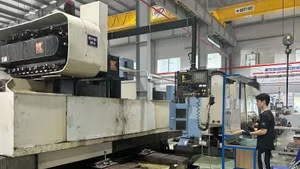
To follow this path, the priority should not be chasing every new technological trend. Rather, Viet Nam must build the genuine foundations of a modern agricultural system: standardised production zones, advanced processing industries, large-scale cold-chain logistics, reliable traceability systems, integrated supply-chain data, and a business ecosystem capable of leading markets. At the same time, the country must develop the capacity to master strategic technologies and create high-tech agricultural solutions, ranging from gene technology, biotechnology, artificial intelligence, and agricultural robotics to technologies for soil restoration, ecosystem regeneration, and low-carbon farming.
More importantly, this modernisation process cannot be separated from indigenous knowledge, traditional farming experience, and the ecological characteristics of each region. Viet Nam’s modern agricultural model cannot simply be copied from elsewhere, it must be built upon the country’s own ecological conditions, farming culture, and local knowledge. Land is not merely a means of production. For Vietnamese farmers, it is also a source of livelihood, the foundation of rural communities, and a pillar of social stability. Only then can science, technology, and digital transformation become genuine drivers of development, rather than remaining limited to demonstration projects or short-lived campaigns.
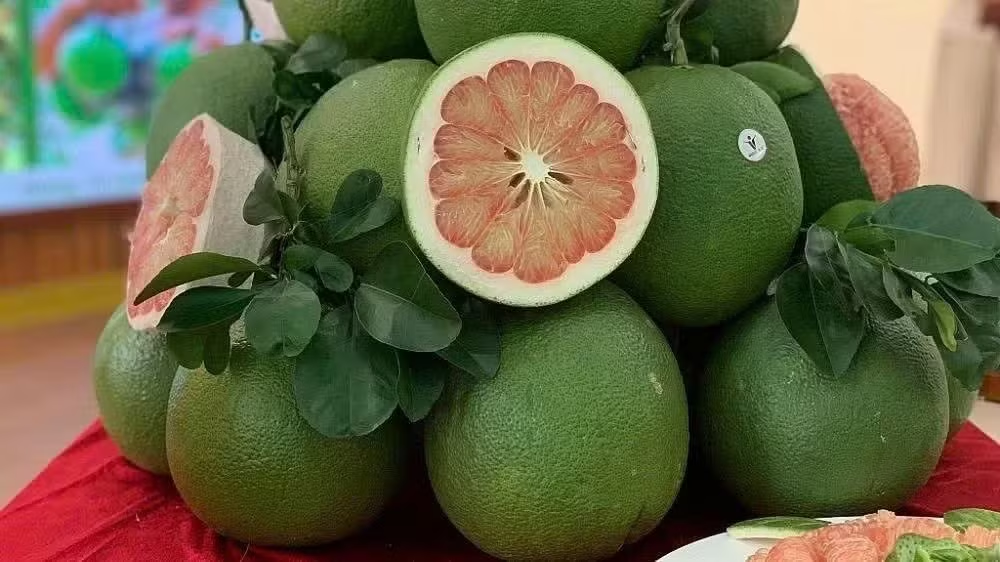
The future of Vietnamese agricultural products is not solely an agricultural issue. Increasingly, it is a question of national development capacity in a world where value chains, technology, and market power are being fundamentally restructured. In this competition, Viet Nam’s position in the 21st century will not be determined merely by how much it produces but by how much value it retains, how much technology it masters, how many standards it controls, and how strong a national capability it can build upon its agricultural foundation.
The countries that master technology, data, standards, and markets will command the highest-value segments of future agriculture. Ultimately, a strong agricultural sector does more than generate economic growth. It preserves land for future generations, safeguards the livelihoods of farmers, protects national ecosystems, and helps strengthen Viet Nam’s standing in the emerging global competitive order.