Tightening regulations while broadening supply sources
According to Ngo Xuan Nam, Deputy Director of the Viet Nam Sanitary and Phytosanitary Notification Authority and Enquiry Point, China has, in recent years, continuously improved its legal framework on food safety management for imports and exports and developed national standards to ensure the quality of goods entering the country.
Chinese authorities have also intensified the enforcement of food safety laws for imported and exported products, including conducting on-site inspections of foreign food production facilities exporting to China, refining the registration system for foreign food manufacturers, and imposing stringent penalties on enterprises that violate food safety regulations. Most recently, China announced Order No. 280, replacing Order No. 248 on the registration of overseas food producers, which will take effect on June 1, 2026.
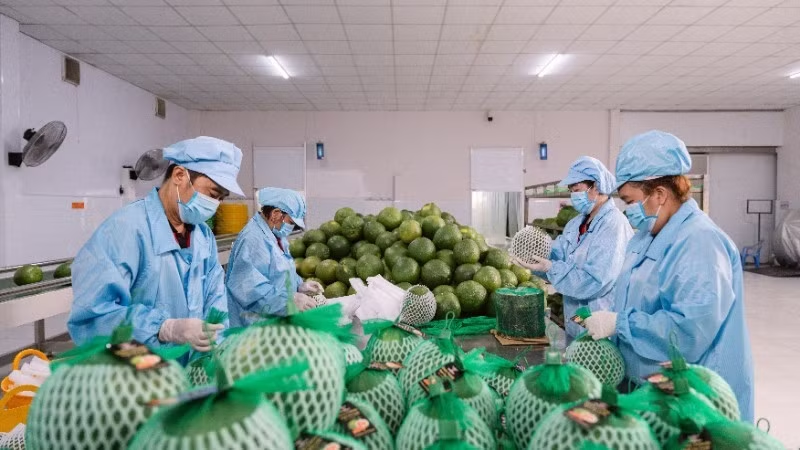
Under this order, only products listed by China will be eligible for registration via competent authorities, instead of the previous self-registration mechanism. Enterprises must therefore familiarise themselves with China’s published product list to ensure their exports fall within the approved categories; establish or strengthen quality management and traceability systems to meet food safety requirements; and update corporate information should there be any changes in legal status, address or licensing. Notably, enterprises must closely monitor the transition period until June 1, 2026 and make use of this time to train personnel and review operational processes. Failure to keep pace with these changes may result in suspension of export codes, returned consignments or blocked customs clearance. Conversely, well-prepared enterprises may benefit from less complex procedures, greater transparency and more stable market access to China.
Alongside regulatory adjustments, China is also broadening its import markets to diversify supply sources. According to the Viet Nam Trade Office in China, in the first six months of 2025 alone, China opened its market to around 15 agricultural, forestry and fishery products from nearly 20 countries and territories. These included Cambodian durians, Malaysian fresh coconuts, Colombian plantains, Ecuadorian mangoes, Gambian cashews, Russian medicinal herbs, wild-caught seafood from New Zealand, Brazil, Kenya, Denmark and Greece, as well as farmed seafood from Croatia, Thailand and Laos, and raw and refined bird’s nests from Cambodia.
According to the Viet Nam Trade Office in China, in the first six months of 2025, China opened its market to around 15 agricultural, forestry and fishery products from nearly 20 countries and territories.
For durians specifically, at the end of September, Guangxi imported 19.8 tonnes of fresh durians from Cambodia, the first such shipment following the China, Cambodia agricultural promotion conference in June. Although the volume remains small, it adds competitive pressure on Vietnamese durians in the market. Meanwhile, Vietnamese bananas, another major export to China, also face increased competition as China expands domestic cultivation of high-quality bananas. In Shanxi Province, bananas grown in greenhouses have successfully met quality standards through controlled temperature adjustments. Previously, greenhouse-grown bananas in Shaanxi also yielded successful harvests.
Finding advantages amid challenges
Viet Nam’s geographic proximity to China offers significant advantages in transport time and logistics costs. Moreover, China has already opened its market to many Vietnamese agricultural products, alongside numerous items traded via traditional channels.
Commercial Counsellor Nong Duc Lai of the Viet Nam Trade Office in China noted that, to enhance competitiveness for premium food products and tropical fruits, Vietnamese enterprises should intensify trade promotion efforts in inland provinces and northern and north-western regions of China, where income levels are higher and consumer demand is strong.
To enhance competitiveness for premium food products and tropical fruits, Vietnamese enterprises should intensify trade promotion efforts in inland provinces and northern and north-western regions of China, where income levels are higher and consumer demand is strong.
Commercial Counsellor Nong Duc Lai,
Viet Nam Trade Office in China
For seafood products, the Viet Nam Association of Seafood Exporters and Producers (VASEP) reports that China remains Viet Nam’s largest shrimp importer. However, Phung Thi Kim Thu, a shrimp market specialist at VASEP, warns that competition in China is fiercer than ever, with Ecuador and India aggressively supplying low-priced frozen shrimp to budget restaurant chains. To secure market share, Vietnamese businesses must therefore focus on premium products.
Shrimp imports into China are forecast to rise slightly in the fourth quarter due to increased demand for the festival season and the Lunar New Year in 2026. High-end products such as live shrimp, lobster and large black tiger shrimp are expected to continue driving this growth. “However, risks arising from border trade control measures and changes in customs regulations remain significant. Even minor adjustments to traceability or food safety requirements could disrupt supply flows,” Thu cautioned.
China’s annual demand for agricultural, forestry and fishery imports is substantial, estimated at 210–230 billion USD. This vast yet constantly evolving market requires Vietnamese enterprises to operate professionally, standardise processes and stay closely aligned with new regulations to capitalise effectively on export opportunities.
![[Infographic] VN-Index rises 0.34% on October 6](https://en-cdn.nhandan.vn/images/j0QNt7m_5iy1OXpnUKiwG61aYhTv_B140GWhfriF26IM-hJLr-YyB-igcHJ7cLRKshCXmgI3hJXGVRYJMfGPzA/chung610-8460.jpg.avif)