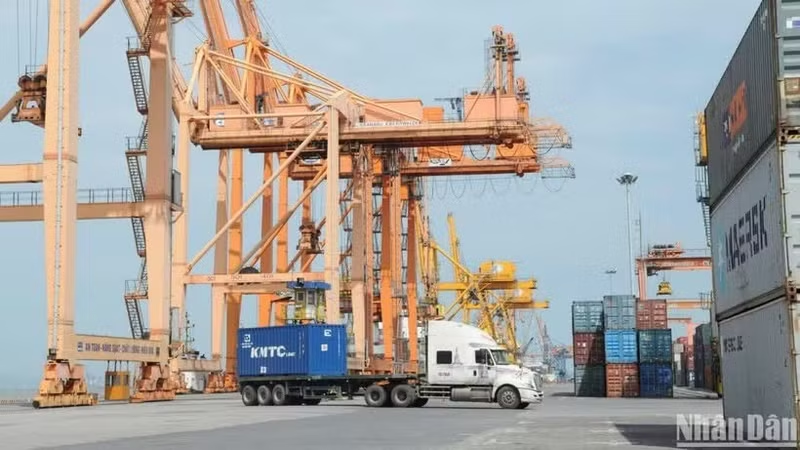
AI trends in current logistics industry
As operating costs continue to rise, global supply chains face persistent disruptions and pressure to optimise efficiency intensifies, the competitive advantage of the logistics sector no longer lies solely in scale. Instead, it is increasingly shifting towards data-processing capabilities, forecasting accuracy and the practical application of technology in operations. According to reports released at the 2026 Logistics Technology Forum, Viet Nam’s logistics market is currently valued at between 40 billion USD and 50 billion USD, maintaining an annual growth rate of 12% to 14%, placing it among the fastest-growing markets in the region. Nevertheless, logistics costs still account for around 16% to 18% of GDP, significantly higher than in many developed Asian economies.
These figures partly reflect the sector’s operational shortcomings, including weak connectivity, fragmented data systems and a lack of optimisation across the supply chain, from warehousing and transportation to import-export procedures. In this context, digital transformation and the application of artificial intelligence (AI) are increasingly viewed as crucial pathways for businesses seeking to enhance their competitiveness.
Tran Thanh Hai, Deputy Director of the Import-Export Department under the Ministry of Industry and Trade and Honorary Chairman of the Viet Nam Logistics Human Resources Development Association, said that AI is transforming the competitive structure of the global logistics industry. Whereas companies previously competed primarily through transport capacity and operational networks, the speed of data processing and the ability to make rapid decisions are now becoming decisive advantages.
According to Hai, the difference between enterprises no longer lies merely in how many vehicles or warehouses they own, but in their ability to harness data to optimise operations, manage risks and respond swiftly to market fluctuations.
Associate Professor Dr Nguyen Binh Minh, Director of the Institute for Technology and Digital Economy at Ha Noi University of Science and Technology, noted that AI is no longer a technology for reference or experimentation, but is gradually becoming a new operational foundation for the logistics industry. According to him, the pressure for digital transformation has shifted from being something companies “should do” to something they “must do” if they wish to maintain competitiveness.
Citing a Deloitte survey, he said that over the next five years, the proportion of supply chain organisations applying or preparing to apply AI is expected to rise from 28% to 82%, while 71% of business leaders fear operational disruptions if they fail to adapt quickly enough.
Gartner forecasts that by 2031, around 60% of supply chain disruption incidents could be handled automatically without direct human intervention. This suggests that AI is no longer a distant future trend, but is gradually becoming an operational tool already taking shape within the logistics sector. The pressure for transformation is becoming increasingly apparent as the business environment grows more volatile.
Since the beginning of 2026, geopolitical tensions in the Middle East have driven fuel prices sharply higher, placing considerable pressure on transport costs. For a north-south container truck journey that can consume nearly 1,000 litres of diesel, even a short-lived rise in fuel prices can significantly increase operating expenses.
Against this backdrop, the application of technology to optimise routes, reduce fuel consumption and improve operational efficiency is no longer a long-term strategic option, but a practical necessity for many logistics firms.
AI becomes an imperative solution
Whereas only a few years ago AI in logistics was largely viewed as a technological trend, it has now begun to emerge across every stage of operations, from document processing and warehouse management to supply chain risk forecasting.
Ngo Ngoc Hoan, Asia-Pacific Sales Representative at Samsung SDS, said AI is now integrated as a key component within the company's logistics systems. Multiple layers of technology are being deployed simultaneously, including robotic process automation (RPA), machine vision and predictive analytics, aimed at accelerating processing speeds and reducing errors.
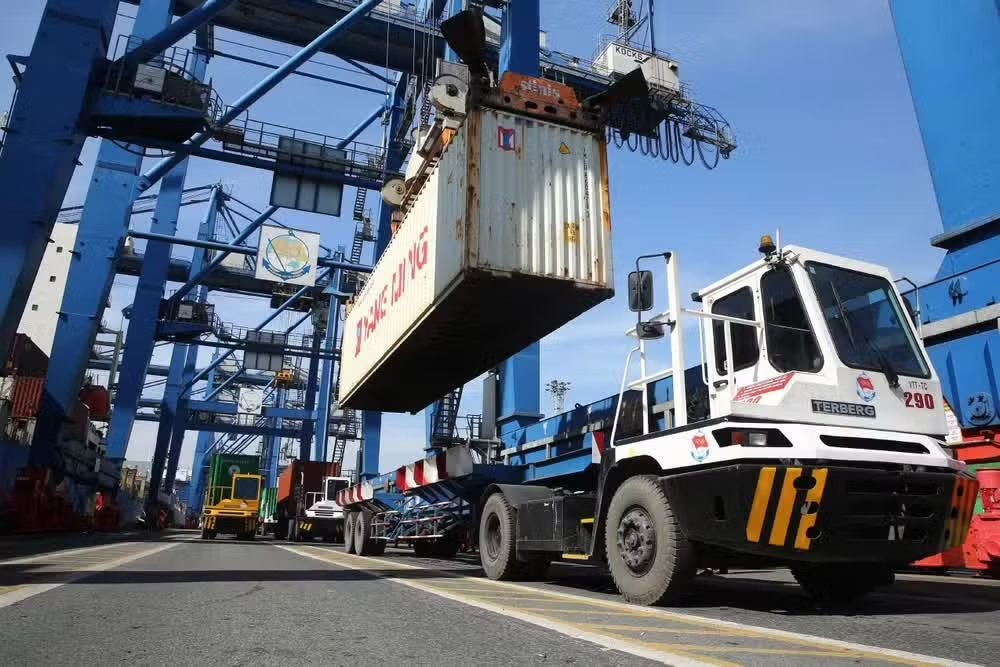
According to Hoan, the noteworthy aspect lies not in individual technologies themselves, but in how they are interconnected within a unified operational ecosystem. Tasks previously dependent on extensive manual processing, such as data entry, document verification and cross-checking information from shipping lines, airlines and seaports, are now gradually being automated.
Instead of manually handling large volumes of PDF files or transport forms, AI systems can automatically recognise data, standardise information and feed it into analytical platforms. As a result, businesses are not only shortening processing times but also significantly reducing operational errors.
More importantly, whereas companies previously tended to react only after disruptions had occurred, AI now allows them to identify potential supply chain breakdowns, transport fluctuations and delivery delay risks at an earlier stage, enabling timely adjustments.
From the perspective of domestic technology enterprises, Pham Khanh Linh, Chief Executive Officer of Logivan, offered another perspective on AI implementation. Rather than deploying AI on a global scale, many domestic companies are applying the technology to highly specific segments within domestic and import-export logistics.
According to Linh, one area where AI has demonstrated particularly tangible results is customs document processing and import-export declarations.
Previously, each document set often had to go through multiple stages of manual inspection, information cross-checking and product code searches, a process that was both time-consuming and prone to errors. With AI support, systems can automatically cross-reference data, identify anomalies and suggest suitable HS codes for different categories of goods. This helps reduce the burden of manual processing for staff while improving accuracy in declarations.

Beyond this, AI is gradually becoming a new "operational support layer" within logistics companies, where people are no longer directly handling every task but are increasingly shifting towards roles focused on supervision, analysis and data-driven decision-making.
However, reality also shows that AI is not a “magic wand” capable of delivering immediate results. The technology can only realise its value when businesses have established sufficiently robust data foundations and relatively comprehensive digitalised operational processes.
This is also why the pace of AI adoption across the logistics sector remains uneven. While some companies have advanced considerably in their digital transformation journey, many others continue to operate under traditional models, with fragmented data systems and heavy dependence on manual processing.
![[Infographic] GRDP growth scenarios for 34 provinces and cities in fourth quarter of 2026](https://en-cdn.nhandan.vn/images/nyM650OGFWrOVWc-xajqN-rTZ68Rlmc1fiGJOhBRYHFSa4DhrHNDxEFdnz313Vk5dNJuxdkHglPA3rLeaPeiaUheNuCI723k2lNssd-YLJuKR58epWq7s21lV5WjM-HR2-Qpbi4MwAzqt9wRjL4WjGkfEz7RO9qhcwg8o8LQFK8/grdp-growth-scenarios-for-34-provinces-and-cities-in-q42026-anh-dai-dien.jpg.avif)