Politburo’s Resolution No.57-NQ/TW identifies science and technology, innovation and digital transformation as among the most important drivers of Viet Nam's rapid and sustainable development. Achieving this vision will depend on effectively transferring research outcomes into practical applications, ensuring that scientific knowledge becomes a direct catalyst for socio-economic development at the local level.
Reality shows that technology transfer is about far more than introducing new technologies into production. It also transforms development thinking by promoting science-based production linked to value chains and market demand. This provides an essential foundation for localities, particularly mountainous areas and ethnic minority communities, to strengthen self-reliance and achieve sustainable development.
A notable example is the Programme to support the application and transfer of scientific and technological advances for socio-economic development in rural, mountainous and ethnic minority areas for the 2016–2025 period. According to the Ministry of Science and Technology, over its ten years of implementation, the programme has supported projects across numerous provinces and cities, established 1,426 science and technology application models, transferred 2,354 advanced technological processes, trained more than 1,800 management officials and 4,000 local technicians, and provided technical training for over 82,700 farmers.
The adoption of new technologies has generated average economic returns more than 30% higher than those achieved using conventional methods. As a result, many high-tech agricultural models have improved productivity and product quality while contributing to the development of raw material production areas, stronger branding and wider market access.
Despite these achievements, technology transfer and application continue to face a number of bottlenecks that require urgent attention. Project appraisal and approval procedures remain lengthy and administratively burdensome, making it difficult for businesses to plan production, mobilise matching funds and respond quickly to market opportunities. In addition, many localities still lack the human resources, infrastructure and production conditions necessary to absorb new technologies effectively, limiting both their impact and their potential for wider replication.
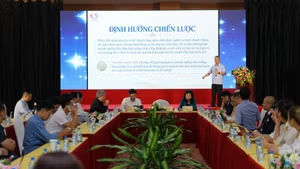
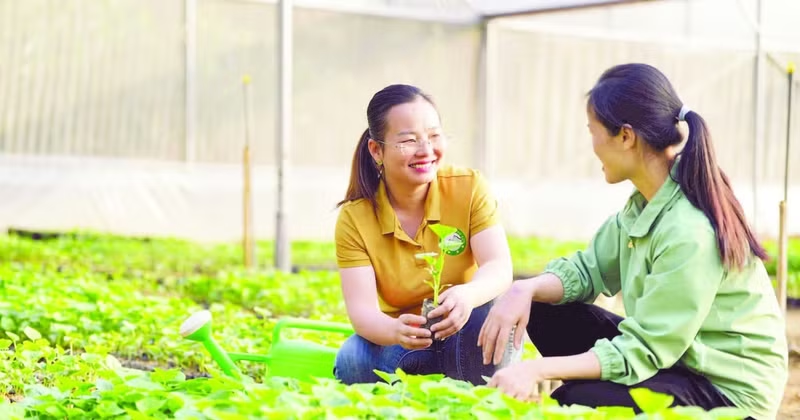
One of the institutions entrusted by the Ministry of Science and Technology with implementing the programme during the 2016–2025 period is the National Institute of Medicinal Materials under the Ministry of Health. The Institute has supported 32 organisations across 23 provinces and cities in applying technologies related to 31 medicinal plant species, helping to bring scientific and technological advances to disadvantaged areas while creating livelihoods, increasing incomes and unlocking local potential.
According to Phan Thuy Hien, Deputy Director of the Institute, the implementation has nevertheless encountered numerous challenges. Most projects are located in remote and mountainous areas where transport is difficult and local technical capacity remains limited, complicating technology transfer, supervision and technical support. Additional obstacles—including the selection of project sites and participating households, natural disasters, adverse weather conditions, procurement procedures for equipment and seedlings, and unstable market linkages—have also affected project progress, long-term effectiveness and the sustainability of models after project completion.
Drawing on these experiences, the Institute has recommended that the Ministry of Science and Technology further improve support mechanisms for technology application and transfer by focusing on key products, local specialities, standardised raw material zones, digital transformation and traceability systems. Such measures are regarded as practical solutions for removing existing bottlenecks, enhancing the effectiveness of technology transfer and contributing to the successful implementation of Resolution No.57-NQ/TW.
In the floriculture and ornamental plant sector, Dr Nguyen Van Tinh, Director of the Centre for Flower and Ornamental Plant Research and Development under the Fruit and Vegetable Research Institute, said the Centre had transferred technologies through 20 projects across various localities, disseminated more than 40 technical processes, established 45 production models, trained 145 technicians, and provided technical instruction to approximately 2,500 farmers and extension officers.
High-value flower varieties, including Phalaenopsis orchids, Rhynchostylis orchids, lilies, gerberas, chrysanthemums and lotus flowers, have been successfully introduced into commercial production, contributing to the establishment of specialised cultivation areas and improving local incomes.
However, the effectiveness of technology transfer has yet to match its full potential because of a number of institutional constraints. These include shortcomings in regulations governing counterpart funding for implementing organisations, limited financial resources for technology transfer in remote areas, shortages of qualified technical personnel at the local level, and insufficiently sustainable market linkages after projects are completed.
Addressing these issues will require stronger policy support for technology transfer, expanded workforce training, and the establishment of demonstration models in disadvantaged regions. Equally important is closer collaboration among research institutions, businesses and local authorities to build sustainable value chains.
Technology transfer not only transforms production methods and strengthens local scientific and technological capacity but also creates effective new economic models while promoting greener and more sustainable agricultural development.
According to Deputy Minister of Science and Technology Le Xuan Dinh, science and technology can become a genuine engine of development only if both thinking and implementation are fundamentally transformed. This means shifting from providing general support to solving concrete local development challenges; from transferring technology to mastering it; and from isolated assistance to developing integrated value chains and innovation ecosystems, while measuring success through socio-economic impact and the scalability of successful models.
He also emphasised that localities should take the initiative in identifying major development challenges and mobilising businesses, research institutes and universities to work together in creating innovative models with broad impact, thereby contributing to the country's goals of rapid and sustainable economic growth.