The Government has issued Resolution No. 168/NQ-CP, updating its economic growth scenario and key policy measures for the remaining quarters of 2026 in pursuit of annual growth of at least 10% while maintaining macroeconomic stability. The Resolution underscores that achieving the national growth target is a shared responsibility of ministries, sectors, localities and state-owned enterprises.
Reallocating growth targets
Based on the updated scenario, the Government has established Gross Regional Domestic Product (GRDP) growth targets for all 34 provinces and centrally governed cities following the recent administrative restructuring. Hai Phong and Quang Ninh have been assigned the highest GRDP growth target nationwide at 13%.
At the other end of the spectrum, four localities have been given single-digit growth targets: Son La (8%), Dong Thap (8.21%), Quang Ngai (9%), and Gia Lai (9.01%).
According to Associate Professor Dr Nguyen Thuong Lang, a lecturer at the Institute of Trade and International Economics, under the National Economics University, the Government had already developed growth scenarios and assigned specific tasks to ministries, sectors and localities for 2025.
In 2026, it continued this approach by allocating growth targets to each locality from the outset of the year based on its policy scenarios. However, after six months of implementation, both domestic and international economic conditions have evolved considerably, while the performance of localities has diverged. Based on reports submitted by ministries, sectors and local governments, gross domestic product (GDP) growth for 2026 is now projected at around 8.7% under the current scenario, below the Government's target of achieving double-digit growth.
Therefore, the adjustment reflects a flexible and evidence-based approach to economic governance, allowing growth targets to be reallocated in line with the capacity and development potential of each locality. Notably, Resolution No.168 goes beyond revising short-term targets by placing local governments on a roadmap towards sustaining double-digit growth during the 2026–2030 period. At the same time, GRDP targets are directly linked to each locality's responsibility for contributing to overall national economic growth.
"Localities will have to proactively identify new growth drivers and fully leverage their comparative advantages. Once responsibilities are quantified, economic governance will inevitably become more decisive and more effective," Lang said.
Sharing this view, Dr Le Duy Binh, Director of Economica Viet Nam, noted that 2026 marks the beginning of a new growth cycle. Viet Nam is not only pursuing rapid and sustainable economic expansion but also embarking on a broader restructuring of its economy. The key drivers of this new development phase will be science and technology, innovation, and improvements in total factor productivity.
Against this backdrop, assigning specific growth targets is regarded as a key policy tool for strengthening accountability, enhancing local governance capacity and improving government transparency. It is also expected to encourage local authorities to improve the investment and business climate while shifting their governance model from administrative control towards better serving citizens and businesses.
Ensuring sustainable long-term growth
However, according to the expert, GRDP growth reflects only part of a locality's overall development performance. The ultimate objective remains improving the quality of growth and ensuring long-term sustainability. The effectiveness of local governance should therefore be assessed through a more comprehensive set of indicators, with the satisfaction of residents and the business community serving as one of the key benchmarks.
A local evaluation framework should include two core groups of indicators. The first concerns economic development capacity, measured by the quality of the investment climate, the strength of the private sector, infrastructure development and the quality of human resources.
The second relates to people's quality of life, reflected in indicators covering healthcare, education, culture, environmental quality and social welfare. These, the expert argued, provide the true foundation for sustainable long-term growth.
From the business community's perspective, Dau Anh Tuan, Deputy Secretary General of the Viet Nam Chamber of Commerce and Industry (VCCI), noted that the recent administrative restructuring has given many localities larger development spaces, creating favourable conditions for building regional economic linkages, expanding markets and attracting investment. This provides a solid basis for achieving the GRDP growth targets assigned by the Government.
At the same time, the expansion of administrative jurisdictions also requires local governments to rethink how they support businesses, particularly small and medium-sized enterprises (SMEs). Local authorities should accelerate the adoption of digital technologies in administrative procedures and business engagement. Business associations also have an increasingly important role to play in conveying the concerns of enterprises, helping resolve bottlenecks and ensuring that government policies are effectively implemented.
According to Tuan, the decisive factor ultimately lies in the quality of implementation at the grassroots level. Commune- and ward-level authorities have been granted greater powers and are the level of government with which businesses interact most frequently. Building a culture of partnership and support for enterprises at this level will improve policy implementation, enhance the investment environment and strengthen localities' ability to achieve their assigned growth targets.
"Businesses and household enterprises deal with commune- and ward-level authorities far more often than with provincial leaders. The quality of public services and the willingness of grassroots authorities to support businesses will therefore determine how effectively policies are translated into practice," Tuan said.
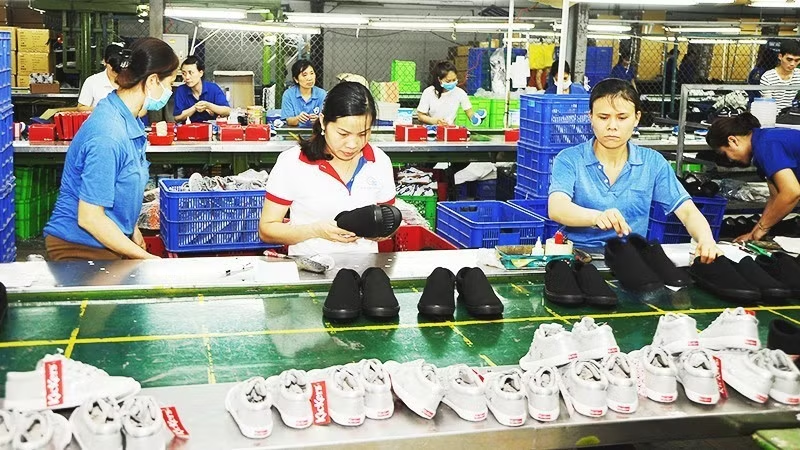
The first-quarter 2026 GRDP performance of localities recording growth of more than 10% also offers several valuable lessons for local economic governance. First, industry and construction continue to serve as the principal engines of growth in high-performing localities such as Ha Tinh, Ninh Binh, Hai Phong and Hung Yen. These localities share a common strategy of attracting investment into industrial production, particularly manufacturing and processing industries. Their experience suggests that identifying the right growth pillars and consistently attracting high-quality investment are critical to achieving strong economic performance.
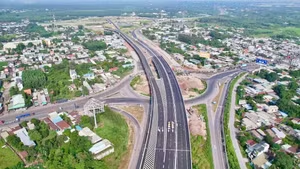
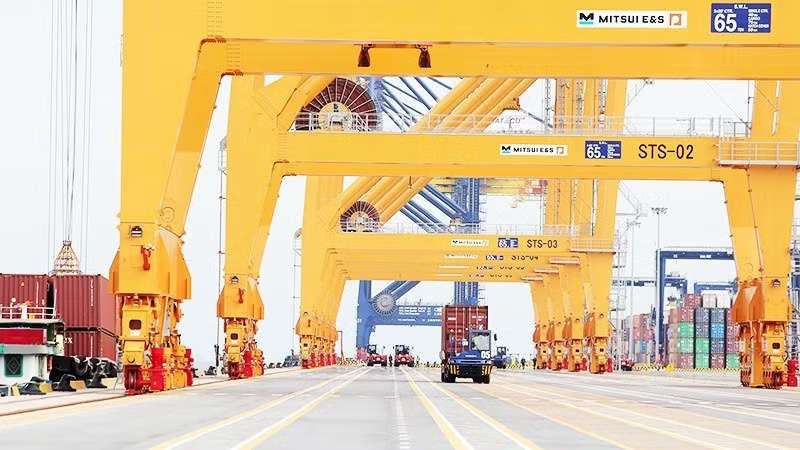
Well-developed socio-economic infrastructure—especially transport networks, industrial parks and logistics facilities—also plays a vital role in enhancing competitiveness and regional connectivity. High-growth localities generally possess relatively well-developed infrastructure, creating favourable conditions for investment inflows and business expansion.
Drawing on these experiences, Nguyen Thi Mai Hanh, Head of the National Accounts Department under the Statistics Office of the Ministry of Finance, said localities should continue prioritising industries where they hold comparative advantages, particularly manufacturing and processing industries as well as sectors capable of moving further up global value chains. She also stressed the importance of strengthening monthly and quarterly monitoring and evaluation mechanisms to closely track developments in production, business activity and investment.
"Based on analyses of individual sectors and industries, local authorities should proactively identify bottlenecks related to institutions, administrative procedures, land access, capital, labour, infrastructure and markets, and promptly introduce solutions to address the challenges facing businesses and investors, particularly large-scale projects with significant spillover effects on local economic growth," Hanh said.
Under Resolution No. 168/NQ-CP, Viet Nam's two largest economic centres have also been assigned ambitious growth targets, with Ha Noi expected to achieve 11% growth and Ho Chi Minh City 10.2%.