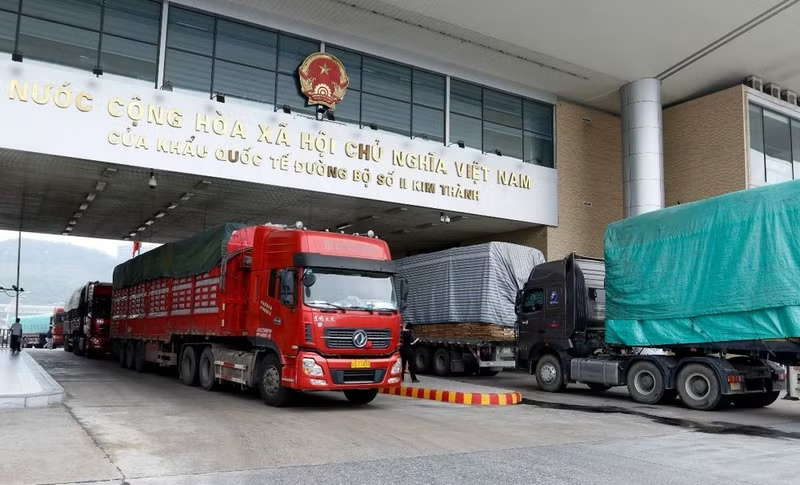
The five-year socio-economic development plan for 2026–2030, which targets “double-digit” average economic growth, also underscores the need to build a modern border gate economy, promote border trade and technological infrastructure, and ensure robust national defence and security. This is both a strategic orientation and an urgent requirement in the current context.
Cao Bang pushes ahead with digital border gate platform
In line with Party policy, Government directives and the Provincial Party Committee’s guidance, Cao Bang authorities have in recent years proactively implemented a comprehensive set of measures to foster border gate economic development.
In 2025, despite global and regional volatility and mounting challenges in international trade, Cao Bang’s border gate economy still achieved positive results, sustaining growth momentum and making significant contributions to local socio-economic development.
Import–export turnover through the province’s border gates reached USD 1.635 billion, up 84% from 2024 and fulfilling 181% of the provincial plan. Budget revenue from import–export activities reached VND 2.257 trillion, up 144% year-on-year and achieving 327% of the plan, underscoring the growing importance of the border gate economy in the local fiscal structure.
In 2025, despite global and regional volatility and mounting challenges in international trade, Cao Bang’s border gate economy still achieved positive results, sustaining growth momentum and making significant contributions to local socio-economic development.
These achievements reflect the strong political will of the Provincial Party Committee and authorities in harnessing the border’s potential and advantages. Entering a new development phase, the Cao Bang Provincial Party Committee has resolved that the border gate economy must become a leading growth engine. Programme No. 04-CT/TU, issued on November 28, 2025, sets out specific tasks and objectives for developing the province’s border gate economy during 2025–2030.
A central solution is the creation of a digital border gate platform aimed at automating vehicle and goods management processes, reducing reliance on manual handling, and enabling data connectivity among functional agencies.
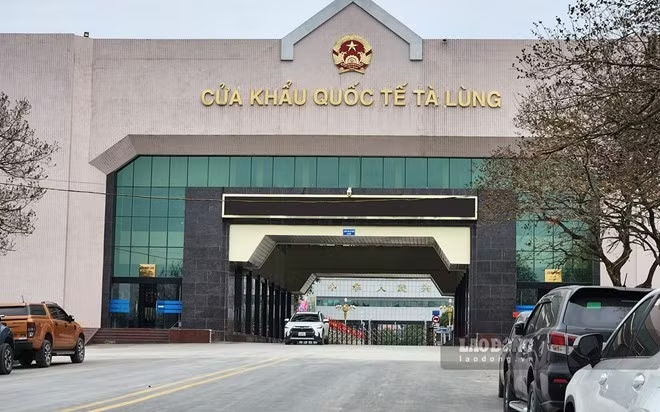
The roadmap is clearly defined in three phases: preparation by March 2026; construction and piloting at Ta Lung and Tra Linh border gates in April–May 2026; and full provincial rollout from 1 June 2026.
With a clear timetable and coordinated involvement of relevant agencies, the digital border gate platform is expected to mark a significant shift in border gate management and operations in Cao Bang.
Experience shows that geographical advantages only translate into developmental advantages when combined with new thinking, modern technology, and advanced governance methods.
Lao Cai advances smart border gate model
With a 182 km border line, the Lao Cai Provincial Party Committee advocates building border gate economic zones as the province’s driving economic regions. The focus is on implementing a smart border gate model, seen as a breakthrough solution to improve management efficiency, reduce logistics costs, and boost customs clearance capacity.
A project to develop smart border gates at the Kim Thanh and Ban Vuoc clearance points of the northwestern province of Lao Cai’s international border gate has been approved, aiming to modernise management, inspection, and supervision through advanced technology and automated transport systems.
The project seeks to build and apply a model based on advanced technologies, including artificial intelligence (AI), the Internet of Things (IoT), and fully automated smart transport systems, while modernising multimodal logistics infrastructure in a synchronised manner.
It will also ensure effective connectivity with railways, inland container depots, expressways, and economic corridors linking Viet Nam and ASEAN countries with China’s southwest region.
Integrating smart border gate development with cross-border e-commerce opens a new pathway aligned with the digital economy trend.
The initiative is oriented towards forming a major hub for import–export activities, helping to enhance competitiveness, promote international integration, safeguard national defence and security, and support sustainable development in the Viet Nam–China border area.
The smart border-gate model is expected to increase clearance capacity and efficiency to meet growing trade demand, while also helping combat smuggling, trade fraud, counterfeit goods, and substandard products.
By 2030, the project aims to double freight throughput at Kim Thanh and Ban Vuoc, reduce average logistics costs for businesses using fully automated smart transport by 20–30%, significantly shorten administrative processing times, and ensure compliance with safety, environmental, and modern logistics service standards. Total import–export turnover through the area is expected to reach approximately 9 billion USD.
Implementation will begin in the second quarter of 2026. Phase one will focus on establishing the legal framework, technical standards, and specialised procedures for the smart border-gate model, as well as reaching agreements with the Chinese side on cross-border road transport of goods using fully automated smart vehicles. Phase two will involve operational deployment of the smart border-gate model in accordance with relevant sectoral regulations, alongside the development of the necessary infrastructure.
Integrating smart border gate development with cross-border e-commerce opens a new pathway aligned with the digital economy trend. Provincial leaders emphasise that the smart border gate model is not only an inevitable trend in international trade but also a vivid embodiment of the Party’s policy to build a modern border gate economy.