2026 is witnessing a final push on numerous key infrastructure projects across the country. After a long period of construction, many projects are entering their final stages, with a view to being commissioned this year.
Race to the finish
In the south, Long Thanh International Airport is entering its final months ahead of trial operations. As scheduled, the airport will undergo trial operations from September to November 2026 and is expected to officially begin operations in December.
The Airports Corporation of Viet Nam (ACV) is maintaining more than 7,100 personnel working at the site and has asked contractors to increase this to nearly 9,000 to ensure the project meets its deadlines.
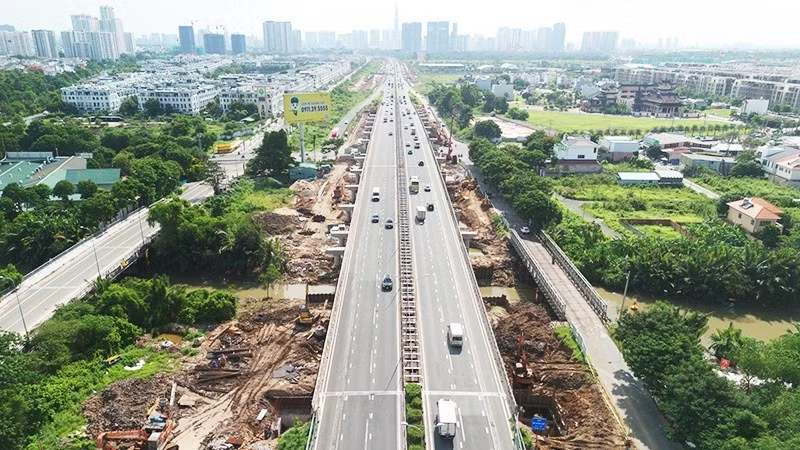
At the same time, work on the expansion of the Ho Chi Minh City–Long Thanh Expressway is being accelerated, with multiple construction teams working simultaneously and machinery operating continuously.
By early August, more than 60% of the project had been completed. At the current pace, the expressway is expected to be largely completed in 2026, in time to meet travel demand when Long Thanh International Airport begins operations.
In the north, the Huu Nghi–Chi Lang Expressway, approximately 60km long with a total investment of 11.8 trillion VND (455 million USD), is also stepping up construction in a bid to complete the entire project by September 30, 2026.
Despite adverse weather, complex geological conditions, and the large volume of work involved, contractors are maintaining multiple construction teams along the route.
These are just some of the prominent projects among a large number of transport infrastructure projects being accelerated nationwide. Notably, projects are increasingly being developed to connect production centres, urban areas, seaports, airports, and border gates, rather than simply meeting the individual transport needs of each locality.
According to Dr Nguyen Quoc Viet, a public policy expert and lecturer at the University of Economics and Business under Viet Nam National University, Ha Noi, when major infrastructure projects are completed, the most immediate impact is smoother travel and goods transportation.
This can then generate wider benefits through lower costs, expanded markets, and increased investment, benefiting businesses and the economy as a whole.
For businesses, improved transport links shorten delivery times, reduce logistics costs, and minimise the amount of goods that need to be stored or remain in transit.
This gives businesses greater flexibility in sourcing raw materials, organising production, and delivering goods, while allowing them to use the savings to invest in machinery, technology or expansion. Amid growing competition over prices and delivery times, this is a significant advantage.
Improved transport infrastructure also changes how businesses choose locations for production and distribution.
Areas that previously suffered from being far from centres, making it difficult to transport raw materials or deliver goods to markets, can become more appealing once better connected.
Businesses therefore have more options for locating factories, warehouses, and distribution centres, while localities outside traditional economic hubs gain greater opportunities to attract new projects.
As the transport network expands and becomes more integrated, the strengths of individual localities can complement one another. Areas specialising in production can link up with those focused on processing, logistics, or services within the same supply chain, rather than operating in isolation.
Such connectivity not only facilitates the movement of goods but also creates conditions for larger-scale production and business zones to emerge.
More broadly, infrastructure can become a driver of growth as lower production and distribution costs, expanded markets, and greater scope for investment create new opportunities.
Better-connected regions also generate increased demand for services, trade, and employment, thereby creating additional resources for socio-economic development.
Progress must be coupled with quality
However, the final months of the year are also placing considerable pressure on projects as many accelerate simultaneously to meet their deadlines.
Demand for construction materials, machinery, and labour is therefore rising sharply, while supply in some areas may fail to keep pace.
Rising material prices, transport costs, and labour expenses will add pressure to contractors’ costs, particularly on projects involving large volumes of construction work.
Contractors must also increase working hours, add equipment, organise additional construction teams, and compete for skilled workers. When multiple projects require earth fill, sand, aggregates, steel, or machinery at the same time, localised shortages may arise, driving up costs and affecting progress.
Weather is another factor that needs to be taken into account, particularly in areas experiencing heavy rainfall or complex geological conditions. Meanwhile, delays in procedures relating to site clearance, the extraction of construction materials, transport, and payments to contractors can all become bottlenecks.
To mitigate these risks, Dr Nguyen Quoc Viet advised that resource coordination should begin early rather than waiting for shortages to emerge at construction sites.
Investors and local authorities need to proactively review the material, labour, and equipment requirements of each project, coordinate with suppliers to ensure stable supplies, and prepare contingency plans.
For materials at risk of shortage, licensing, extraction, and transport procedures should be expedited, while prices should be controlled to minimise additional costs.
For contractors, advance planning for labour, equipment, and cash flow is also crucial. Rather than concentrating all resources in the final months, construction schedules should be properly allocated from earlier stages, easing pressure on construction and reducing competition for resources between sites.
At the same time, management agencies need to swiftly resolve difficulties relating to site clearance, procedures, and payments, while strengthening coordination among localities through which projects pass.
“When supplies of materials, labour, and equipment, as well as land clearance and funding, are secured in a coordinated manner, accelerating construction can genuinely deliver results, rather than simply adding pressure on project costs and quality,” Viet said.
Taking a more cautious view, economist Nguyen Tri Hieu warned that when multiple projects are being implemented simultaneously, pressure to meet deadlines could lead some investors to prioritise progress over quality, technical, and environmental requirements.
Without close supervision, accelerated construction could result in repair and maintenance costs or affect the lifespan of projects. Particularly for large-scale projects, even a small number of components requiring reconstruction or design changes could lead to significant additional costs and delays.
Therefore, efforts to accelerate progress should be based on strict controls from preparation through construction and acceptance, rather than simply placing pressure on projects to be completed within a short period.
According to Hieu, projects should be regularly assessed in terms of quality, costs, and operational viability, particularly those involving large amounts of capital and long implementation periods.
Issues relating to design, materials, geology, or total investment should be addressed early to prevent costs and workloads from piling up towards the end.
In addition, management agencies need to assess the effectiveness of projects after they enter operation, rather than judging them solely on whether they are completed on schedule or whether the allocated capital is fully disbursed.
A project that is built quickly but operates inefficiently, lacks connectivity, or requires major repairs after opening will diminish the value of the resources invested.
Therefore, alongside the goal of completing key projects, attention must be paid to quality, connectivity, and long-term operational efficiency.
“Infrastructure investment should not simply pursue the goal of completing projects; it must ensure that those projects genuinely create new development capacity. Progress is important, but quality and operational efficiency ultimately determine the value of an investment,” Hieu stressed.