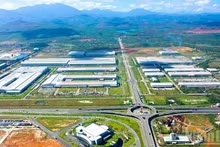
FDI inflows boost Viet Nam's economic growth
Foreign direct investment (FDI) inflows into Viet Nam are reaching new highs, both in registered and disbursed capital, expanding production capacity and providing fresh momentum for economic growth.
#Economic Growth
Foreign direct investment (FDI) inflows into Viet Nam are reaching new highs, both in registered and disbursed capital, expanding production capacity and providing fresh momentum for economic growth.
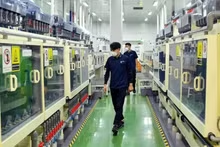
Politburo Resolution No. 68-NQ/TW (dated May 4, 2025) on private sector development sets the target of having two million enterprises operating in the economy by 2030, while striving to have at least 20 large enterprises participate in global value chains and achieve average annual labour productivity growth of 8.5–9.5% in the private sector.

Ministries, agencies and localities were also told to accelerate the development of national databases and digital infrastructure, with key databases on education, social security, personnel and health to be completed by November 30, 2026.

Politburo Resolution No. 80-NQ/TW on the development of Viet Nam's culture identifies culture as the foundation, an important endogenous resource, a major driving force, a pillar, and a regulatory mechanism for rapid and sustainable development. The resolution calls for a comprehensive identification of cultural resources; research and assessment of their total economic value; and the transformation of heritage into assets.
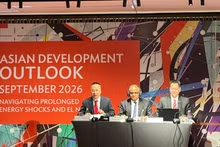
The Asian Development Bank (ADB) has raised its economic growth forecast for Viet Nam to 7.8% in 2026 and 7.6% in 2027, reflecting stronger-than-expected economic performance in the first half of 2026, according to the September 2026 edition of the Asian Development Outlook (ADO), released on September 23.
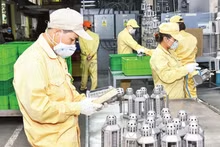
In the third quarter, Viet Nam’s economy has shown strong signs of acceleration, expanding room for growth in the final months of the year. Many key sectors and industries have recorded high growth compared with the same period in 2025, providing an important foundation for striving to achieve the double-digit growth target.
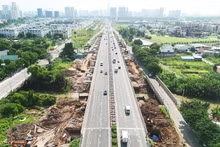
As roads, airports, and connecting infrastructure projects are completed one after another, expectations go beyond simply adding new facilities. The aim is to expand economic space, reduce costs, and create fresh momentum for development.
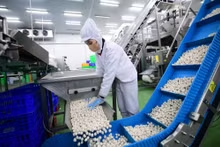
As Viet Nam enters a new stage of development to realise its aspirations for higher-income status and avoid the middle-income trap, Shantanu Chakraborty, Country Director of the Asian Development Bank (ADB) in Viet Nam, shared his insights with Nhan Dan Newspaper on addressing structural bottlenecks and creating new drivers for sustainable economic growth.
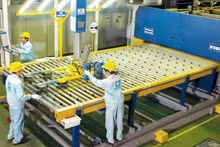
Despite mounting challenges in both the domestic and international business environment, Vietnamese enterprises have continued to demonstrate greater resilience and adaptability, while recording strong growth in numbers.
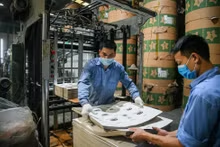
With GDP expanding by 8.18% in the first half of 2026, Viet Nam’s economy has shown encouraging signs, underpinned by the performance of major economic centres and key sectors. Nevertheless, mounting domestic and international pressures call for flexible and decisive policy responses.
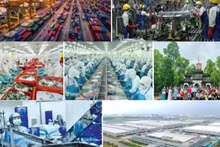
Nguyen Thi Huong, Director General of the National Statistics Office of Viet Nam under the Ministry of Finance, said that the Vietnamese economy is facing a mix of opportunities and challenges in the final six months of 2026.
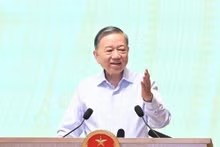
Party General Secretary and State President To Lam on July 4 urged the Government and local authorities to immediately remove obstacles to policy implementation, describing execution as the "bottleneck of all bottlenecks" at present, to accelerate economic growth and lay a solid foundation for the country's next development phase.

Despite continued growth across many sectors during the first five months of the year, the economy is still expected to face considerable challenges in maintaining sustainable development momentum.

Modern history shows that there has never been a universally successful model that can be applied perfectly to every country. Sustainable development is only possible when a nation finds a path suited to its own historical circumstances, level of development, governance capacity, and national interests.
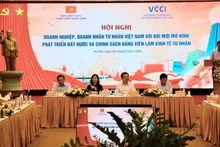
More than 100 representatives from the private sector attended a conference on May 27, organised by the Central Policy and Strategy Commission (CPSC) in coordination with the Viet Nam Chamber of Commerce and Industry (VCCI), to offer ideas on renewing the country’s development model.
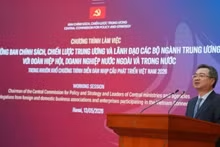
Politburo member, Secretary of the Party Central Committee (PCC) and Head of the PCC’s Commission for Policy and Strategy, Nguyen Thanh Nghi, held a working session with delegations from foreign and domestic business associations and enterprises in Ha Noi on May 13 within the framework of the Viet Nam Connect Forum 2026.
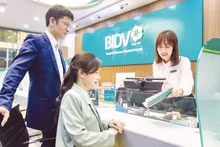
Following a meeting with the State Bank of Viet Nam, commercial banks moved almost immediately to cut deposit interest rates.
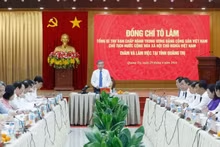
Party General Secretary and State President To Lam has urged the central coastal province of Quang Tri to reposition its development space under a “reaching East, spreading West” strategy.

At the second plenum of the 14th Party Central Committee, General Secretary and State President To Lam stressed that “high economic growth must serve the interests of the people, improve their material and spiritual well-being, and ensure social equity”.
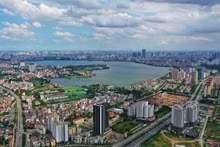
In the first quarter of 2026, economic growth across many localities was broadly positive, according to the National Statistics Office (NSO), with Ha Noi and Ho Chi Minh City maintaining their positions as the nation’s economic engines.