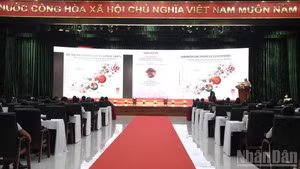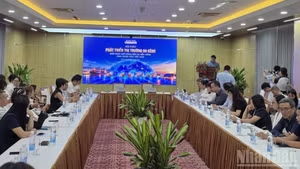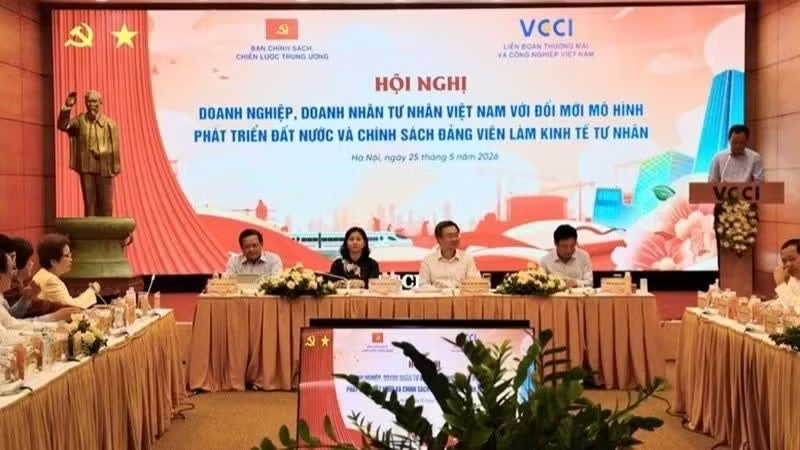
Speaking at the conference, Politburo member and Head of the CPSC Nguyen Thanh Nghi said that after nearly 40 years of Doi Moi reform, Viet Nam’s economy had made significant gains, but the current growth model was showing a number of limitations.
Nghi noted that a development model relying mainly on resource extraction, credit expansion, processing and assembly, and low-cost labour was gradually losing its competitive advantages.
Meanwhile, although Viet Nam’s labour productivity had improved, it remained low compared with many regional peers, and the risk of the country falling into the middle-income trap was growing.
The official added that the benefits of Viet Nam’s golden population were gradually narrowing, while pressures to pursue green growth, meet net-zero targets and strengthen technological competitiveness were becoming ever more intense.
“If we persist with the old model, we will not only struggle to achieve double-digit growth during the 2026-2030 period, but also risk falling further behind the rest of the world,” Nghi stressed.
He said that in the new era, Viet Nam’s development model would not be limited to economic growth alone, but would also encompass social, environmental, cultural, defence, security and foreign policy dimensions.
Within this overall framework, businesses are recognised as playing a central role in creating value, driving innovation, generating employment and contributing to social welfare.
Speaking at the conference, VCCI President Ho Sy Hung said that the private sector was playing an increasingly important role in the economy.
According to Hung, the private sector accounted for nearly 97% of all businesses in the country, contributing more than half of GDP and over 30% of state budget revenue, while creating jobs for more than 80% of the workforce.
Moreover, private enterprises have played a pioneering role in innovation, digital transformation, investment in new technologies, the development of the green economy and deeper integration into global value chains.
However, for the private sector to truly become the most important driving force of the economy, Hung stated that Viet Nam must continue to improve its institutional environment, reduce compliance costs and remove bottlenecks in areas such as land access, capital, technology and human resources.
Hung also proposed enabling private enterprises to take a greater role in major national projects, particularly in the areas of strategic infrastructure, strategic technologies and strategic products.
At the conference, entrepreneurs and business association representatives also discussed the role of the private sector, institutional reform, improvements to the investment and business environment, innovation promotion, green development, logistics infrastructure modernisation and deeper participation in global value chains.