Shifting from pre-clearance inspection to post-clearance inspection
Reforming administrative procedures, reducing business and investment requirements, and cutting compliance costs for people and businesses are among the key tasks of the customs sector. As part of this process, the management method is gradually shifting from pre-clearance inspection to post-clearance inspection, reducing direct intervention by regulatory agencies in business operations while still ensuring effective inspection, supervision, and violation prevention.
In the field of duty-free goods business, this approach is reflected in Government Decree No. 273/2026/ND-CP on duty-free goods business, which takes effect on August 21, 2026, together with Circular No. 82/2026/TT-BTC issued by the Ministry of Finance.
Under the new regulations, many conditions and procedures related to duty-free goods business operations have been further reviewed and reduced. Businesses are given greater autonomy in investment, site arrangements, expansion of business premises, and the implementation of their business operations, provided that they fully meet the standards and conditions prescribed by law.
Instead of having to prepare dossiers and wait for regulatory agencies to review and confirm many matters as before, businesses can now rely directly on the published standards to proceed with their plans. Greater autonomy comes with the responsibility to make their own commitments and assume legal responsibility for meeting all conditions and for their duty-free goods business operations as a whole.
Previously, when businesses wished to expand their premises, increase the scale of their operations, or add investment capital at duty-free business locations, they could have to spend considerable time preparing and completing dossiers and carrying out related procedures. In some cases, the process could take several months, affecting investment schedules and the timing of new facilities being put into operation.
Under the new regulations, the processing time for certain procedures has been reduced from several months to just a few days, helping businesses cut the time, costs, and resources required to prepare and complete dossiers. Businesses can take the initiative in carrying out their operations once they meet the prescribed standards and conditions, while also making their own commitments and assuming legal responsibility for their duty-free goods business activities.
Under the new regulations, the processing time for certain procedures has been reduced from several months to just a few days, helping businesses cut the time, costs, and resources required to prepare and complete dossiers. Businesses can take the initiative in carrying out their operations once they meet the prescribed standards and conditions, while also making their own commitments and assuming legal responsibility for their duty-free goods business activities.
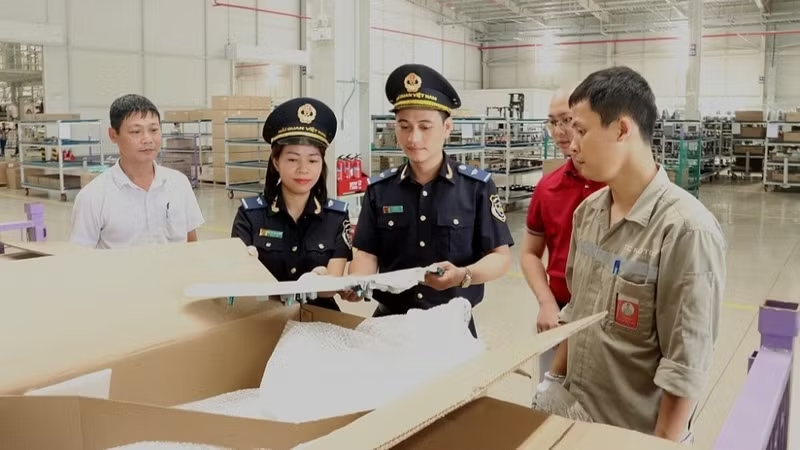
The shift from pre-clearance inspection to post-clearance inspection also changes how businesses fulfil their responsibilities and how customs agencies carry out management. Accordingly, businesses take the initiative in organising their business operations, while regulatory agencies conduct inspections and supervision using appropriate methods, based on compliance and data connected and shared by businesses.
Decree No. 273/2026/ND-CP also sets out tax policies for goods brought into duty-free shops for sale. Alongside the reduction of business conditions and the simplification of procedures, the new regulations provide a basis for shortening processing times, reducing compliance costs, and increasing businesses' autonomy.
These changes reflect a reform-oriented approach to managing duty-free goods, aimed at reducing unnecessary procedures and conditions while strengthening management and inspection through electronic data platforms. As a result, duty-free goods business operations are gradually becoming more convenient and transparent.
Management and supervision through electronic data platforms
Alongside the shift from pre-clearance inspection to post-clearance inspection, Decree No. 273/2026/ND-CP and Circular No. 82/2026/TT-BTC require greater use of information technology in the management of duty-free goods business operations.
Accordingly, duty-free goods businesses must ensure that the management software system meets the requirements for monitoring imported, exported goods, inventory, and sales; and fully stores data generated during operations. The enterprise's system must be able to connect, transmit, and share information with customs authorities according to regulations.
Duty-free shops, warehouses, and other relevant locations must also meet requirements relating to surveillance camera systems and technological infrastructure for management purposes. Maintaining these technical systems is not only a business requirement but also helps customs authorities monitor the movement, storage, and sale of goods.
On this basis, information on goods is managed throughout the entire process, from the time they are brought into duty-free shops or warehouses, through storage and transfer, until they are sold to eligible purchasers or handled in other ways in accordance with regulations. Data on imports, exports, and inventories are updated in the system, providing a basis for businesses to manage their own operations and for customs authorities to inspect and compare information.
These requirements lay the foundation for shifting management methods from a reliance on paper-based records and reports to management via electronic data. Information regarding the import, export, inventory, and sale of goods is updated on the system, facilitating customs authorities in monitoring, inspection, and comparing information.
At international airports, the processes of moving goods in and out, and conducting duty-free sales are managed via the customs electronic data processing system. This enables businesses to reduce paperwork and the frequency of in-person procedural steps, while providing customs authorities with a basis for monitoring business operations.
Once data are connected, customs authorities can compare information regarding import, export, and inventory volumes; verify the alignment between sales data and eligible customers; and detect fluctuations or anomalies to initiate appropriate inspections. Data-driven management also facilitates the classification of business compliance levels, thereby enhancing the effectiveness of post-clearance inspection.
For businesses, management through electronic data helps reduce the volume of paper documents, limit the need to enter the same information repeatedly and shorten the time to complete procedures. A centralised management system also helps businesses accurately monitor their goods, track inventory levels, and control sales activities at each location.
Standardising, connecting, and reusing data also helps reduce errors arising during declarations. Instead of repeatedly filling out forms with similar content, data that is already available in the system can be used for processing procedures, inspection, and supervision. This both reduces compliance costs and improves the consistency of management data.
However, the electronic management method also places demands on the quality of businesses' information technology systems. Data must be updated fully, accurately, and promptly, while systems must operate stably and ensure connectivity and data storage capacity. Businesses must also pay due attention to governance, access rights management, information security, and incident handling.
For customs authorities, institutional improvement must be carried out alongside the building and upgrading of information technology systems. These systems need to meet requirements for receiving, processing, analysing, and comparing data; supporting risk alerts; and providing information to customs officials in the performance of their duties.
One of the goals set by the customs sector is to digitise 100% of documents included in customs declaration registration dossiers, while continuing to cut unnecessary procedures and facilitate businesses' import and export activities.
In 2026 and the following years, the customs sector will continue to pursue the goal of abolishing at least 30% of unnecessary business and investment requirements, reducing the time needed to process administrative procedures by at least 30%, and cutting compliance costs for citizens and businesses by at least 30%, in line with the government's requirements.
The combination of simplified procedures and electronic data-based management helps increase businesses' autonomy while providing a basis for customs authorities to reform their methods of inspection and supervision. This is a step towards compliance-based management and the building of digital customs, creating more favourable conditions for duty-free goods business operations.