As agriculture shifts towards commercial production, data is becoming an integral part of production capacity. By recording data systematically, the sector can organise production more precisely and transparently, and so become more competitive in the digital economy.
From fields to data
Go Gon Agricultural Cooperative in Vinh Thanh Commune, Tay Ninh Province, is becoming a trusted data hub for farmers. Selected to take part in the project on the sustainable development of one million hectares of high-quality, low-emission rice cultivation, the cooperative applied a production model on about 50 hectares in the 2025-2026 winter-spring crop, with more than 10 farming households participating.
The cooperative adopted combine harvesters, straw balers, equipment for incorporating fertiliser into the soil and advanced cultivation practices. As a result, it achieved a yield of nearly 11 tonnes of rice per hectare, almost three tonnes more than with traditional farming methods, while cutting production costs by about 5 million VND (roughly 190 USD) per hectare.
As it invested in science and technology, the cooperative began digitising its production records across the whole production chain. Data on cultivated areas, farming practices, input materials, output and product quality is gradually being standardised.
The rice is grown under a controlled process, backed by an integrated information system that enables traceability. This has allowed the cooperative to establish a uniform raw material area with clear standards and reliable data, helping it meet the increasingly stringent requirements of export markets.
Truong Huu Tri, Director of Go Gon Agricultural Cooperative, said: “Digitising data adds value to rice by building partners’ confidence in the transparency of production processes and in our ability to demonstrate quality through data. This change may not be visible to the naked eye, but it matters when agricultural products seek to enter demanding markets, where every product must be tasty and clean, with a transparent origin and production process.”
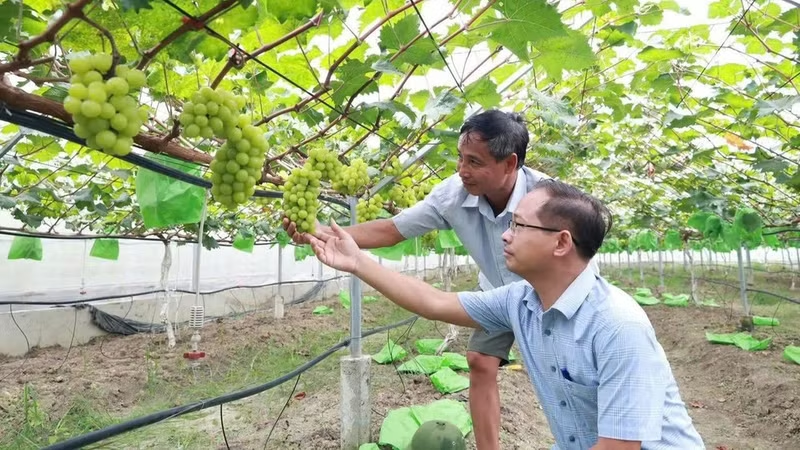
At Thieu Hung Agricultural Services Cooperative in Thieu Hoa Commune, Thanh Hoa Province, production data is being digitised in a similar way. In its concentrated growing areas for melons, cucumbers, grapes and other crops, notebooks and manual record-keeping are gradually giving way to smartphones and tablets.
Information on cultivated areas, crop varieties, planting dates, cultivation and crop care, inputs used and harvesting times is being systematically updated, stored and managed on digital platforms. This makes it easier to retrieve details of products, brands, production processes and quality standards.
Le Thi Tham, a member of Thieu Hung Agricultural Services Cooperative, said while checking the information on her phone: “Previously, we wrote everything down in notebooks. Now we upload the information to our phones and can check it immediately whenever we need to, so we know exactly what has been done in each field and how much input material has been used. Every stage of the process has been digitised, so we feel much more confident in our production.”
Digital transformation is helping cooperatives shift from traditional service provision to organising and managing production and linking value chains.
Nguyen Van Duong, Director of Thieu Hung Agricultural Services Cooperative, said conventional farming methods no longer met quality requirements. The cooperative had therefore adopted Israeli technology, including automated irrigation systems, misting systems and sensors, while also developing databases, introducing product traceability and expanding sales channels. These measures have helped reduce risks and improve the efficiency of marketing and sales.
Nguyen Dinh Tuan, Chairman of the Thanh Hoa Cooperative Alliance, said the province had recently organised 32 training courses for more than 1,300 cooperative managers and members. The province had also supported agricultural cooperatives in digitising management processes and using traceability labels for their products.
Many cooperatives are now taking the initiative in applying information technology to management and operations and adopting scientific and technological advances in production and business, thereby improving efficiency.
A new path for modern agriculture
From the rice fields of Tay Ninh to the fruit and vegetable growing areas of Thanh Hoa, cooperatives are gradually integrating data into agricultural production. Information that was once scattered across individual farmers’ notebooks is now being digitised, connected and standardised, making product origins more transparent.
Mai Quang Vinh, Chairman of the Board of Directors of the Viet Nam Digital Economy Cooperative Alliance, said: “Doing things right, recording accurately and maintaining effective control are the foundations for turning data into value. Technology is only a tool; the value of data comes from production discipline, farmers’ sense of responsibility and the management capacity of cooperatives. This is also what allows data to become a new asset in modern agriculture.”
Tuan said support for cooperatives needed to shift from fragmented, piecemeal assistance to coordinated public services that focus on key areas and meet cooperatives’ practical needs.
He called for stronger support for cooperatives to list their products on e-commerce platforms, connect agricultural producers with major buyers, encourage members to develop standard-compliant raw material areas and expand their activities into multiple sectors, trades and service stages.
Experience on the ground shows that when data is organised into an integrated system, it not only supports production but also builds management capacity and competitiveness for an entire region.
Cao Xuan Thu Van, Chairwoman of the Viet Nam Cooperative Alliance, said the alliance was mobilising resources to implement Politburo Resolution 57 on breakthroughs in science and technology development, innovation and national digital transformation.
For the cooperative sector, the resolution creates new opportunities to pool data from individual households and production areas into a shared resource that supports the organisation of production and adds value.
It also lays the groundwork for cooperatives to move beyond traditional production models and take on a new role: connecting, managing and harnessing data across agricultural production areas.
At the same time, the alliance is seeking partnerships with international organisations so that technology, data and innovation deliver tangible benefits to cooperative members.
The early successes of Go Gon Agricultural Cooperative and Thieu Hung Agricultural Services Cooperative show that science and technology, innovation and digital transformation are opening new approaches to modern agriculture.
Large-scale farming therefore requires not only larger fields but also smarter ways of organising production. In this model, cooperatives bring farmers together, organise production, consolidate data and connect value chains.
Taking control of data helps cooperatives steadily strengthen their autonomy in managing raw material areas and raise the value of their products. This, ultimately, is the purpose of innovation.