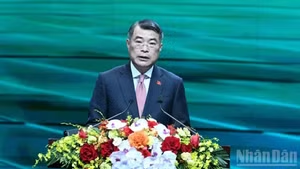
At a working session with local Party committees on June 4, 2025, Party General Secretary To Lam affirmed that these traditions are both the source of the character and identity of the people in the region and a foundation for inspiring aspirations for development, a spirit of innovation and creativity, and the determination to shape the future.
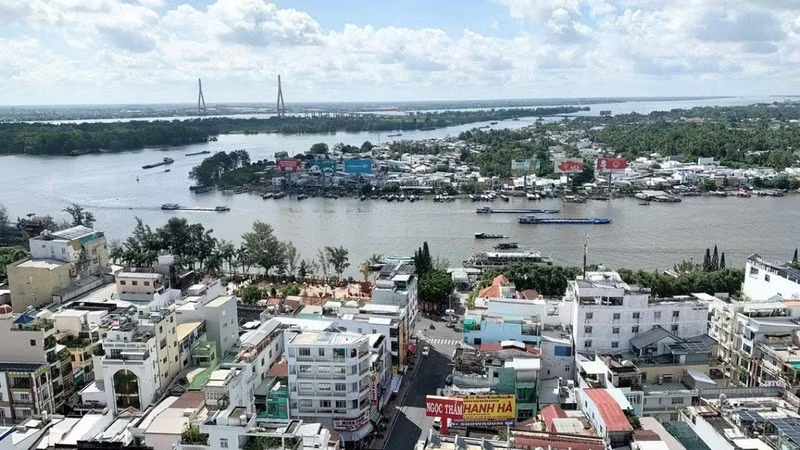
It is expected that Can Tho City will quickly establish itself as a dynamic growth pole at the heart of the southwestern region, serving as a hub for trade and spreading development across the region. Following the Party General Secretary's direction, the city's Party organisation, authorities, and people are determined to apply lessons from the revolution, continue to innovate and create, and lead the region in making breakthroughs towards the country's development goals.
Tapping new development space
With an important geostrategic position, Can Tho has been identified by the Party Central Committee as the economic centre of the Mekong Delta. This is a source of honour and pride for the local Party organisation, while also placing high demands on it as it faces numerous difficulties and challenges.
Determined to turn challenges into opportunities, the 2025-2030 Can Tho City Party Congress identified the need to synchronously improve institutions; resolutely remove bottlenecks and unlock resources; and maximise the city's potential, internal strength, and new development space. To this end, the entire Party organisation has focused on renewing its leadership methods in a proactive and creative manner, closely following reality and highlighting the role and responsibility of heads of agencies and units.
Immediately after the administrative merger, the Can Tho Party Committee instructed the city authorities to study and revise the city master plan to suit the new geographical space and development vision. On December 31, 2025, the municipal People's Committee approved adjustments to the city master plan, identifying strategic economic corridors, including the Chau Doc-Can Tho-Soc Trang corridor; the East-West Expressway corridor; the North-South corridor connecting the entire region; and the coastal corridor.
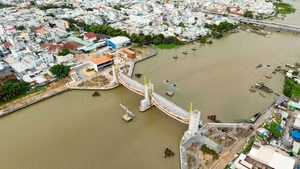
Functional zones have been planned in a coordinated manner, notably the more-than-40,000-hectare Tran De Economic Zone, a free trade zone, and an industrial-logistics-science and technology complex. The implementation of the master plan has been accelerated in conjunction with the implementation of the central government's strategic resolutions, helping remove a number of bottlenecks in the transport infrastructure system and gradually turning Can Tho into an intra-regional connectivity hub linking the region with major economic centres nationwide.
Following the merger, Can Tho City now has a 72-kilometre coastline, accounting for 2.21% of the country's total coastline. Focusing on tapping its new marine space, the Can Tho Party Committee issued Resolution No. 19-NQ/TU on April 29, 2026, on developing the city's marine economy through 2030, with a vision to 2045.
Several breakthrough solutions have been proposed, including building infrastructure, developing economic zones and industrial clusters to serve the marine economy, developing marine tourism and the fisheries economy, and attracting investment in marine energy sectors. At the same time, the city is implementing a strategy for agricultural mechanisation and the processing of agricultural, forestry, and fishery products through 2030.
With new spatial planning and production methods, Can Tho will become a driving force in transforming the Mekong Delta's major rice-producing locality into a regional high-tech agricultural hub.
At Tran De Fishing Port, activities and services have been bustling this August. Pham Van Hua, Director of the Tran De Fishing Port Management Board, said that the port's trade activity had increased sharply compared with 2025. In the first quarter of 2026, the port received 5,868 vessel arrivals and berths, exceeding the target by more than 103%. Cargo throughput reached more than 42,000 tonnes, making an important contribution to the locality's socio-economic development.
The strength of people's trust and revolutionary traditions as a foundation
Despite these positive results, the city's economic growth in the first six months of the year was estimated at 6.7%, ranking 31st among the country's 34 provinces and centrally-run cities. Taking a frank and responsible approach, the Can Tho Party Committee identified the reasons as the management of the larger territory and population following the merger failing to keep pace with practical requirements, while efforts to resolve long-standing projects and mobilise social resources remained limited.
Building on lessons from the historical traditions forged through numerous revolutionary movements in the Tay Do region, the Can Tho Party Committee is determined to continue renewing its thinking and management methods to mobilise the people's substantial resources towards development goals, with a focus on improving the effectiveness of the two-tier local government system in a people-oriented manner. Party committees at all levels and agencies have stepped up efforts to build digital government and shift administrative thinking towards serving the people.
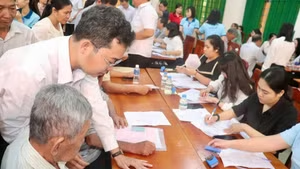
The Lam Tan Commune Party Committee has pioneered the use of mobile public administrative consultancy teams, applied AI digital assistants to help citizens complete administrative procedures, and introduced online satisfaction assessments and monitoring.
In the city centre, Thuan Hung Ward has publicly listed 471 administrative procedures under the ward-level authority and 1,689 city-level administrative procedures that can be carried out regardless of administrative boundaries, and has integrated QR codes to make it easier for residents to access and search for information.
Alongside administrative reform, the city's Party committees, authorities and agencies have strengthened their efforts to work alongside the people in resolving difficulties and obstacles and unlocking resources. As a locality hosting a number of the city's key projects, the Chau Thanh Commune Party Committee holds monthly and quarterly dialogues with residents, enabling it to promptly identify and address petitions concerning land and ensure people's legitimate rights and interests.
In implementing regulations on setting an example for heads of agencies and units, city leaders regularly hold dialogues with businesses to resolve difficulties related to mechanisms and policies and create favourable conditions for business development.
The specific and practical actions taken by the city's Party committees, authorities, officials, and Party members have received high appreciation from the people. In My Xuyen Ward, when the authorities implemented projects to widen roads and build hospitals, schools, and community cultural centres, more than 100 local households voluntarily donated land, moved fences, trees, and crops, and contributed more than 400 million VND, while working with the authorities to accelerate the projects.
Pham Van Dong, over 80, who lives on Tran Hung Dao Street, said that the practice of letting people know, discuss, and inspect matters by the ward Party Committee and authorities had helped residents understand the projects and encouraged them to willingly contribute their efforts to common work.
Can Tho is becoming an attractive destination for domestic and foreign investors. In the first seven months of 2026, the city attracted 24 new projects, including 21 domestic investment projects with total registered capital of more than 41.423 trillion VND and three foreign direct investment projects with total registered capital of 25.2 million USD. New growth drivers such as logistics, science and technology, and renewable energy have begun to generate positive economic results.
According to Dong Van Thanh, Standing Deputy Secretary of the Can Tho Party Committee and Chairman of the Can Tho People's Council, renewing governance thinking, improving the effectiveness and efficiency of the administrative apparatus, putting people and businesses at the centre of public service, and promoting great national unity while inspiring aspirations for development and a sense of responsibility across the entire political system will be breakthrough solutions in the coming period.
These efforts will help the city achieve its economic growth targets while ensuring rapid and sustainable development and improving the quality of life of the people; and are worthy of being a revolutionary "flagship" of the Mekong Delta.