Innovating to keep craft villages alive
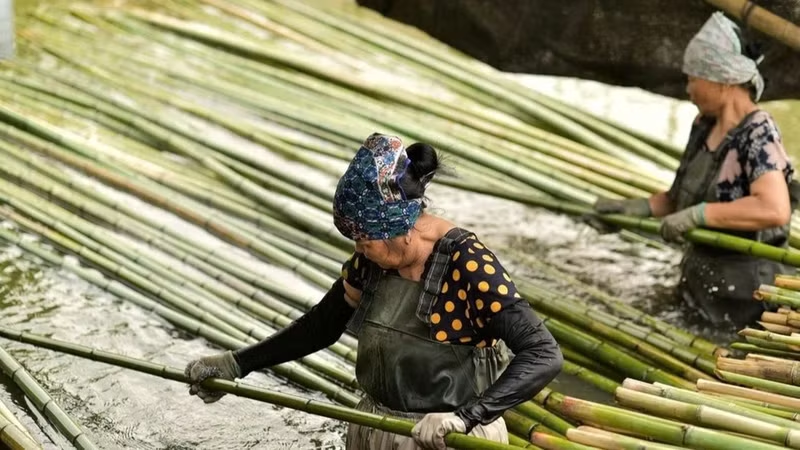
Xuan Lai bamboo and rattan craft village in Gia Binh Commune, Bac Ninh Province, has a history spanning more than 200 years. According to Meritorious Artisan Nguyen Van Ky, who has been involved in the craft for more than 30 years, the greatest value of Xuan Lai bamboo and rattan lies not in the raw material itself but in the traditional technique of smoking whole bamboo poles passed down through generations. "This is the distinctive feature that has built the village’s brand, and it is something we have always worked hard to preserve," Ky said.
To create a finished product, artisans have to go through nearly 20 stages, from selecting and soaking bamboo and cleaning it to smoking, processing, and finishing. Among these, smoking whole bamboo poles requires experience and meticulous attention to control the temperature, amount of smoke, and smoking time, creating the distinctive deep brown colour that has become the hallmark of Xuan Lai craft village.
As competition from industrial products and cheaper handicrafts of the same type intensifies, preserving these unique techniques has become a matter of survival for the craft village.
These days, the sound of cutting machines and chisels still fills workshops in Xuan Lai. Yet behind this bustle of work lies concern over declining orders, while the costs of materials, labour, and transportation continue to rise, forcing many establishments to operate only on a limited scale.
According to Ky, difficulties are unavoidable, but instead of pursuing output, artisans have chosen to maintain quality in order to protect the prestige and brand of the craft village.
Yet necessity has also bred ingenuity. Xuan Lai bamboo and rattan products, along with those of many other craft villages nationwide, have chosen adaptation rather than retreat, persevering with production innovation, enhancing product value, and expanding markets to lay the foundation for sustainable development.
At Chuyen My mother-of-pearl inlay craft village in Ha Noi, mother-of-pearl and seashell pieces are still meticulously inlaid into wood using traditional techniques, but the way products reach the market has changed.
Instead of waiting for customers, artisans and business owners have proactively put their products on websites, social media platforms, and e-commerce marketplaces, while actively participating in domestic and international fairs and exhibitions to expand their markets.
The proactive approach taken by craft villagers has helped Chuyen My mother-of-pearl inlay products reach consumers, demonstrating the adaptability of a craft village that preserves its unique traditional techniques while entering the modern market.
Currently, 99% of households in the craft village make their living from traditional crafts, with mother-of-pearl inlay providing livelihoods for many families while helping preserve cultural identity, create jobs, and increase local incomes.
Sharing the village’s achievements, Artisan Vu Van Dinh expressed his delight, saying that thanks to greater use of digital technology to expand markets, Chuyen My mother-of-pearl inlay products are now sold nationwide and exported to Western European markets and many Southeast Asian countries.
By choosing the right path for development while preserving the essence of their craft, Chuyen My artisans have breathed new life into the mother-of-pearl inlay trade. Building on traditional techniques, they have refreshed products ranging from furniture and gifts to decorative items, striking a balance between craftsmanship and modern aesthetic trends and better meeting market demand.
Preserving identity while adapting to market demand
Commenting on the future of craft villages, Nguyen Thi Thuy Huong, Vice Chairwoman of the Chuyen My Commune People’s Committee, said that alongside preserving traditional crafts, the locality is working with specialised agencies to support businesses in applying digital technology, building brands, participating in the OCOP Programme, promoting trade, and connecting products with consumers to enhance the competitiveness of craft village products.
Amid constantly changing markets, the vitality of craft villages cannot rely on tradition alone. It needs to be reinforced by innovation, digital transformation, brand building, and sufficiently strong policies to preserve and promote the value of traditional crafts.
From a management perspective, Le Duc Thinh, Director of the Department of Cooperative Economy and Rural Development, said craft villages play not only a role in preservation but also serve as an important driver of rural economic development, job creation, and income improvement. However, for craft villages to develop sustainably, they need to shift their mindset from production to a craft village economy, with market demand at the centre.
Alongside preserving the craftsmanship passed down from previous generations, production establishments need to focus on renewing designs, building brands, improving product quality, promoting digital transformation, and using e-commerce to expand their markets. At the same time, craft village development should be linked with the OCOP Programme, rural tourism, and value chains to increase product value.
Experience from Xuan Lai smoked bamboo craft village and Chuyen My mother-of-pearl inlay craft village shows that, although they have chosen different paths, both share the same goal of preserving traditional crafts in a new context.
While Xuan Lai has persevered in preserving its technique of smoking whole bamboo poles, using quality as the foundation for protecting its brand, Chuyen My has proactively embraced digital transformation, expanded online sales channels, and diversified its markets.
The efforts of Xuan Lai and Chuyen My to "keep their crafts alive" offer a path forward for many craft villages nationwide: taking tradition as the foundation and innovation as the driving force. Only when connected with technology, digital transformation, e-commerce, and a market-oriented mindset can traditional identity truly become a competitive advantage. At that point, each craft village product will generate not only economic value but also promote cultural values, contributing to rural economic development and sustainable new-style rural development.