Heritage villages embrace experiential tourism
Quat Dong embroidery village in Thuong Tin commune has long held a place on Viet Nam’s “embroidery map”. Yet in the past, visitor numbers were modest. Embroidered products were mainly sold to order or distributed wholesale to craft shops in Ha Noi’s Old Quarter. Today, however, the atmosphere in the village has changed markedly with the launch of embroidery workshops by Tu Thi Hand Embroidery Shop.
Bui Mai Lan, founder of Tu Thi, was born in Quat Dong and later built her own embroidery brand in the Old Quarter. She noticed that many customers wanted to learn about the craft, so in 2025 she introduced workshops as an immersive experience for enthusiasts of traditional arts.
Similar workshops had previously been held in the Old Quarter, receiving positive feedback and suggestions to host classes in the village itself. This allowed participants not only to learn the technique but also to explore the village—engaging with its space, its people, and the rhythm of Quat Dong embroidery.
The workshop in Quat Dong is led by Pham Thi Huong, a 55-year-old manager at Tu Thi and a native of the village, who has devoted more than 40 years to the craft. Under Huong’s meticulous guidance, participants learn how to thread needles, stitch, blend colours, and appreciate the generational flow embodied in each piece.
Alongside practical skills, they stroll through the village to hear stories of its craft, take photographs, and savour rustic cuisine.
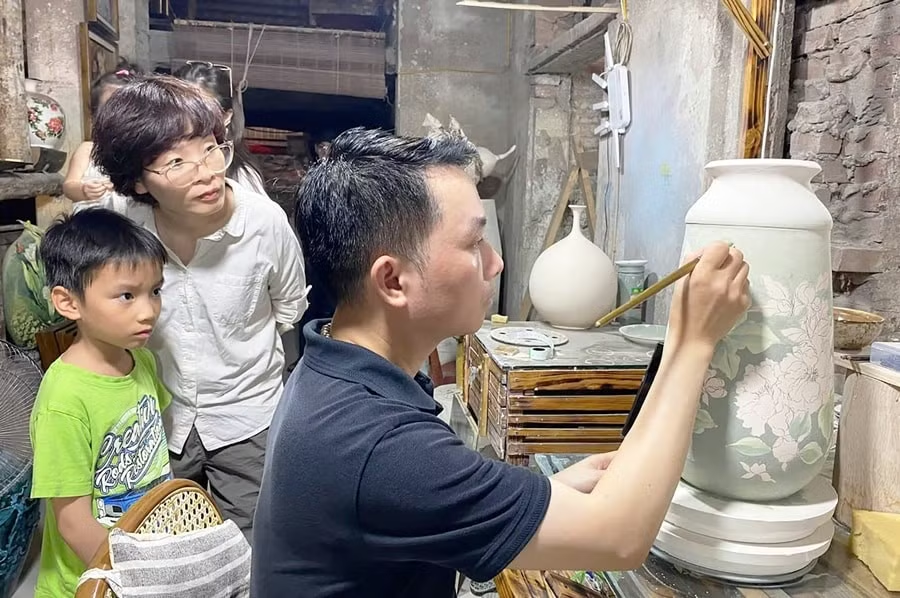
Bat Trang pottery village is home not only to a wide range of ceramic products but also to a rich trove of tangible and intangible cultural heritage. Recently, local authorities unveiled the “Rotating Table” model, a cultural-industrial ecosystem connecting three main pillars: performing arts, tourist experiences, and heritage education.
The project comprises three major activities: visiting and learning about the village communal house and the site honouring scholarly achievement; exploring old houses, sampling local cuisine, and hearing artisans’ stories about Bat Trang’s delicacies; and watching pottery demonstrations while practising pottery-making.
The model of offering experiential services is increasingly promoted across Ha Noi’s traditional craft villages
This is positioned as a high-end experiential tourism product. It exemplifies a new heritage approach, turning heritage narratives into concrete cultural-industrial offerings.
The model of offering experiential services is increasingly promoted across Ha Noi’s traditional craft villages, including Xuan La ‘to he’ (toy figurine) village in Phuong Duc commune, Chang Son fan-making village in Tay Phuong commune, Chuong conical-hat village in Thanh Oai commune, and Phu Vinh bamboo and rattan village in Phu Nghia commune. Local artisans are proactively creating dedicated spaces for visitor experiences rather than simply offering sightseeing tours.
The studio of artisan Dang Van Hau in Xuan La village has become a creative space for telling the craft’s story, showcasing its beauty, providing vocational training, and offering visitor experiences.
Similarly, a space developed by artisan Nguyen Thi Tuan in Chang Son hosts hundreds of visitors a day, who are guided to make colourful handmade paper fans themselves.
Challenges remain in turning craft into tourism
Craft-village tourism in Ha Noi’s suburban areas is making a distinct mark with experiential activities. Yet in reality, there are still relatively few “deep-experience” tours with distinctive cultural flavours, especially when compared with the total of 1,350 craft villages.
Many villages still face difficulties in organising structured tourism products, lack links with tour operators, and have not fully exploited local cultural values.
Ha Thi Vinh, Chairwoman of the Ha Noi Handicraft and Craft Village Association
In some villages, although they have joined the World Crafts Cities network—such as Son Dong lacquer sculpture village—visitor numbers remain low. Local artisans mainly focus on production and have not prioritised tourism or creating added value through experiences. Activities are often held spontaneously and lack proper orientation.
According to Ha Thi Vinh, Chairwoman of the Ha Noi Handicraft and Craft Village Association, many villages still face difficulties in organising structured tourism products, lack links with tour operators, and have not fully exploited local cultural values. As a result, craft-village tourism remains largely focused on selling ready-made products.
To foster tourism development in craft villages, People’s Artisan Nguyen Van Tinh proposes that functional agencies should deploy coordinated measures.
These include training artisans not only to be highly skilled in their craft but also proficient in tourism, communications, storytelling, and experience design; strengthening connections with tour operators; and stepping up support for marketing and brand-building on digital platforms and international markets.