Site clearance hurdles and pressure from escalated complaints
Despite being underway for years, the project to address erosion and reinforce the riverbed in Ganh Hao Town (Ganh Hao Commune) — spanning 945 meters with a total investment of over 310 billion VND — still has eight out of thirty-nine cases (primarily involving businesses) where the site has not yet been handed over.
According to Huynh Tan Khanh, Head of the Ganh Hao Commune Division of Economy and Infrastructure, local authorities are actively coordinating with provincial departments, agencies, and the project owner to review dossiers and submit them to the Provincial People’s Committee for resolution in accordance with regulations.
If necessary, local authorities will prepare plans to ensure security and order during construction and guarantee the handover of a clear site to the project owner, thereby making up for lost time and accelerating project progress.
Nguyen Minh Duc, Director of the Provincial Agricultural Project Management Board, acknowledged that the lack of synchronised site handover, combined with fluctuating construction material prices, forced two-thirds of the original contractors to request contract terminations. This has slowed construction progress, with only about 50% of the workload completed so far.
The project developer is urgently coordinating with relevant agencies to resolve site clearance issues while simultaneously signing contracts with new contractors to make up for lost time, demonstrating a firm commitment to completing the project as scheduled by the end of 2026.
According to the Ca Mau Department of Agriculture and Environment, as of mid-July 2026, there were 57 key projects requiring land acquisition, covering a total area of over 1,431 hectares and directly affecting 7,251 households and individuals as well as 15 organisations.
However, certain major transport infrastructure projects still face unresolved challenges; for instance, regarding the road construction project from Trem Trem to Xeo Quao, 85 out of 503 affected households have yet to receive compensation, while the DT.979 road project (connecting Phuoc Long and Ba Dinh) has encountered difficulties due to a lack of consensus among some local residents.
According to the Provincial Party Committee’s Internal Affairs Commission, the number of petitions and complaints submitted directly to the Standing Committee of the Provincial Party Committee and provincial-level agencies — bypassing lower administrative levels —reached 468 in the first six months of the year, an increase of nearly 70% compared to the same period in 2025. A significant proportion of these submissions concerned compensation and land-related issues.
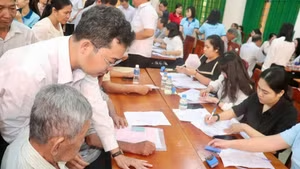
Tran Huu Phuoc, Head of the Internal Affairs Commission, stated that most of these “skipped-level” petitions stemmed from citizen dissatisfaction with the handling of their cases by grassroots authorities; instead of addressing the issues locally, they escalated them directly to higher levels.
This situation not only places pressure on provincial citizen reception offices but also prolongs resolution times and incurs additional travel costs for citizens. Furthermore, the transition to a two-tier local government model has left some grassroots officials — who lack in-depth experience and feel overwhelmed by policy changes — hesitant and fearful of making errors, resulting in delays in case processing.
Decisively removing obstacles to boost capital flow
Recognising these “bottlenecks”, the Standing Committee of the Provincial Party Committee and the People's Committee of Ca Mau Province have recently implemented a series of synchronised, decisive, and breakthrough solutions, treating this as a key political task and a top priority.
As of the end of July 2026, the total public investment plan for the province (including capital carried over from 2025) stood at over 10.32 trillion VND, with more than 3.46 trillion VND disbursed (reaching 33.5%). Regarding the 2026 capital plan specifically assigned by the prime minister, Ca Mau achieved a disbursement rate of 40% (over 2.78 trillion), surpassing the national average of 38.75%.
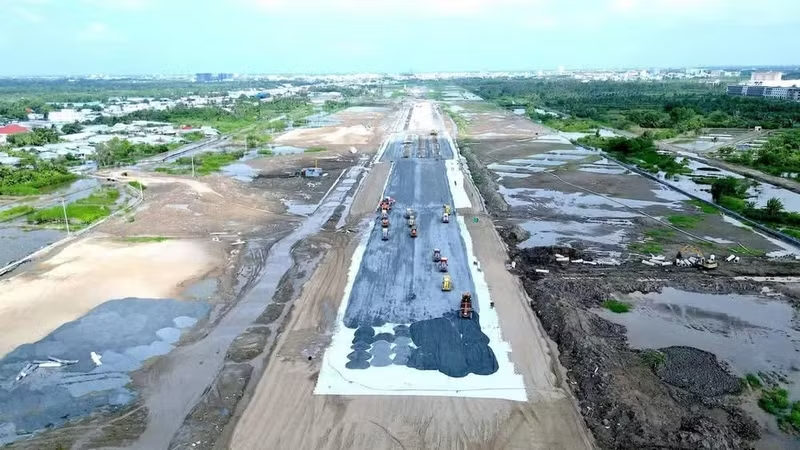
Many major projects have achieved 100% completion of site clearance, such as the upgrades to Ca Mau Airport, the Ca Mau–Dat Mui Expressway, and the access road to Hon Khoai Island, while others have reached high clearance rates, including the West Sea Dike project (97.58%) and the Bac Lieu Outer Ring Road (98.82%).
According to Lu Quang Ngoi, Deputy Secretary of the Provincial Party Committee and Chairman of the Provincial People's Committee, the Standing Committee of the Ca Mau Provincial Party Committee issued Directive No. 10/CT-TU (dated June 29, 2026) to strengthen Party leadership regarding compensation, support, resettlement, and site clearance work.
This directive also aims to effectively implement Scheme No. 03-DA/TU and Regulation No. 05 regarding the responsibilities of heads of agencies in receiving citizens and engaging in direct dialogue with the public.
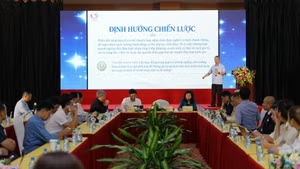
The Standing Committee of the Provincial Party Committee has also established five supervision teams —led by members of the Standing Committee — to conduct direct inspections and resolve obstacles on site. The consistent guiding principle of the provincial leadership is the need to shift mindsets and enforce strict public service discipline.
“Commune-level authorities must be more proactive in shifting from a mindset of ‘waiting for citizens to come’ to actively ‘meeting citizens’, thereby grasping and thoroughly resolving issues right at the grassroots level. Specialised agencies must focus on finalising documentation and resolving project obstacles, ensuring that the passing of the buck or fear of responsibility does not delay the progress of compensation and site handover,”emphasised Lu Quang Ngoi, Deputy Secretary of the Provincial Party Committee and Chairman of the Provincial People's Committee.
Nguyen Ho Hai, Secretary of the Ca Mau Provincial Party Committee, emphasised that public investment serves as a key driver of local socio-economic development, contributing to the realisation of the province's goal of achieving double-digit growth throughout the 2026–2030 period. To ensure 100% disbursement of allocated funds, Party committees, authorities, and heads of agencies must strictly uphold individual accountability and enforce rigorous public service discipline.
Results regarding site clearance and public investment disbursement will serve as decisive, mandatory criteria for evaluating officials' year-end performance. In cases where project owners fall behind schedule, the province will resolutely reallocate funds after the third quarter and consider reassigning officials or civil servants who lack the necessary competence or sense of responsibility.
With the entire political system taking decisive action, Ca Mau is gradually removing site clearance obstacles and unlocking the flow of public investment capital. The province aims to successfully meet its 2026 socio-economic development targets, thereby establishing a solid foundation for a breakthrough into double-digit growth during the 2026–2030 period.