Viet Nam and Australia upgraded their relationship to a Comprehensive Strategic Partnership in 2024. Cooperation agreements between Ho Chi Minh City and the Australian states of Queensland, New South Wales, and Victoria, as well as the Northern Territory, have further advanced economic and trade cooperation.
In the first seven months of 2026, bilateral trade between Viet Nam and Australia reached 9.79 billion USD, up 20% compared with the same period in 2025, while Viet Nam's exports to Australia rose by 30%. In Ho Chi Minh City, two-way trade with Australia totalled 1.56 billion USD in the first nine months of 2026. Exports reached 985 million USD, an increase of 16.3% year on year.
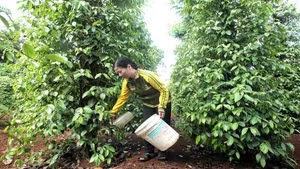
Many of Ho Chi Minh City's key product groups have opportunities to enter the Australian market. These include industrial goods, machinery and equipment, textiles and garments, footwear, timber and wood products, agricultural produce, seafood, processedfood and consumer goods. At the same time, the city is seeking cooperation with Australian partners in a range of fields, including technology, logistics, education, clean energy, green development, and other high-value-added industries.
Deputy Director of the Ho Chi Minh City Investment and Trade Promotion Centre Le Anh Hoang, said Australia was considered a market with strong purchasing power, diverse demand, and considerable untapped potential for Vietnamese goods. However, it also imposed stringent requirements on product quality, food safety, quarantine and biosecurity, traceability, and technical standards, alongside increasingly demanding sustainability criteria.
To enter and expand in the market effectively, businesses therefore need to proactively improve product quality and thoroughly familiarise themselves with Australian import regulations, consumer trends, distribution networks, and business practices.
According to Hoang, as a major economic, trade, and services hub and one of Viet Nam’s leading gateways for international commerce, Ho Chi Minh City has consistently focused on expanding export markets, diversifying trading partners, and strengthening business links with promising destinations. Australia is among those offering considerable potential for the city's businesses to further develop trade and investment cooperation.
Under its development strategy for 2026–2030, Ho Chi Minh City will continue to promote sustainable import and export activities, increase the added value of goods, accelerate digital and green transformation, develop logistics, and support businesses in integrating more deeply into regional and global supply chains. Expanding cooperation with high-standard markets such as Australia will also encourage businesses in the city to modernise production, improve product quality, and strengthen their competitiveness.
Experts say one of the advantages for Vietnamese businesses in Australia is the three free trade agreements to which both countries are parties: AANZFTA (the ASEAN–Australia–New Zealand Free Trade Area Agreement), CPTPP (the Comprehensive and Progressive Agreement for Trans-Pacific Partnership), and RCEP (the Regional Comprehensive Economic Partnership).
Commercial Consul representing the Viet Nam Trade Office in Australia Nguyen Manh Hiep said that amid rising trade protectionism, the reduction of tariffs on most import tariff lines to zero under these agreements helped businesses cut costs and improve their competitiveness.
However, to benefit from these preferences, businesses must comply with rules of origin and prepare all the necessary documentation. Under AANZFTA, they need to understand the rules of origin applicable to each product code, maintain transparent records of input materials, and be prepared to meet verification requests from Australian authorities, including after goods have cleared customs.
Businesses need to move from simply knowing that FTAs exist to mastering how to use them. This includes restructuring supply chains and maintaining strict control over material sources and documentation.
Nguyen Manh Hiep
Commercial Consul representing the Viet Nam Trade Office in Australia
Given this reality, Hiep recommended that businesses move from simply knowing that FTAs exist to mastering how to use them, with a focus on restructuring supply chains and maintaining strict control over material sources and documentation.
Alongside tariff advantages, businesses also face increasingly intense competition. Australian consumers exhibit strong brand loyalty, while Vietnamese goods must compete with products from China, Thailand, and India.

Businesses can broaden their market access through trade fairs and specialised exhibitions, partnerships with local distributors, or cross-border e-commerce for suitable products. For small and medium-sized enterprises, sectoral collaboration is also seen as a way to strengthen supply capacity and meet the requirements of major distribution networks.
According to experts, expanding exports to Australia requires businesses in Ho Chi Minh City to strengthen their capabilities across the board, from production and quality management to supply chain organisation. These are key areas in which the city is focusing its support for businesses seeking to expand imports and exports in conjunction with green and digital transformation, and efforts to enhance product value. This will gradually strengthen businesses' ability to integrate more deeply into international supply chains and markets.