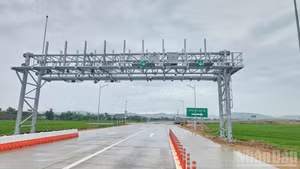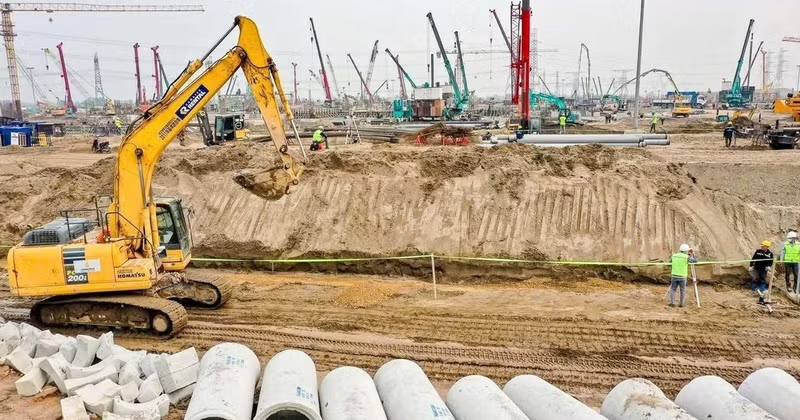
Disbursement rate reaches 35.5% of target
According to the Ministry of Finance, in the first two quarters of the year, public investment disbursement nationwide exceeded 356 trillion VND, representing 35.5% of the target set by the Prime Minister. Compared to the same period in 2025, the disbursement rate held steady but the amount of disbursed capital was 38.4 trillion VND higher. This increase stems from the total public investment plan for 2026 reaching an all-time high of 1.01 quadrillion VND.
Among top-performing localities in public investment disbursement, Ha Noi emerges as a standout performer, having disbursed 51.8% of the target set by the Prime Minister with an absolute figure of over 62 trillion VND, ranking the capital third nationwide in disbursement rate and first in total value disbursed.
Nguyen Ngoc Tu, Director of the Ha Noi Municipal Department of Finance, stated that the city has identified public investment disbursement as a central political task, serving as a crucial driver to propel growth in 2026 and subsequent years.
Therefore, from the outset, Ha Noi has issued directives and action plans, assigned KPIs to each department, sector, and project owner, while enhancing the inspection and monitoring of progress for each project.
Identifying site clearance as the primary bottleneck, Ha Noi mandates that projects facing delays at this stage establish detailed weekly schedules for both site clearance and disbursement.
Through this mechanism, implementation outcomes are linked to staff evaluations and the responsibilities of leaders, while capital reallocations will be considered for projects lagging schedule for two consecutive months.
For key and urgent projects, city leaders regularly conduct on-site inspections, establish critical path schedules for each component, and decisively reallocate funds from slow-progressing projects to those with higher disbursement capacity.
He added that in the third quarter, Ha Noi will finalise a digitalised database system for public investment projects, enabling real-time daily tracking and management of construction progress and disbursement.
In An Giang, the province’s total public investment plan for 2026 stands at over 28.6 trillion VND. In the first six months, more than 8.6 trillion VND was disbursed, achieving over 32% of the target set by the Prime Minister. For infrastructure projects serving the APEC 2027 Economic Leaders' Week, the disbursement rate reached over 38%, higher than the average.
Pham Minh Tam, Director of the An Giang Department of Finance, noted that the primary hurdle in public investment disbursement currently lies in these APEC projects. While accounting for over 50% of the province's public investment capital, many require adjustments to their total investment figures and capital structures, preventing funds from being disbursed despite completed volumes.
Public investment serves as a vital driver for An Giang to secure GRDP growth of about 10.71% in the second half of the year.
To accelerate the disbursement of public investment and help attain this growth target, the authorities have urged the Government to consider refining specific mechanisms for key projects and allocate additional central budget funds for strategic infrastructure, digital transformation, and APEC-related developments.
Focusing on the efficiency of public investment
Although the public investment disbursement rate in the first six months of the year remains modest, the silver lining is a clear trend of recovery and acceleration, reflecting the immense efforts made by ministries, sectors, and localities in their determination to invigorate a key driver of the economy.
Notably, numerous important national infrastructure projects have entered their peak construction phase, generating substantial volumes for major acceptance in the remaining months of the year. Furthermore, the impact of geopolitical fluctuations, raw material prices, and transport costs has begun to stabilise, creating favourable conditions to accelerate implementation and disbursement in the coming period.
Le Thanh Quan, Director General of the Department of Infrastructure Development under the Ministry of Finance, noted that from the perspective of capital efficiency, rapid disbursement is merely a necessary condition, whereas the ultimate goal is to maximise overall investment efficiency.
Consequently, if public investment projects experience prolonged schedules, undergo multiple adjustments, or are slow to enter commercial operation, costs will escalate, capital efficiency will be reduced, and the ICOR (Incremental Capital Output Ratio) will be adversely affected.
According to the Statistics Office, the average ICOR was 6.77 during the 2016–2020 period before slightly declining to 6.43 in 2021–2025. From 2024 to 2025, the ratio showed signs of easing, recording figures of 5.79 and 5.15, respectively.
Le Thanh Quan stated that to reduce the ICOR to 4.5–4.8 during the 2026–2030 period as targeted in Conclusion No. 18-KL/TW of the Second Plenum of the 14th Party Central Committee on the Five-Year Plan for socio-economic development, national finance, public debt borrowing and repayment, and medium-term public investment for 2026–2030, in line with the goal of striving for double-digit growth, close coordination and strong determination from ministries, sectors, and localities are essential. They must synchronously implement long-term solutions to streamline disbursement and enhance the efficiency of public investment.
Specifically, it is necessary to continue refining the legal framework to eliminate regulatory gaps in investment activities; enhance the quality of planning, investment preparation, and project selection; and continue to restructure public investment towards a more focused and targeted approach.
It is crucial to promote the responsibilities of leaders in execution, streamline administrative procedures, and resolve bottlenecks related to material supply and pricing, site clearance, and project management personnel.
It is also necessary to innovate the public investment management mindset towards prioritising investment efficiency as the core objective, bringing works into operation swiftly, and maximising socio-economic benefits.
In addition, management and monitoring throughout implementation must be strengthened, alongside regular reviews to reallocate capital from delayed, under-disbursed, or redundant projects to those making good progress.
Finally, the role of public investment in leveraging social resources must be fully capitalised on by focusing capital on strategic and highly connected infrastructure projects, while accelerating digital transformation and information technology application in public investment management.
As the strategic advisory body on socio-economic development, for the remaining months of the year, Minister of Finance Ngo Van Tuan has requested units under the Ministry of Finance to coordinate with ministries, sectors, and localities to ensure the disbursement of 100% of the 2026 planned capital, tied closely to capital efficiency, thereby creating momentum for the economy.









![[Infographic] GRDP growth scenarios for 34 provinces and cities in fourth quarter of 2026](https://en-cdn.nhandan.vn/images/nyM650OGFWrOVWc-xajqN-rTZ68Rlmc1fiGJOhBRYHFSa4DhrHNDxEFdnz313Vk5dNJuxdkHglPA3rLeaPeiaUheNuCI723k2lNssd-YLJuKR58epWq7s21lV5WjM-HR2-Qpbi4MwAzqt9wRjL4WjGkfEz7RO9qhcwg8o8LQFK8/grdp-growth-scenarios-for-34-provinces-and-cities-in-q42026-anh-dai-dien.jpg.avif)