Capital allocation exceeds 98%, disbursement increases by over 38 trillion VND
According to a report by the Ministry of Finance on the allocation and disbursement of the public investment plan in 2026, the National Assembly allocated, and the Prime Minister assigned, a total public investment plan of more than 1 quadrillion VND to ministries, central agencies, and local authorities.
Of this amount, more than 89.4 trillion VND remains under the Government's authority for allocation. Specifically, nearly 44.8 trillion VND is earmarked for allocation to new projects after investment efficiency assessments conclude and medium-term public investment plans for the 2026–2030 period secure approval; 16.1 trillion VND will be directed to tasks and projects under the national target programmes; nearly 9.9 trillion VND is reserved for science and technology, innovation, and digital transformation; and nearly 18.6 trillion VND comes from reductions in the 2026 capital plans of ministries, central agencies, and localities, which will be transferred to the Government's unallocated capital fund.
By the end of June 2026, ministries, central agencies, and localities had specifically allocated nearly 1 quadrillion VND to specific tasks and projects. Excluding the additional local budget balance capital of more than 14.7 trillion VND, the total amount of capital specifically allocated exceeded 985 trillion VND, equivalent to 98.1% of the plan assigned by the Prime Minister. This figure includes the 5% local budget savings reserved for the proposed Lao Cai–Ha Noi–Hai Phong railway project.
At present, more than 19.3 trillion VND, accounting for 1.9% of the capital plan assigned by the Prime Minister, remains unallocated by nine ministries, central agencies, and 26 local authorities. According to the report, the main reason is that many tasks and projects are still finalising investment procedures and therefore do not qualify for capital allocation. Of this amount, around 8.8 trillion VND is funding for national target programmes that was only added in the middle of June. In addition, several ministries, sectors, and localities have proposed reducing their capital plans because the funds are no longer needed and can be transferred to other units.
Regarding disbursement, by June 30, 2026, nearly 357 trillion VND had been disbursed nationwide, reaching 35.5% of the plan assigned by the Prime Minister. Compared with the same period of 2025, the value of disbursed capital increased by more than 38.3 trillion VND, although the disbursement rate was 0.5 percentage points lower.
Excluding the more than 32.5 trillion VND (equivalent to 5% of the public investment budget plan from the local budget) reserved for the proposed Lao Cai–Ha Noi–Hai Phong railway project, the nationwide disbursement rate reached 36.7% of the total capital plan of more than 972 trillion VND.
Removing obstacles and accelerating key projects
According to reports from ministries, central agencies, and localities, the pace of disbursement remains hindered by various challenges. One of the most significant issues is the shortage of construction materials, which fails to meet the increasing demand during the current push for public investment. In addition, the distribution of construction materials between regions remains uneven. Fluctuations in fuel prices and transport costs have also created cost differences, forcing many projects to revise their contracts.
Site clearance remains a major bottleneck due to unresolved issues related to determining land origins, compensation rates, and compensation plans, preventing many projects from proceeding as scheduled. Furthermore, the capacity and responsibility of some project investors, project management boards, and contractors remain limited. Some communes and wards also lack officials responsible for public investment and have to assign multiple duties to the same staff. Inaccurate planning that does not reflect actual demand and implementation capacity, together with the poor quality of investment preparation for some projects, has resulted in project adjustments or the return of allocated capital, further slowing the pace of disbursement.
To accelerate disbursement during the remaining months of the year, the Government has directed ministries, central agencies, and localities to reinforce the role and responsibility of their heads, promptly resolving difficulties within their authority or reporting them to the relevant authorities for consideration and resolution.
Regarding site clearance and the supply of construction materials, ministries, sectors, and localities are required to strictly implement the Prime Minister's directives set out in Official Dispatch No. 25/CD-TTg dated March 21, 2026, and Official Dispatch No. 28/CD-TTg dated April 1, 2026. The Ministry of Construction is tasked with closely monitoring developments in the construction materials market and coordinate with localities to balance regional supplies to ensure sufficient materials for projects.
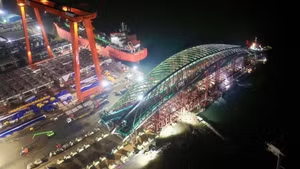
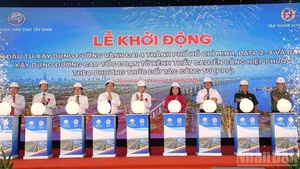
For key transport projects, the Ministry of Construction and localities are required to fully implement the tasks specified in Notice No. 343/TB-VPCP dated July 1, 2026, with the aim of achieving a higher disbursement rate for key projects than the national average during the third quarter of 2026. At the same time, discipline and order will be reinforced, while project investors, project management boards, organisations, and individuals who fail to fulfil their responsibilities or hinder project progress will be dealt with strictly. Authorities will also review staffing levels to ensure there are enough officials to manage public investment effectively, particularly in remote communes and wards.
According to the report, by June 30, 2026, key transport projects had disbursed nearly 59.3 trillion VND, equivalent to 24.2% of the total capital plan of more than 245 trillion VND.
Notably, two nationally important railway projects were allocated a combined capital plan of approximately 101 trillion VND, accounting for 75.6% of the Ministry of Construction's 2026 capital plan, but their disbursement progress lags. The North–South high-speed railway project has disbursed just over 1.068 billion VND, equivalent to 2% of its capital plan of nearly 56.9 trillion VND. Meanwhile, the Lao Cai–Ha Noi–Hai Phong railway construction project has disbursed nearly 1.2 trillion VND, reaching 2.5% of its capital plan of more than 48.1 trillion VND.
According to the assessment, the slow disbursement of these two railway projects has significantly impacted the Ministry of Construction's overall disbursement results, as well as the disbursement rate of nationally important projects. Excluding the capital plans and disbursement results of these two railway projects, the disbursement rate for key transport projects reached 40.8% of the planned target, higher than the national average.