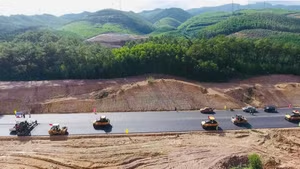
Ho Chi Minh City–Moc Bai Expressway land clearance to be completed in October
According to the Ho Chi Minh City Department of Agriculture and Environment, the 24.7-km section of the Ho Chi Minh City–Moc Bai Expressway running through the city passes through the five communes of Phu Hoa Dong, Nhuan Duc, Thai My, Cu Chi, and Tan An Hoi. The project affects 2,118 landholders, with approximately 217.65 hectares expected to be acquired.
So far, 1,993 affected households and organisations have agreed to receive compensation, support, and resettlement payments, accounting for 94%, with total funding exceeding 5,064 billion VND. A total of 2,089 landholders have agreed to hand over their land, representing 98.63% and covering 185.17 hectares. The city has identified land clearance as a pressing task to facilitate construction.
Phan Van Rat, from Ba Sa Hamlet in Tan An Hoi Commune, who handed over his agricultural land to the Commune People's Committee at the end of September.
“After handing over 300 square metres of land for the project, my family still has more than 1,000 square metres left, so this is also an opportunity to renovate our house. We also hope construction will begin soon so that local people can see vehicles travelling along this expressway,” he said.
According to the Department of Agriculture and Environment, the resettlement area for the project in Nhuan Duc Commune is expected to be completed and commissioned by the end of 2026, ensuring stable accommodation for households whose land is acquired.
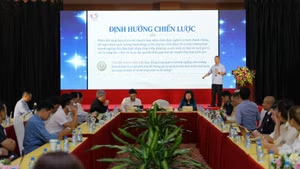
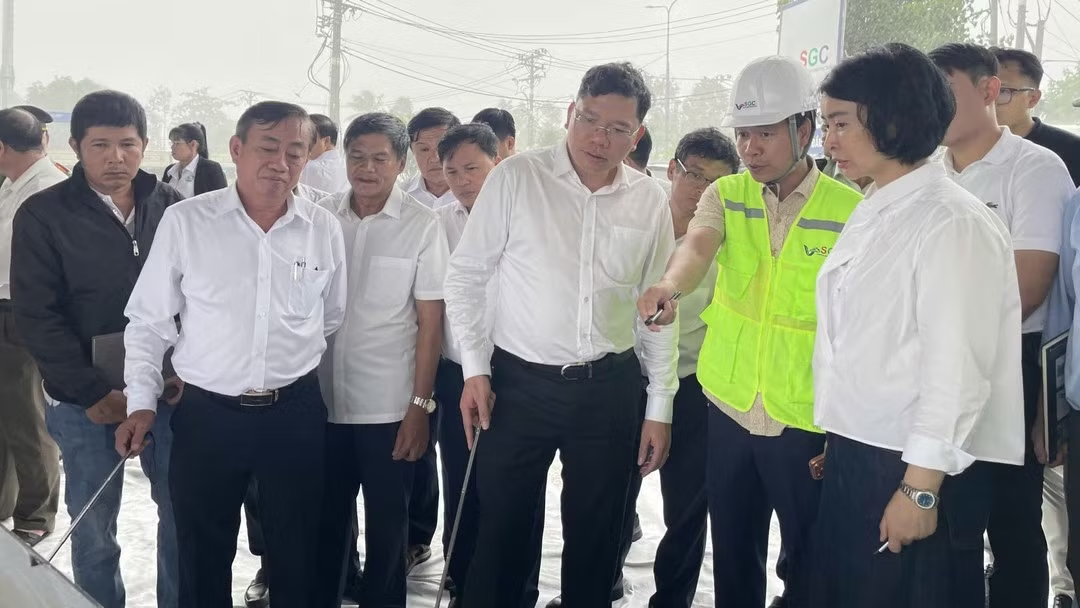
During a recent site inspection of the Ho Chi Minh City–Moc Bai Expressway in Phu Hoa Dong Commune, Vice Chairman of the Ho Chi Minh City People's Committee Hoang Nguyen Dinh, acknowledged the efforts of the authorities of the five communes along the route. However, he noted that implementation remained behind schedule relative to targets set at the previous progress review meeting.
He urged the local authorities to work closely with the Transport Construction Investment Management Board, the project investor, to complete compensation procedures and strive to conclude land clearance in October 2026, ensuring that construction can proceed. Another issue requiring a prompt resolution is the provision of resettlement arrangements and temporary accommodation allowances for residents while awaiting plots in the resettlement area.
Representatives of the contractor consortium, comprising 194 Investment and Construction Corporation Joint Stock Company and Lizen Joint Stock Company, said that two concrete batching plants were being installed. The first bridge girder is expected to be cast in mid-October.
The expressway will have interchanges with Provincial Roads 15 and 8, National Highway 22, and Road 787B. At Thay Cai Canal, the crossing will comprise a 13-span bridge, with the three central spans to be constructed using the balanced cantilever method. The contractor has pledged to complete the project components before November 2028, ensuring that the entire expressway can be opened to traffic as planned.
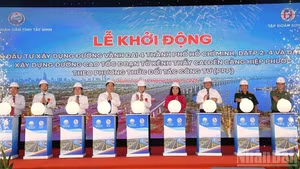
Previously, in August 2025, Ho Chi Minh City broke ground on Component 1 of the Ho Chi Minh City–Moc Bai Expressway project, involving the relocation of technical infrastructure. This is a key national project whose investment policy was approved by the Prime Minister under Decision No. 760/QD-TTg dated August 2, 2024. It is being implemented under a public-private partnership (PPP) model through a build-operate-transfer (BOT) contract.
The expressway is 51 km long, including 24.7 km in Ho Chi Minh City and 26.3 km in Tay Ninh Province. It begins at the Ring Road 3 connection in Phu Hoa Dong Commune and ends at National Highway 22, approximately 7 km from the Moc Bai Border Gate. The road is being built to expressway standards, with a design speed of 120 km/h and four fully developed lanes.
Expedited construction of the Ben Luc–Long Thanh Expressway interchange with Rung Sac Road
Identifying the interchange connecting the Ben Luc–Long Thanh Expressway with Rung Sac Road in Binh Khanh Commune as a critical project linking the western and southern parts of the city, Vice Chairman of the Ho Chi Minh City People's Committee Hoang Nguyen Dinh, conducted a site inspection to survey the proposed site. He said the project was a key and pressing priority to be implemented through the appointment of an EPC general contractor. Accordingly, consultancy, construction, and the relocation of electricity, water supply, and telecommunications infrastructure needed to proceed under an appropriate mechanism.
According to the Binh Khanh Commune People's Committee, the project requires the acquisition of 21.44 hectares of land and affects 100 households. The commune is actively carrying out land clearance, paying compensation, and encouraging residents to hand over their land promptly. So far, 45 of the 100 affected households have transferred their land, covering 17.29 of the total 21.44 hectares, or 80.64%.
Vice Chairman Hoang Nguyen Dinh called on relevant agencies to focus on land clearance, construction, and the relocation of technical infrastructure to ensure that all components of the interchange project proceed in a coordinated manner. The project developer must proactively coordinate with electricity, water supply, and telecommunications providers to determine the precise areas affected and develop relocation plans.
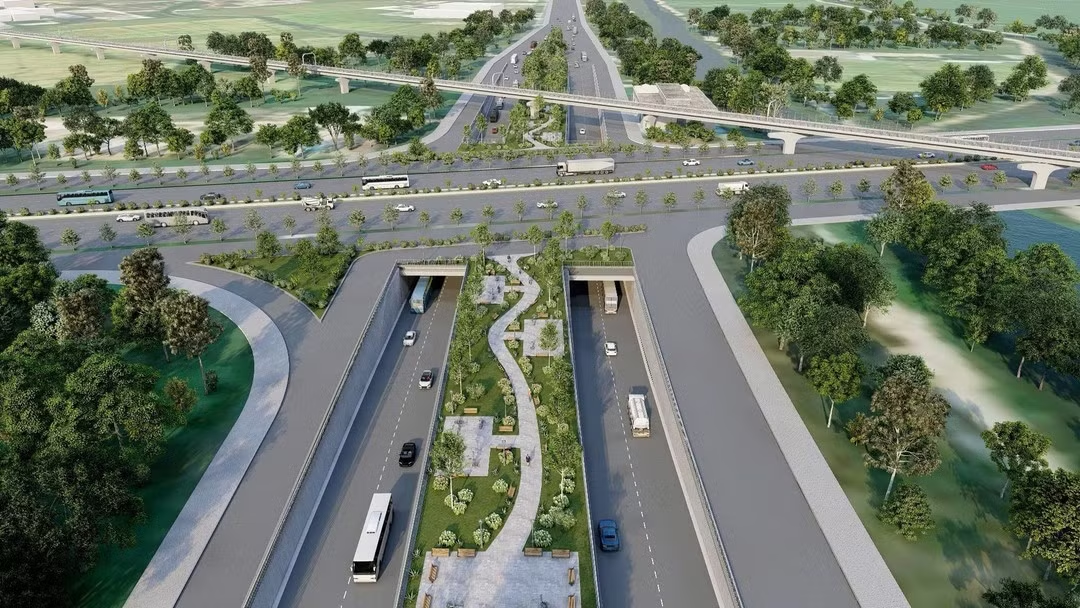
The interchange project is designed as a grade-separated junction, comprising overpass ramps and underpasses, with a roundabout at ground level to direct vehicles towards different routes. The total preliminary investment for the project is nearly 3,000 billion VND, with funding proposed from the city budget. Construction is expected to begin in the fourth quarter of 2026 and be completed in 2028.
The nearly 58-km Ben Luc–Long Thanh Expressway, which connects Tay Ninh, Ho Chi Minh City, and Dong Nai, recently opened to traffic. Meanwhile, Rung Sac Road is a key transport artery in Can Gio, connecting Binh Khanh Ferry Terminal with the Vinhomes Green Paradise urban area. Once completed, the interchange linking the two routes is expected to ease travel for residents and enhance investment in both projects.
In particular, the project is expected to facilitate access to air transport. Once Long Thanh International Airport becomes operational, it will be more easily accessible from Can Gio via National Highway 51 and the Ben Luc–Long Thanh Expressway.