Under Resolution No. 216/NQ-CP on the government’s regular meeting in July, issued on August 6, 2026, the government once again asked ministries, sectors, and localities to strive to fulfil all targets set in the 2026 socio-economic development plan, particularly the goal of achieving economic growth of at least 10%.
Economic “locomotives” accelerate
Accordingly, the final six months of the year must focus on implementing a wide range of measures in a coordinated manner, striving for growth of around 11.7%, while promoting the role of “locomotives” of economic regions, growth poles, and major cities such as Ha Noi, Ho Chi Minh City, Hai Phong, Da Nang, and Dong Nai.
Following growth of 8.22% in the first six months of the year, Ha Noi has reviewed, updated, and adjusted its economic management scenario, targeting growth of 13.44% in the second half of the year to achieve annual growth of at least 11%. The city is also urgently conducting a comprehensive review of growth drivers and building detailed growth scenarios for each quarter and month, quantifying the contribution of each industry, sector, key project, and development resource, with the aim of achieving GRDP growth of around 12.5% in the third quarter and around 14.3% in the fourth quarter. Notably, the municipal People's Committee has also assigned relevant agencies to provide regular updates on factors that could affect the implementation of socio-economic development following the adjusted targets.
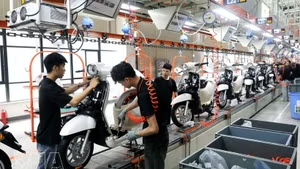
Ministries and sectors are also making every effort to accelerate economic development, with the goal of achieving double-digit growth while maintaining macroeconomic stability. The Ministry of Industry and Trade has asked the entire sector to introduce breakthrough measures to make up for shortfalls in growth targets, striving to fulfil and exceed the targets assigned by the government. The focus is on targets that were not achieved in the first half of the year, including total power generation capacity, the Index of Industrial Production (IIP), B2C e-commerce growth and the proportion of businesses applying e-commerce, total retail sales of goods, and consumer service revenue.
Notably, economic management has been required to become more flexible and proactive, focusing on resolving difficulties and obstacles of localities, businesses and key projects that still have room for growth. This entails promptly proposing solutions whenever there is a risk of failing to meet targets, rather than waiting for periodic reviews.
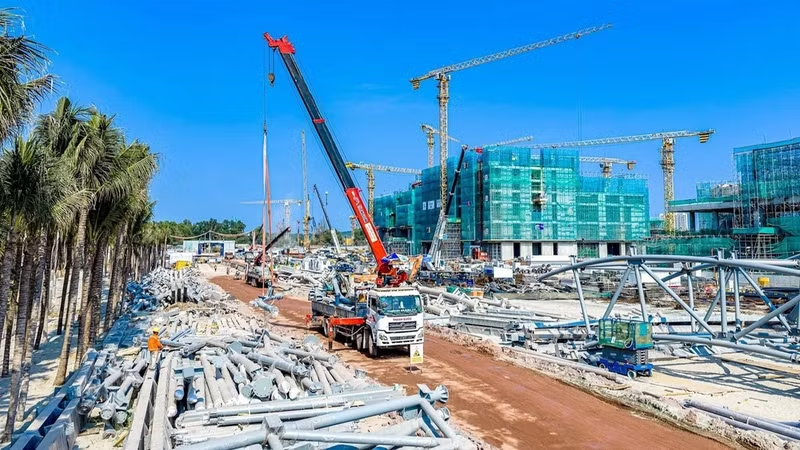
The Ministry of Finance has also advised the government on the issuance of detailed management scenarios to proactively and flexibly respond to unexpected market developments. At the same time, it continues to implement a range of coordinated solutions, with a focus on policies on tax exemptions and reductions as well as extensions for tax payments, land rental payments, fees, and charges; accelerating the disbursement of public investment capital; and striving to ensure that total state budget revenue for the year exceeds the 2025 figure by at least 10%.
Promoting new growth drivers
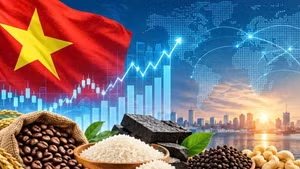
Recently, economic forums have raised concerns about the possibility of the trade balance reversing, as the trade deficit reached 20.52 billion USD in the first seven months of the year, compared with a trade surplus of 10.35 billion USD in the same period last year. This is a noteworthy development in international trade relations, as Viet Nam has consistently maintained a large trade surplus since 2016.
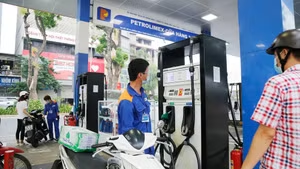
Deputy Minister of Finance Nguyen Duc Chi said that the trade deficit in the early months of the year had several aspects requiring attention. Global fuel prices have risen sharply, while domestic demand for fuel for production, business, and daily life has also increased, resulting in a significant rise in fuel import turnover. In addition, most import turnover was concentrated in components, machinery, equipment, and raw materials used for production. Viewed within the broader macroeconomic picture, the structure, scale, and nature of imported goods show that businesses are actively preparing their production capacity for orders and business opportunities.
Another macroeconomic indicator of concern is inflation. Average consumer price index in the first seven months rose by 4.39%, while core inflation increased by 4.19% year on year, approaching the 4.5% inflation-control target approved by the National Assembly. This reality poses a challenge for economic management in the final months of the year, which must ensure a balance between containing inflation, supporting growth, and maintaining macroeconomic stability.
The double-digit growth target is facing numerous challenges. This further highlights the need to promote new growth drivers alongside traditional ones, namely exports, investment, and consumption. Accordingly, growth drivers from the green economy, digital economy, and innovation need to be promoted more strongly, not only to create additional room for growth but also to help the economy reduce its dependence on traditional growth drivers if exports encounter difficulties.
Le Thi Tuong Thu
Deputy Director General of the Bureau of Statistics
Based on socio-economic developments in the early months of the year, Le Thi Tuong Thu, Deputy Director General of the Bureau of Statistics, said that the double-digit growth target is facing numerous challenges. This further highlights the need to promote new growth drivers alongside traditional ones, namely exports, investment, and consumption. Accordingly, growth drivers from the green economy, digital economy, and innovation need to be promoted more strongly, not only to create additional room for growth but also to help the economy reduce its dependence on traditional growth drivers if exports encounter difficulties.
Dr. Le Duy Binh, Executive Director of Economica Viet Nam, said that this is the time to resolutely accelerate the disbursement of public investment capital and government spending to help boost growth, lead social resources towards development investment, create jobs, and improve people’s livelihoods. Against the backdrop of complex and unpredictable regional and global developments, steadfastly pursuing the growth target while adopting proactive and flexible economic management will help ministries, sectors, and localities adapt quickly and shift their approach when necessary. When every risk has a contingency plan and every growth driver has a potential alternative, the economy will not only grow faster but also demonstrate greater resilience against unpredictable external shocks.