Through the concerted efforts of the political system, businesses, and the public, Gia Lai province has proactively shifted its management model from “passive administration based on outdated thinking” to a “development-oriented, action-driven government”, creating new momentum to overcome challenges and accelerate progress.
Removing bottlenecks and unlocking investment
Recently, Gia Lai has focused on resolving stagnation, refining management methods through substantive KPIs, and accelerating the digitisation of administrative procedures. These efforts aim to achieve a Gross Regional Domestic Product (GRDP) growth rate of 10.2% by 2026 — surpassing the 8–9.4% range set by central authorities. This goal represents not merely a growth target but also a determination to innovate, integrate, and advance.
While the province’s GRDP grew by 8.21% in the first half of the year, substantial effort is still required to meet the full-year target. Pham Anh Tuan, Chairman of the Provincial People’s Committee, emphasised: “The aspiration for double-digit growth cannot be realised through passivity or a lack of decisive implementation.”
Gia Lai’s administrative innovation focuses on two main approaches. The first leverages KPIs applied to specific tasks, linking duties to the concrete responsibilities of individual officials — including leaders of departments, sectors, communes, and wards — and to tangible outcomes. The second involves the digitisation of entire workflows and the application of artificial intelligence (AI) to process administrative procedures, particularly in the land sector.
Data reveals that within just two weeks of implementing the new model, the province eliminated over 1,200 unnecessary documents, saved more than 1,000 working hours, and reduced processing time to less than two hours per document.
“We are committed to a fundamental transformation from a passive administrative model to a development-oriented, service-oriented government. We will ensure that businesses do not wait for procedures, capital does not wait for projects, and development opportunities are not missed. The KPIs of each leader will provide answers to the public and the business community — not through promises, but through concrete results,” Tuan affirmed.
In the first half of the year, Gia Lai attracted 165 new projects, constituting the bulk of the 170 projects planned for the entire year. Total social investment capital rose by 8.9%, with non-state investment increasing by 11.9%. Projections indicate that by the end of 2026, Gia Lai will have attracted a total of 610 trillion VND in investment capital, with private investment exceeding 350 trillion VND.
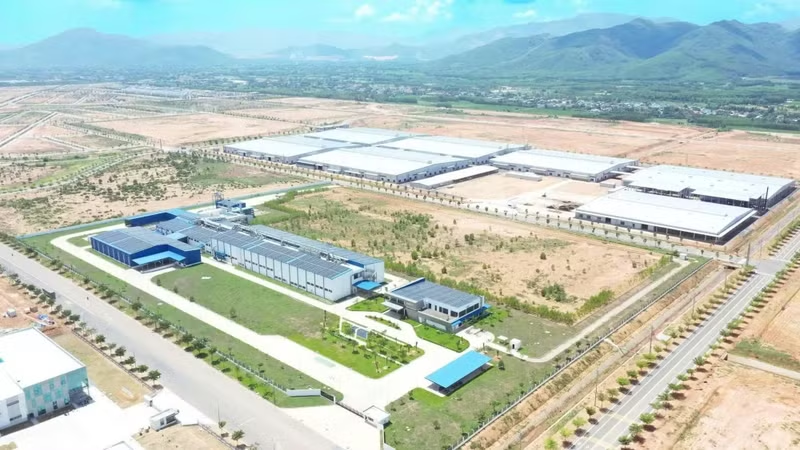
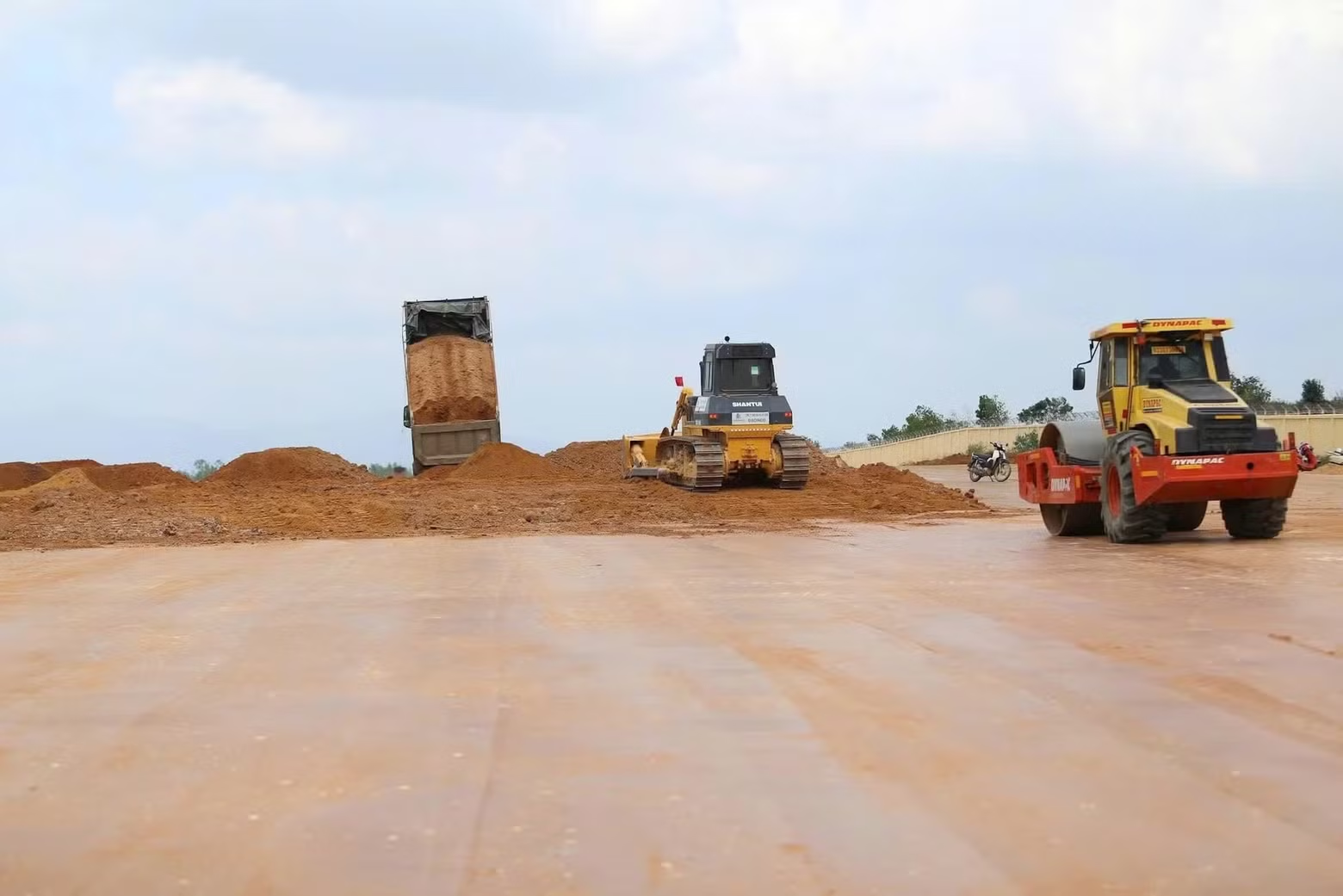
This reflects the province’s escalating appeal, particularly as bottlenecks are removed and progress accelerates on key projects such as the Quy Nhon–Pleiku Expressway, the second runway at Phu Cat Airport, and the link connecting the North–South Expressway to the Phu My Industrial Park and Phu My Port.
Decisive action
Beyond merely reforming procedures, a profound shift in Gia Lai is the adoption of a philosophy characterised by “partnership, unity, and a bold, innovative mindset”. A key aspect of this approach is the pivot from general rhetoric toward assigning specific responsibility to individual leaders — across sectors, communes, and wards — as well as to project owners.
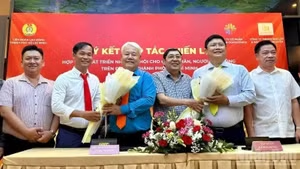
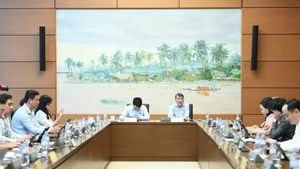
The province has invited businesses to participate directly in socio-economic development conferences. Issues regarding administrative procedures, the investment climate, site clearance, access to bank credit, and input costs are discussed openly and directly. Leaders of provincial departments and local authorities are required to commit to resolving these issues personally, thereby expediting the removal of bottlenecks in a more concrete and transparent manner.
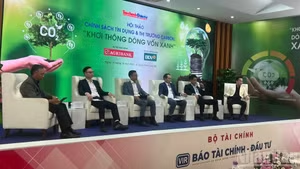
Furthermore, Gia Lai encourages businesses to proactively pursue green transformation, engage more deeply in afforestation projects and the development of large-scale raw material zones, and adopt advanced, circular technologies.
According to Nguyen Van Lang, General Director of Becamex Binh Dinh, Gia Lai’s strategic vision for the 2026–2030 period seeks to establish the province as a hub for manufacturing and processing, renewable energy, high-tech agriculture, services, tourism, semiconductors, and AI. Green transformation and ESG (Environmental, Social, and Governance) practices are fundamental requirements for achieving these goals.
Gia Lai needs to support the local business community in aligning with sustainable development trends, gradually adopting ESG standards tailored to local realities, enhancing competitiveness, and attracting foreign investment.
Simultaneously, the province must continue to improve living standards and social welfare, invest in human resource training, and create a premium living and working environment for workers, experts, and investors.
A key breakthrough in administrative reform is the determination to eliminate the deep-seated “fear of responsibility” at the grassroots level. The Chairman of the Provincial People's Committee noted that many local authorities have been hesitant to engage with businesses, slow to process procedures, and prone to avoiding complex issues.
Consequently, the principle of “clear responsibilities, clear tasks, and clear results” is being strictly applied to each unit to heighten the accountability of their leaders. “A lack of growth, failure to disburse funds, or sluggish project implementation are the faults of the heads of departments, sectors, and local authorities,” Tuan emphasised.
According to Thai Dai Ngoc, Secretary of the Gia Lai Provincial Party Committee, the final months of the year will be decisive for achieving the target of 10.2% annual GRDP growth.
By effectively mobilising and leveraging the “three pillars” — a facilitating government, partnering businesses, and a supportive public — and by embracing the philosophy of “action, action, and action; work, work, and work” as directed by General Secretary and President To Lam, all goals become fully attainable.
“The road ahead is not easy, but I believe that with a spirit of solidarity and the will for self-reliance and resilience, Gia Lai will rise to become a new growth hub for the South-Central Coast and Central Highlands regions,” Ngoc emphasised.
Gia Lai is undergoing a genuine transformation driven by substantive reforms that centre on a facilitating government and tangible implementation results, anchored by individual accountability and a partnership with the business community.
This powerful shift serves as a launchpad for the province to establish a new position on the socio-economic development map of the South-Central Coast and Central Highlands, paving the way for high-quality, sustainable growth.