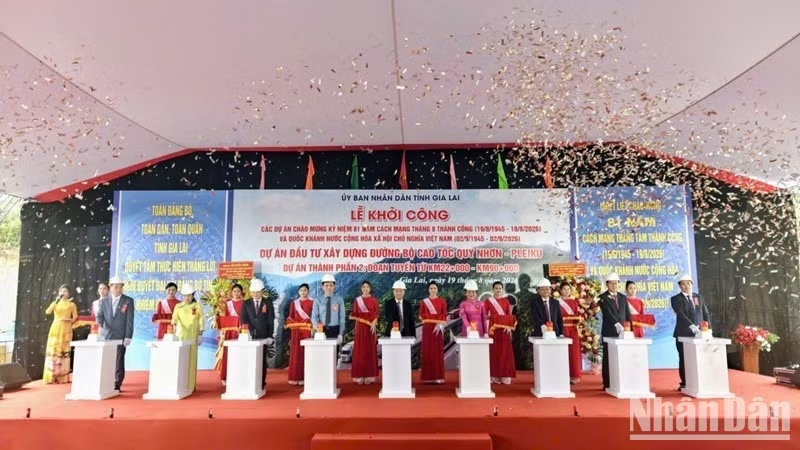
The Quy Nhon–Pleiku Expressway construction project has a total length of 125km, passing through 16 communes and wards of Gia Lai Province. The project is designed with four lanes, a roadbed and bridge width of 24.75m, a design speed of 100km per hour, and total investment of 43.734 trillion VND, including 42.484 trillion VND from the central budget and 1.25 trillion VND from the local budget.
The project is divided into three component projects. Component Project 1, which is 22km long, and Component Project 3, which is 35km long, started construction in December 2025 and have so far seen more than 97% of their construction sites handed over.
Component Project 2 is 68km long, with total investment of around 27.576 trillion VND. This is the most technically complex section of the entire route, featuring two special-grade bridges and two special-grade tunnels running through An Khe Pass and Mang Yang Pass, requiring the application of modern construction technologies to overcome difficult terrain.
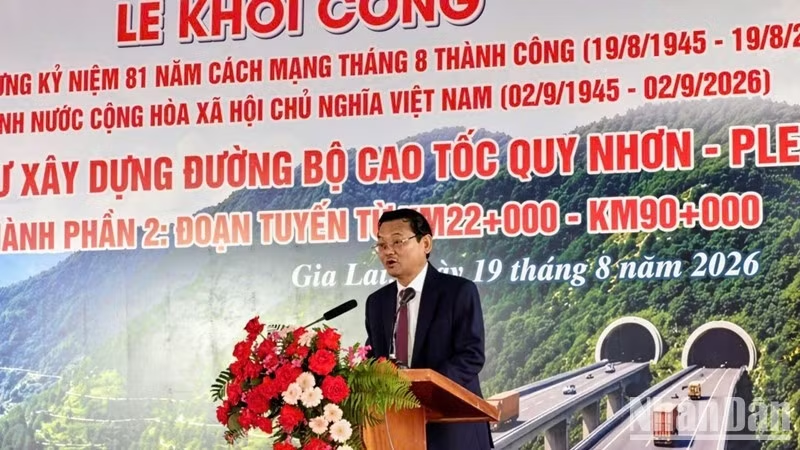
Speaking at the ceremony, Nguyen Tu Cong Hoang, Vice Chairman of the Gia Lai Provincial People’s Committee, emphasised that Component Project 2 serves as the “red thread” connecting Component Projects 1 and 3, creating synchronisation and continuity for the entire expressway axis. The implementation progress of Component Project 2 will directly determine when the whole Quy Nhon–Pleiku Expressway can be put into operation.
In implementing the Resolution of the first Gia Lai Provincial Party Congress for the 2025–2030 tenure, the province has identified the completion of a synchronous and modern transport infrastructure system as one of its four strategic breakthroughs. The Quy Nhon–Pleiku Expressway serves as a key east-west economic corridor, directly connecting the South–Central Coast with the Central Highlands and north-eastern Cambodia. The project will open the shortest trade route from the highlands to the coastal seaport chain, paving the way for logistics flows and investment attraction.

Deputy Minister of Construction Le Anh Tuan said the implementation of Component Project 2 of the Quy Nhon–Pleiku Expressway is a concrete step in realising the Resolution of the 14th National Party Congress and the central leadership’s directions on breakthroughs in transport infrastructure. The route will not only remove infrastructure bottlenecks and ensure national defence and security for the Central Highlands, but also serve as an east-west economic corridor.
It will thereby form the shortest gateway to the sea, connecting the South–Central Coast and the Central Highlands with the Cambodia–Laos–Viet Nam Development Triangle, especially north-eastern Cambodia.
The implementation of Component Project 2 of the Quy Nhon–Pleiku Expressway on the occasion of the 81st anniversary of the August Revolution and National Day on September 2 not only ignites an exciting emulation spirit, but also represents a firm commitment by the Party Committee, authorities, and people of Gia Lai Province to realising inter-regional transport connectivity infrastructure, enabling the locality to make a strong breakthrough towards prosperity in the era of the nation’s rise.