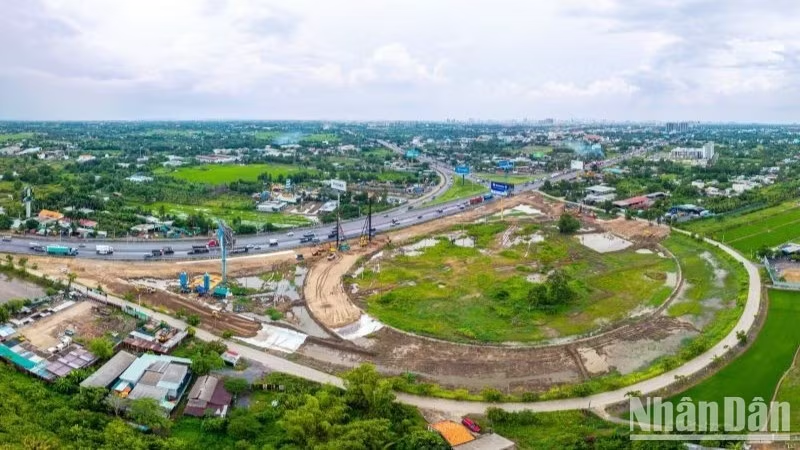
According to the plan, the national expressway system encompasses 46 routes with a total length of over 10,100km. To date, 3,345km have been operationalised and are technically open to traffic; 1,252km are under construction; and over 1,700km are in undergoing investment preparation. It is projected that by 2030, the whole country will have approximately 5,762km of expressways in operation, meeting the target set at the 13th National Party Congress.
According to Minister of Construction Tran Hong Minh, there are now 258km of two-lane expressways nationwide, demanding nearly 42.7 trillion VND for expansion. Of this, the budget and investor capital (already balanced) is nearly 8.78 trillion VND, and the central government budget must allocate nearly 33.9 trillion VND during the 2026–2030 period. In addition, there are nearly 2,100km of limited four-lane expressways, demanding over 400 trillion VND for expansion, of which the 1,222km North–South expressway project (eastern section) alone demands nearly 200 trillion VND.
Economic experts assert that investing in the more than 1,000km North–South expressway under the PPP model and collecting tolls for capital recovery will exert a profound impact upon transportation costs and substantially influence national production capacity (approximately 20 years within the BOT project contract term); generate pressure to increase traffic volume on parallel routes (National Highway 1, local roads); and impede the target of reducing logistics costs by 2030.
According to Minister Tran Hong Minh, the eastern North–South expressway is a national strategic "backbone," playing a particularly crucial role in the competitiveness of the economy, passing through a region that contributes up to 80% of the country's GRDP. It is also a vital trade axis connecting the two largest economic centres in the country, Ha Noi and Ho Chi Minh City, serving as a transit point between key economic regions such as the Red River Delta, Central region, and the Southeast region. Therefore, investing in the upgrading and expansion of the eastern North-South Expressway is of paramount importance. The Ministry of Construction plans to execute this through public investment; after completion, tolls will be collected at an appropriate rate to recoup the expenditure.
However, due to the substantial investment needs and limited resources, the Ministry of Construction's leadership asserts that establishing investment priorities is imperative to determine a coherent roadmap. Priority should be given to expanding sections with two lanes to ensure synchronisation, modernity, and compliance with expressway standards; followed by sections located within economic corridors, dynamic regions, and growth poles of the national master plan; routes with high traffic demand that are expected to exceed traffic capacity in the near future; and expressways connecting to economic centres, seaports, and economic zones; as well as routes possessing favourable conditions for implementation.
Currently, specific mechanisms and policies for mobilising investment capital, and regulations on PPP investment for projects mobilising non-budgetary capital, have been substantially finalised, overcoming difficulties and obstacles regarding risk-sharing mechanisms and interest rates suitable to the market. Therefore, each project will be meticulously evaluated by the Ministry of Construction regarding the mobilisation of non-budgetary capital in the feasibility study report.
, playing a strategic connecting role between the central and Central Highlands regions. (Photo: nhandan.vn)")
According to Minister of Construction Tran Hong Minh, the demand for transportation in the coming period is forecast to escalate more than originally projected. To gradually complete the phased expressway projects, the Ministry of Construction recommends that the Government leadership agree on the principle of prioritising the expansion of two-lane expressways to a full scale to ensure traffic safety and forestall the congestion of goods and passengers. Accordingly, the Government is evaluating the expansion of the eastern North–South expressway, with a preliminary total cost of approximately 154 trillion VND, and a medium-term public investment plan capital requirement of approximately 103 trillion VND. In case of difficulties in securing funding, priority should be given to investing in the expansion of sections such as Mai Son–Bai Vot and Nha Trang–Dau Giay (534 km long, with a total capital of approximately 64 trillion VND).
In addition, the Ministry also recommends that the Government consider allocating central budget capital of approximately 33.9 trillion VND (including 5.67 trillion VND from the Ninh Binh–Hai Phong project) to upgrade sections of a two-lane scale. At the same time, priority will be given to allocating nearly 3.5 trillion VND to investigate and invest in sections with lower expansion costs than the approved total investment, which are currently under construction (such as Dau Giay–Tan Phu, Tan Phu–Bao Loc, and Bao Loc–Lien Khuong) to facilitate adjustments to design solutions and utilise available resources and manpower.
The Ministry of Construction also recommended that the Government leaders assign the Ministry of Finance to examine the unallocated capital in the medium-term public investment plan for the 2026–2030 period and report to the Prime Minister for consideration and approval of the notification of capital for the phased expansion of expressways according to investment priority. The Ministry of Construction and relevant localities should promptly finalise the procedures for preparing investment in upgrading and expanding the phased expressway sections, continue to explore the mobilisation of non-budgetary capital, accurately determine the amount of central government budget capital required as supplementation, and calculate the socio-economic efficiency as required.
Localities should continue to evaluate and proactively calibrate, and prioritise the allocation of local budget capital in the medium-term public investment plan for the 2026–2030 period to expand the phased expressway sections; the Ministry of Construction should finalise the plan for expanding the eastern North–South expressway and report to the Prime Minister for consideration and decision.