According to Huong, the economic recovery continues to be strengthened by macroeconomic stability, the continued upward trend in industrial production and the service sector, strengthened public investment, and a continuously improving investment environment. However, the global economic context still harbours many uncertainties, especially the increasing trend of trade protectionism, geopolitical fluctuations, monetary policies of major economies, and the uneven recovery of global aggregate demand. Domestically, the resilience of the business sector remains limited, some traditional growth drivers are showing signs of weakening, while new drivers are not yet strong enough to create a breakthrough.
Analysing the growth pressures for the final six months of the year, Director General Nguyen Thi Huong pointed out specific pressures related to the global economic context with the increasing trend of trade protectionism, expansion of trade defence measures, and technical barriers, which are increasing risks to Viet Nam's exports.

Huong pointed out that another growth pressure is that Viet Nam's exports still depend mainly on a few key markets and product groups, while the domestic value-added ratio of many products remains low.
Notably, the disbursement of public investment capital continues to face difficulties such as slow land clearance, lengthy project adjustment procedures, shortages of construction materials in some localities, and uneven implementation capacity among investors.
The business sector in particular continues to face significant pressure. After the recovery period, many businesses, especially small and medium-sized enterprises (SMEs), still face difficulties with cash flow, access to credit, logistics costs, and fluctuations in the output market. Although interest rates have decreased compared to the previous period, the economy's ability to absorb capital has not truly improved, reflecting a cautious sentiment in expanding investment in production and business.
Meanwhile, pressure on macroeconomic management, exchange rates, interest rates, and inflation remains present. Fluctuations in the US dollar, the monetary policy trends of major central banks, and changes in global energy and raw material prices could put pressure on the exchange rate and domestic price levels. At the same time, the continued adjustment of prices for some state-managed goods and services according to the planned schedule may also narrow the scope for monetary policy adjustments in the remaining months of the year.
Furthermore, the real estate market has shown signs of recovery, the situation remains fragmented across segments. The supply of housing that meets actual demand is limited, while some real estate businesses still face financial difficulties and challenges in raising capital. This could affect the recovery speed of the construction industry and related sectors.
Traditional growth drivers
Nguyen Thi Huong noted that, despite these challenges, the economy still has many favourable factors to maintain its growth momentum, primarily traditional drivers, including:
Production-based drivers:
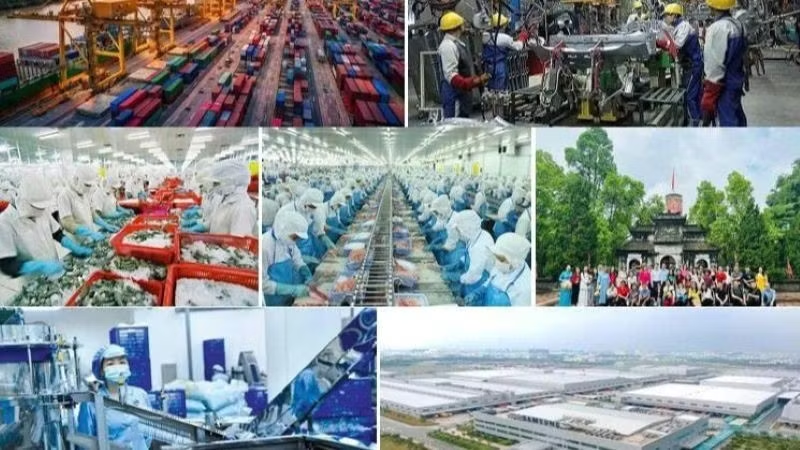
Firstly, the processing and manufacturing industry remains the foundation of economic growth if export orders continue to improve and the production activities of foreign-invested enterprises remain stable. At the same time, foreign direct investment (FDI) continues to be a bright spot in the economy thanks to a stable political environment, a network of new-generation free trade agreements, and the trend of restructuring global supply chains. Projects in the electronics, semiconductor, high-tech, data centre, and energy sectors continue to create room for expanding production capacity in the medium and long term.
Secondly, the service sector continues to play a crucial role as a growth driver. The trade, transportation, logistics, finance-banking, information technology, accommodation, food and beverage, and tourism sectors are expected to maintain positive growth rates thanks to increased domestic demand and the recovery of the international tourist market.
Demand-side drivers:
Firstly, public investment continues to be identified as a key driver of economic growth in the last six months of the year. With the large scale of public investment and many key infrastructure projects underway (such as the Lao Cai-Ha Noi-Hai Phong Railway, inter-regional expressways, and five strategic urban railway (metro) lines which recently launched simultaneously in Ha Noi), accelerating disbursement will create a strong ripple effect on the construction, materials processing industry, transportation, and trade sectors, creating more jobs and stimulating aggregate demand in the economy.
In addition, the expected recovery of private investment will contribute to expanding aggregate demand and enhancing the production capacity of the economy.
Secondly, domestic consumption is expected to continue recovering thanks to improved income and employment for workers, along with the development of e-commerce, modern retail, and consumer stimulus activities. The final months of the year are also a peak period for shopping and service demand, contributing to the growth of the trade and service sector.
Thirdly, the government retains room to implement economic policies.
Continued efforts to implement synchronised fiscal and monetary solutions, reform administrative procedures, remove difficulties for businesses, promote public investment disbursement, and improve the investment environment will contribute to strengthening the confidence of the business sector and investors while enhancing the economy's resilience to external fluctuations.
New growth drivers
Firstly, the shift in supply chains and international investment capital flows continues to create opportunities for Viet Nam to enhance its position in the global production network. With the advantage of a stable political environment, a network of free trade agreements, and a favourable geoeconomic position, Viet Nam continues to be an attractive destination for high-tech, electronics, semiconductor, data centre, and smart manufacturing projects. However, to effectively capitalise on this opportunity, it is necessary to improve the quality of human resources, develop supporting industries, and strengthen linkages between domestic businesses and foreign-invested enterprises to increase domestic added value.
Secondly, science, technology, innovation, the digital economy, and digital transformation are becoming new strategic growth drivers for the economy. Promoting the application of digital technologies, artificial intelligence (AI), big data, cloud computing, the Internet of Things (IoT), and automation in production, business, and governance contributes to increased labour productivity, reduced production costs, optimised supply chains, and the promotion of innovative growth models.
At the same time, the rapid development of e-commerce, digital payments, digital finance, and digital platforms is expanding the development space of the digital economy, gradually becoming an increasingly significant contributor to GDP growth. However, the level of technology application in many businesses, especially small and medium-sized enterprises, remains limited; investment in research and development (R&D), digital infrastructure, and high-quality human resources has not met development requirements. Therefore, the contribution of this driving force in the last six months of the year will mainly be reflected in improving the efficiency of existing economic sectors rather than creating breakthrough growth in the short term.
Thirdly, the development of a green economy and energy transition is opening new opportunities in attracting investment and enhancing the competitiveness of the economy. The commitment to net-zero emissions, along with the trend of shifting global supply chains towards sustainable development, creates conditions for Viet Nam to attract investment projects in renewable energy, clean technology, green production, and the circular economy. However, efforts to take advantage of these opportunities still depend on the progress of perfecting mechanisms and policies, mobilising investment resources, and developing energy infrastructure.
Fourth, institutional reform and improvement of the investment and business environment continue to be considered fundamental drivers. Promoting decentralisation, simplifying administrative procedures, and removing bottlenecks in investment, land, construction, and capital markets will contribute to improving the efficiency of resource allocation, encouraging private investment and innovation. This is a driving force with broad spillover effects, contributing to increased total factor productivity (TFP), improved competitiveness, and creating a foundation for rapid and sustainable growth in the medium and long term.