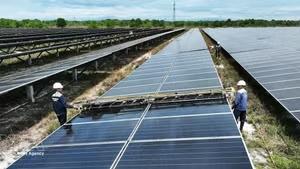
This poses a major challenge to the safe operation of the power grid. Gas-fired power plants using liquefied natural gas (LNG) have therefore emerged as an optimal solution for the energy transition.
LNG-fired power plants can quickly raise or lower their output, helping to offset fluctuations in renewable generation and maintain a stable power system.
A flexible power source for the national grid
Bui Quoc Hung, Deputy Director of the Electricity Department under the Ministry of Industry and Trade, said that as electricity demand continues to rise and requirements for the reliability, stability, and flexibility of the power system become more stringent, LNG-fired power is seen as a strategic transitional source in the years ahead.
This power source will balance electricity supply and demand, support the integration of large-scale renewable energy, improve the stability and safety of the power system, and help Viet Nam meet its international commitments to reduce greenhouse gas emissions.
The orientation for developing gas-fired power is also reflected in Politburo Resolution 70 (dated August 20, 2025) on ensuring national energy security by 2030, with a vision towards 2045.
Under the revised Power Development Plan VIII (PDP8), total LNG-fired thermal power capacity is targeted to reach 22,524 MW by 2030, accounting for around 9.5-12.3% of total installed capacity. The plan also calls for developing around 2,000-3,000 MW of flexible power sources capable of rapid start-up, helping regulate the load and maintain system stability as the share of renewable energy continues to rise.
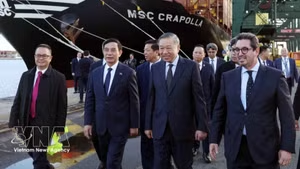
Deputy Minister of Industry and Trade Nguyen Sinh Nhat Tan said that by 2030, Viet Nam needs to develop its LNG import capacity in step with demand from LNG-fired power plants and other users; establish concentrated LNG energy hubs that are balanced across regions; and prioritise investment in infrastructure for LNG imports, storage, and consumption.
The plan to establish integrated national energy industrial hubs for gas, liquefied gas, electricity, refining, petrochemicals, and renewable energy in localities with strengths in these areas requires coordinated development of the LNG value chain.
Removing bottlenecks to unlock LNG-fired power projects
Under the revised PDP8, 22 LNG-fired thermal power projects are expected to be built and commissioned nationwide between 2025 and 2035, including 15 that are planned to commence commercial operation by 2030, with a combined capacity of 22,524 MW.
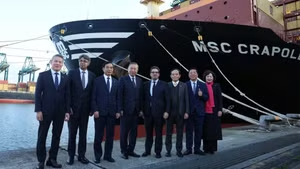
Implementation has made notable progress in recent years, with the Nhon Trach 3 and 4 LNG-fired power plants entering commercial operation, adding capacity to the system and improving its operational stability.
However, many LNG-fired power projects continue to face considerable difficulties. Le Ba Quy, Director of the Power Project Management Board under PetroVietnam Power Corporation (PV Power), said there are two major infrastructure bottlenecks: the transmission grid needed to evacuate the power generated, and site clearance for shared infrastructure.
As gas-fired power technology is now relatively mature, with many options available on the international market, the harder issues lie in the economics of the projects and in ensuring their financial viability.
As LNG is entirely imported, its price is highly sensitive to international market conditions, transport costs, exchange-rate fluctuations, and geopolitical factors.
Meanwhile, gas-fired power projects need very large capital outlays, have long lifespans and depend on long-term financing, making it a major challenge for investors to balance fuel costs, electricity prices, and the recovery of their investment.
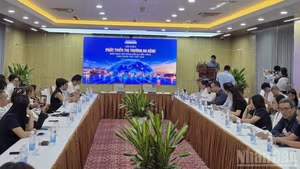
Economist Tran Dinh Thien said economic profitability is one of the key issues that need attention. Energy planning takes a long-term view of 20-30 years, he said, while investors must address the financial viability of each individual project. The legal framework, particularly regarding regulations under the amended Electricity Law, therefore needs to establish appropriate mechanisms to ensure that projects are feasible.
Nguyen Quoc Thap, Chairman of the Viet Nam Petroleum Association, proposed reviewing the portfolio of LNG-fired power projects and classifying them into three groups: those capable of reaching a final investment decision within 6-18 months; those requiring additional procedures; and those facing serious difficulties that call for separate solutions.
On this basis, the authorities can determine which projects need procedural obstacles removed, which require policy support and which need their feasibility reconsidered.
One suggested solution is to extend the direct power purchase agreement (DPPA) mechanism to LNG-fired power projects. Thap said this mechanism could enable buyers and sellers to negotiate long-term commitments to buy the power generated, while also allowing the parties to consider investing in or leasing suitable transmission infrastructure.
This could shift part of the risk from the government to entities participating directly in the market. Associate Professor Ngo Tri Long said flexible power purchase agreements (PPAs) tailored to different project stages should also be studied, together with a multi-component electricity pricing mechanism, including capacity charges, to balance the government’s regulatory requirements with investors’ ability to recover their capital.
Indeed, Resolution 70 calls for an urgent review to remove difficulties hindering gas-fired and LNG projects, particularly electricity purchase and selling price mechanisms. It also calls for the development of a competitive, transparent, and efficient electricity market; completion of the electricity trading system; and the establishment of stable, long-term PPA mechanisms that safeguard investors’ legitimate interests.
Research into ancillary service mechanisms has also been proposed to create additional revenue streams and improve the financial performance of projects.
For LNG-fired power to fulfil its role in the energy transition, bottlenecks related to institutions, infrastructure, electricity prices, power purchase agreements, dispatch mechanisms, and financing arrangements must be addressed simultaneously.
Once these conditions are met, LNG-fired power, together with other power sources, can help strengthen energy security, meet the needs of socio-economic development, and support the country’s high-growth targets.