A major transformation
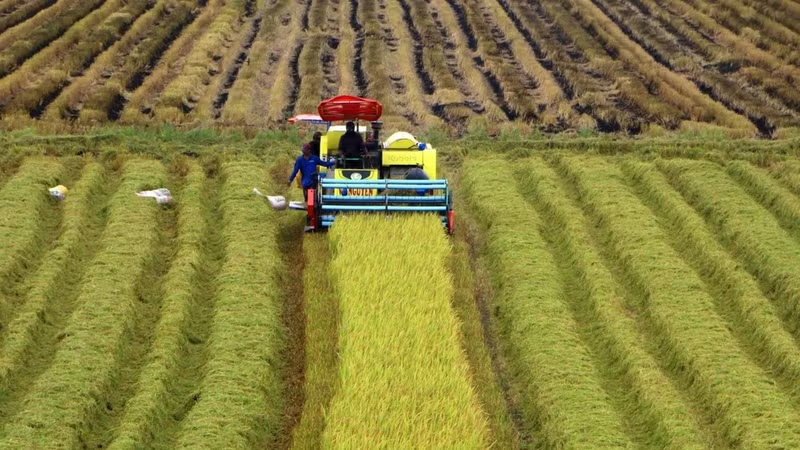
During the 2025-2026 winter-spring crop, Go Gon Agricultural Cooperative in Tay Ninh Province was selected as a pilot model for the implementation of the project on developing one million hectares of high-quality, low-emission rice cultivation. The cooperative’s director, Truong Huu Tri, said that many households were initially hesitant, particularly about reducing the amount of rice seed sown from 120kg per hectare to below 80kg per hectare and adopting alternate wetting and drying (AWD) irrigation.
However, the results of the first crop quickly dispelled those concerns. By optimising the use of seeds and agricultural inputs, production costs fell by 4-5 million VND (154-192 USD) per hectare. Rice yields rose to more than 8 tonnes per hectare, 0.5 tonnes higher than those of control fields.
Notably, all the produce from the model was purchased by partner businesses at a premium of 200 VND per kilogramme. From the initial 53ha trial involving 11 households, the cooperative expanded the cultivation area to 100ha in the summer-autumn crop and plans to increase it to 200ha in the coming winter-spring crop.
In Can Tho City, the high-quality, low-emission rice farming model is also demonstrating its advantages. Huynh Van Dung, director of Kien Thanh Agricultural and Services Cooperative in Vi Thanh 1 Commune, said that compared with traditional farming methods, the amount of rice seed sown had been reduced by 30-50%, chemical fertiliser use by 20-30%, and irrigation water use by 20-40%, while the number of pesticide applications had been cut by two to three per crop.
Lower input costs and higher yields, which rose by 5-12%, have increased profits by 1.5-9.3 million VND (58-358 USD) per hectare per crop.
Huynh Van Dung said that in the past, they had to go door to door to persuade farmers to adopt the model. Now, however, in light of its clear economic benefits, farmers themselves are taking the initiative and expressing a desire to expand the cultivation area under the model.
Nguyen Quoc Manh, Deputy Director of the Department of Crop Production and Plant Protection under the Ministry of Agriculture and Environment, said the project on “Developing one million hectares of specialised high-quality, low-emission rice cultivation linked with green growth in the Mekong Delta by 2030” is making positive progress. The 2025 target was 180,000ha, but by the end of 2025, the cultivation area had exceeded 379,000ha. As of August 2026, the figure had risen to nearly 421,000ha, of which nearly 68,000ha had met all the criteria.
The project has attracted more than 175,000 farming households. At the local level, An Giang is leading the region with 159,667ha, followed by Dong Thap with 97,053ha, Can Tho with 76,000ha, Tay Ninh with 69,390ha, Vinh Long with 13,703ha and Ca Mau with 5,000ha.
In the northern region, high-quality, low-emission rice farming models are also being actively implemented by localities such as Hung Yen, Ninh Binh and Hai Phong. Luong Thi Kiem, Deputy Director of the Hai Phong Department of Agriculture and Environment, said the city aims to cultivate 10,000ha of low-emission rice in 2026. At present, 5,000ha are entering the final stages of tillering and panicle initiation, with encouraging signs. This provides a foundation for the city to achieve its target of reducing total greenhouse gas emissions by 10-15% by 2035 compared with the 2020 baseline.
Alongside completing cultivation processes for rice, the Ministry of Agriculture and Environment is developing similar processes for other crops, including coffee, cassava and other key crops, with a view to gradually transforming the entire crop production sector towards ecological, low-emission farming. This is a practical step towards fulfilling international commitments on climate change response, while also providing an important foundation for building a green, responsible and high-value-added agricultural sector.
Unlocking resources and developing concentrated production areas
Despite the positive results, the implementation of low-emission crop production models still faces a number of difficulties. According to localities, mechanisms, policies and resources remain insufficiently coordinated and do not yet meet production requirements. Irrigation infrastructure, internal farm roads, drying facilities, storage and logistics remain inadequate in many areas.
In some areas, mechanisation has yet to be carried out systematically, particularly precision sowing equipment and water management equipment. The application of science and technology and digital transformation also remains fragmented. MRV (measurement, reporting and verification) systems, certification standards and carbon credit mechanisms have yet to be fully developed.
The lack of clear mechanisms for managing revenues and sharing benefits from emission reductions is another bottleneck. In addition, the management capacity, service provision and linkage organisation of some cooperatives remain weak.
Huynh Van Dung, director of Kien Thanh Agricultural and Services Cooperative, said contracts with businesses for the purchase of low-emission rice products had not yet been truly stable. Farmers also face difficulties in collecting, transporting, processing and marketing rice straw. Trade promotion and brand development remain limited, meaning that prices for high-quality, low-emission rice have not yet differed significantly from those of conventional rice. In addition, cooperatives, cooperative groups and farmers have difficulty accessing preferential loans.
In the coming period, the crop production sector will focus on reviewing and addressing difficulties and bottlenecks. Priorities will include standardising the MRV system, developing value chains and markets for low-emission products, and establishing low-emission crop production areas for individual commodities and ecological zones.
Nguyen Quoc Manh, Deputy Director of the Department of Crop Production and Plant Protection
Nguyen Quoc Manh, Deputy Director of the Department of Crop Production and Plant Protection, said that in the coming period, the crop production sector will focus on reviewing and addressing difficulties and bottlenecks. Priorities will include standardising the MRV system, developing value chains and markets for low-emission products, and establishing low-emission crop production areas for individual commodities and ecological zones.
The sector hopes that international organisations and donors will shift their focus from developing individual models to standardising, integrating and scaling them up on a large scale, first and foremost by supporting research, trials and the completion of technical packages for high-quality, low-emission rice production tailored to each ecological sub-region and crop season.
Core techniques should include the use of high-quality certified seed, precision sowing to reduce seed use, and alternate wetting and drying irrigation. At the same time, greater attention should be paid to nutrient management, reducing nitrogen fertiliser use, improving soil health and combining these measures with integrated crop health management to reduce pesticide use. Straw treatment and reuse, mechanisation from production through to harvesting, drying and storage should be carried out in an integrated manner to reduce losses. Investment should also be increased to upgrade irrigation systems, internal farm roads, drying facilities, warehouses and logistics networks.